




What happens to living tissues and delicate immune cells when they leave Earth’s gravity behind? The SpaceX CRS-35 cargo mission answers that question by lifting thousands of pounds of scientific experiments toward the International Space Station. A Falcon 9 rocket carries lab-grown human brain models, fungal crop infections, and student-designed medical materials to test cellular survival in orbit [1, 7]. The uncrewed Dragon capsule delivers these biological payloads to help researchers protect astronaut health on deep space journeys and improve clinical treatments on Earth [1, 6].
What Is the SpaceX CRS-35 Mission?
The SpaceX CRS-35 mission is the 35th commercial resupply flight contracted by NASA to deliver science experiments, crew supplies, and maintenance hardware to the orbiting laboratory [2]. Lifting off from Space Launch Complex 40 at Cape Canaveral Space Force Station in Florida, the uncrewed flight carries more than 6,300 pounds of cargo and experimental gear inside a reusable Dragon spacecraft [3, 7]. If morning weather or range conflicts delay the Tuesday attempt, ground teams have set a backup launch opportunity at 6:08 a.m. Wednesday to keep station schedules on track [7].
Following stage separation, the Falcon 9 first-stage booster returns to Cape Canaveral to touch down at Landing Zone 40, completing its eighth flight after previously launching GPS satellites, cargo runs, and defense payloads. When a rocket climbs into high-altitude sunlight while ground watchers stand in predawn darkness, glowing exhaust plumes can create a shimmering cloud known as a space jellyfish in the morning sky [7]. While earlier station work focused on space health technology testing during orbital crew swaps, this resupply run focuses on cellular stress models, plant immunity assays, and novel biomaterials [1].
After traveling in orbit for about 52 hours, the Dragon spacecraft docks with the station’s Harmony zenith port on Thursday, where NASA astronaut Anil Menon and Canadian Space Agency astronaut Joshua Kutryk monitor its arrival [3, 7]. The vessel stays attached to the station for about a month before returning to Earth in mid-November. It will splash down in the Pacific Ocean carrying research samples, a spacesuit, station water hardware, and a failed Canadarm2 robotic joint for ground inspection [7].

Does SpaceX Work for NASA on Cargo Resupply?
SpaceX works under commercial contract for NASA to deliver cargo, replacement parts, and research investigations to the International Space Station. Through the Commercial Resupply Services program, NASA buys orbital transport services from private American space companies rather than building and operating government-owned cargo shuttles. This commercial arrangement gives the agency steady delivery flights and frees researchers to concentrate on orbital laboratory science [2].
Hardware reuse plays a big role in keeping these flights regular and affordable [2]. The Dragon capsule assigned to this resupply run, Cargo Dragon C211, is making its fourth flight to the orbiting laboratory after completing the CRS-26, CRS-29, and CRS-33 missions [3, 7]. Flying proven capsules cuts turnaround times between orbital expeditions [7]. Ground crews inspect heat shields and avionics between flights, allowing the same spacecraft to ferry delicate cell cultures, frozen blood samples, and student experiments across multiple orbital campaigns [1, 6].
Mission scheduling also needs flexibility when launch pad damage disrupts the international flight manifest. The CRS-35 flight was originally planned for November 2026, but an accident on November 27, 2025, damaged Site 31 at the Baikonur Cosmodrome during a Soyuz launch, prompting NASA to move Dragon flights forward to fill potential cargo gaps. After quick repairs restored the Baikonur pad, mission managers returned CRS-35 to its planned autumn schedule [3]. Commercial access keeps the station supplied even when foreign spaceports meet maintenance delays [2].
Studying 3D Brain Models and Human Cells in Orbit
Long journeys into deep space expose human bodies to microgravity, cosmic radiation, and mental stress. To examine how the human brain responds to these extreme environments, researchers from NASA’s Biological and Physical Sciences division sent small, lab-grown 3D brain models to the space station for five weeks. These cellular structures mimic human brain tissues, allowing scientists to monitor cellular changes without placing living astronauts at risk. Investigators compare space-flown organoids with identical control samples kept on Earth to map how microgravity alters brain cell architecture and stress reactions [1].
Understanding cellular reactions helps scientists build medical safeguards for crews traveling to the Moon and Mars [1]. A related project onboard, the MINDS experiment, uses brain organoids to investigate neural inflammation linked to neurodegenerative disorders like Alzheimer’s, Parkinson’s, and multiple sclerosis. Microgravity causes cells to behave differently than they do in standard culture dishes on Earth, allowing researchers to spot biological pathways that stay hidden in terrestrial laboratories. Scientists hope these orbital models will point to new cellular targets for treatments that slow disease in aging patients on Earth [7].
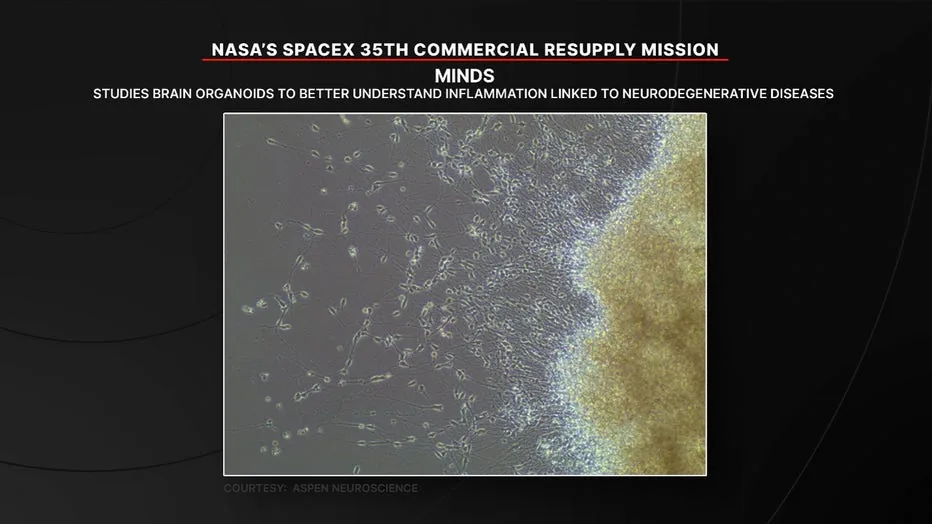
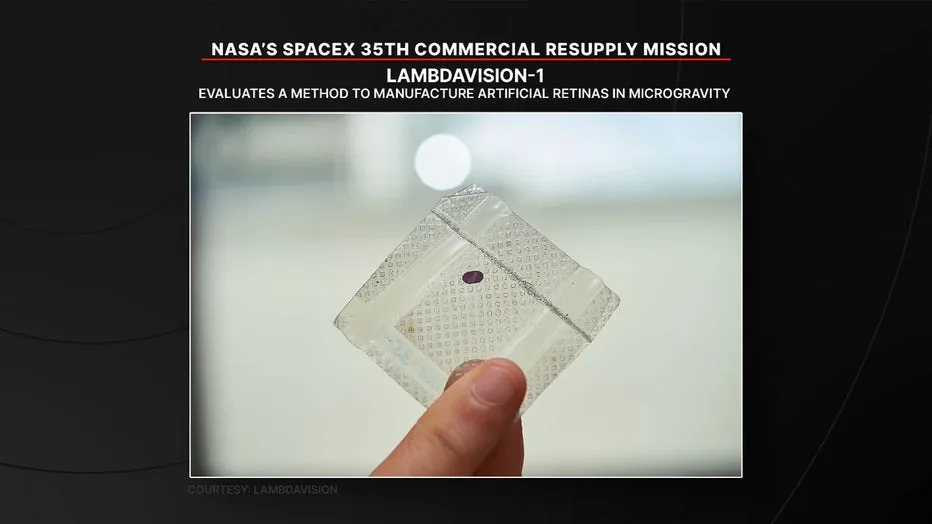
Orbital health research on this mission extends beyond brain tissue into heart biology and eye care. The Stellar Spheroids experiment studies 3D human heart tissue models in microgravity, tracking how muscle cells grow and form capillary networks when gravity does not compress them. Meanwhile, the LambdaVision-1 experiment tests the production of artificial retinas in space. Microgravity lets fluid layers settle more evenly than on Earth, which may help manufacturers produce uniform retinal implants for patients suffering from incurable blinding conditions [7].


How the CRS-35 Mission Tests Plant Disease in Microgravity
Astronauts traveling on multi-year exploration flights cannot rely on packaged food rations alone. Growing fresh crops aboard spacecraft provides needed vitamins, dietary variety, and psychological comfort, while living foliage absorbs carbon dioxide and generates breathable oxygen. However, space farming systems face real biological risks if pathogens find their way into closed orbital greenhouses. The CRS-35 mission carries a plant investigation to test whether crop diseases develop faster and more severely in weightless conditions than on Earth [1].
The investigation compares structural and molecular changes between Earth-grown plants and space station crops infected with a disease-causing fungus. In microgravity, fluid circulation inside plant stems slows down, and plant immune defenses can falter under orbital stress. By studying how fungal infections penetrate plant cell walls in microgravity, botanists can identify gene pathways that help plants resist infection. These findings will guide agricultural breeding programs on Earth to produce hardier crops and prevent harvest losses in future lunar habitats [1].
Developing resilient crops is essential because resupply flights become impossible once human missions venture toward Mars. Space crops recycle wastewater and purify cabin air, acting as living components of closed-loop life support systems. If a fungal blight ruins an orbital crop chamber, astronauts lose a main source of fresh nutrients and psychological well-being. Data gathered from this space crops study will help engineers design sealed greenhouse modules that keep pathogens from spreading between plant trays [1].
Testing Student Hydrogels and Rapid Biomarkers in Space
Spacesuits protect astronauts from vacuum and extreme temperatures, but their bulky pressure layers restrict joint mobility and can cause painful abrasions and skin tears. Because immune responses weaken in space and bacteria can turn more aggressive, healing wounds in microgravity presents tough clinical challenges. To solve this problem, four undergraduate students from the University of South Florida—Krystal Walford, Jade Fei, Hannah Kirschenmann, and Jaiden Brick—developed a biodegradable wound-healing hydrogel. Selected from more than 420 submissions in the Student Spaceflight Experiments Program, their project tests how microgravity affects hydrogel structure [6].
The students chose a chitosan material derived from crustacean and insect shells because it resists bacterial growth and keeps wounds moist during healing. Walford, a mechanical engineering major leading the student group, said gravity pulls liquid down unevenly on Earth: “On Earth, gravity can cause hydrogels to form with uneven pore structures. In microgravity, fluids mix differently, which we believe could create a stronger, more uniform structure than what we can make on Earth”. Working under Professor Sylvia Thomas at USF with guidance from doctoral student Eva Fernandez, postdoctoral scholar Ridita Khan, and commercial partner Rhodium Scientific, the team prepared two liquid solutions for astronauts to mix aboard the station, while keeping an identical control batch on Earth [6].

Speeding up medical diagnosis in space is another priority aboard the spacecraft. The mission carries the first orbital operational test of a compact microplate reader under the Commercially Enabled Rapid Space Science initiative. The shoebox-sized diagnostic reader detects biomarkers including antibodies, antigens, and disease proteins in biological samples. Instead of freezing blood samples and waiting months for a cargo ship to return them to Earth, astronauts can analyze diagnostic samples inside the orbital laboratory and detect emerging infections within hours [1].
Why NASA Tracks Antibiotic Resistance on SpaceX CRS-35
Spacecraft cabins provide warm, sealed environments where microbes adapt under cosmic radiation and microgravity. On the SpaceX CRS-35 mission, orbital microbial tracking marks the fourth and concluding flight for an ongoing health study evaluating how bacteria resist antibiotics under weightless conditions. Astronauts repeatedly swab surfaces across the station’s living quarters, hygiene compartments, and science racks to collect microbial samples. Tracking genetic shifts in these orbital superbugs helps flight surgeons create sanitation protocols that prevent bacterial outbreaks during long missions [1].
The findings also deliver practical medical insights for hospitals on Earth. Overusing antibiotics in clinical medicine has generated drug-resistant superbugs that resist standard therapies, creating a global public health problem. Observing how bacteria develop protective defenses in space reveals genetic mechanisms that drive drug resistance on Earth. Microgravity acts as a biological accelerator, showing researchers how bacterial populations adapt when environmental stressors force rapid evolutionary changes [1].
Beyond biological science, Dragon carries hardware upgrades including the final pair of International Space Station Roll-Out Solar Arrays (IROSAs) to reinforce station electrical power for its remaining operational lifespan. The cargo manifest also features three live Halocaridina rubra shrimp from the student-led SCAMPI Project, an Artemis III urinal unit, and research payloads from Langston University [3, 7]. As commercial launch tempo grows, tracking rocket selections like NASA’s selection of the SpaceX Falcon 9 for the StarBurst mission illustrates how reusable vehicles support expanding scientific exploration beyond Earth [2].
- PRESS RELEASE Pritchard, C., & NASA Science Editorial Team. (2026, October 12). NASA’s SpaceX CRS-35 Mission to Launch Health Research. NASA Science. [Article Link]
- PRESS RELEASE Zakrzewski, J. (2026, October 2). NASA’s SpaceX CRS-35. NASA. [Article Link]
- WEBSITE Wikipedia contributors. (2026, October 12). SpaceX CRS-35. Wikipedia, The Free Encyclopedia. [Article Link]
- ONLINE NEWS Mirage News. (2026, October 12). NASA’s SpaceX CRS-35 Mission To Launch Health Research. Mirage News. [Article Link]
- ONLINE NEWS PressBee. (2026, October 12). NASA’s SpaceX CRS-35 Mission to Launch Health Research. PressBee. [Article Link]
- ONLINE NEWS Garcia, J. (2026, October 6). Astronauts to test USF students’ wound-healing research aboard the International Space Station. USF News. [Article Link]
- ONLINE NEWS Frigerio, J. (2026, October 12). SpaceX CRS-35 launch could bring sonic booms, ‘space jellyfish’ to Central Florida. FOX 35 Orlando. [Article Link]
APA 7: TWs Editor. (2026, October 13). How SpaceX CRS-35 Launches Health Research to Orbit. PerEXP Teamworks. https://perexpteamworks.com/en/spacex-crs-35-health-research-launch/


