





Network address translation serves as a core networking mechanism that allows private internal hosts to exchange data with external public networks without requiring individual public addresses for every connected device. Having network address translation explained from its core mechanisms shows how home routers and enterprise gateways direct local packets to the wider internet without assigning unique global routable coordinates to each phone, laptop, or server. Does a local network need unique public credentials for every internal host to communicate across the internet? By substituting private address headers with public gateway coordinates during transit, translation bridges separated address realms while conserving global address space [13].
- The Exhaustion of IPv4 Address Space
- Basic NAT Operation and Header Rewriting
- How Port Multiplexing Maps Active Connections
- Network Address Translation Traversal Techniques
- Resolving Overlapping IP Subnets with DNS
- Load Sharing Across Server Pools Using NAT
- Transition Strategies Toward IPv6 Connectivity
- Stateless Prefix Translation in Modern Networks
The Exhaustion of IPv4 Address Space
Internet Protocol version 4 relies on 32-bit addresses, offering an architectural ceiling of approximately 4.3 billion unique device identifiers. By 1992, early Internet engineers noticed that rapid institutional adoption and network expansion were exhausting unallocated address blocks much faster than initial projections had anticipated. The Internet Engineering Task Force published RFC 1631 in 1994, presenting network address translation as a short-term solution to IP address depletion and scaling problems in global routing tables [13].
To prevent private networks from consuming globally routable addresses, RFC 1918 reserved dedicated private ranges including 10.0.0.0/8, 172.16.0.0/12, and 192.168.0.0/16 for internal enterprise and residential subnets. Organizations could deploy millions of local nodes using these non-routable numbers without registering them with regional internet registries. Because these numbers can’t circulate across public transit providers, edge routers must alter outbound datagrams before forwarding them to public transit links [13].
With network address translation explained through packet headers, engineers can see how intermediate routers alter source IP coordinates while maintaining active session state. By 2004, the deployment of translation gateways had become widespread across broadband modems, enterprise edge routers, and commercial hosting facilities. The technique became widely known as IP masquerading because it hid entire internal topologies behind a single public address. Address scarcity turned a temporary bridge into permanent internet infrastructure [13].
Basic NAT Operation and Header Rewriting
Basic address translation operates as a one-to-one mapping mechanism between separate IP address domains without altering transport layer identifiers. When an internal host initiates an outbound session, the boundary router swaps the internal private IP address in the packet header with a dedicated public IP address drawn from a designated pool. The router modifies the header checksum to reflect the altered address fields so that intermediate routers do not discard the packet during transit [13].
Return packets traveling back from the external server arrive at the router addressed to the leased public coordinate. The edge gateway inspects its internal translation table, identifies the matching mapping entry, and overwrites the destination field with the internal host address. This basic translation requires a dedicated pool of external addresses equal to the number of active internal hosts. One-to-one translation does not save public addresses when all internal systems connect simultaneously [13].
Network engineers frequently deployed basic translation when integrating external partner networks or during corporate consolidations where two entities used conflicting private subnets. For network environments that need to understand routing local traffic across network segments, translation rules maintain isolated addressing structures without forcing system administrators to readdress hundreds of internal nodes. Static table entries preserve predictable address mappings for dedicated internal servers [3].
How Port Multiplexing Maps Active Connections
Because most organizations possess only a single public IPv4 address, simple one-to-one translation can’t support multiple concurrent users on local networks [2]. In 1996, engineers introduced port-address translation, also designated as network address and port translation in RFC 2663, to overcome this numerical bottleneck. By translating both IP addresses and transport port numbers simultaneously, routers enable thousands of local hosts to share one public IP address [13].
Internet communications running across TCP and UDP identify connections through unique socket tuples consisting of source IP addresses, source ports, destination IP addresses, and destination ports [4]. Standard server applications listen on well-known ports such as port 443 for encrypted web traffic or port 465 for mail transfer, while client operating systems allocate ephemeral ports between 1024 and 65535 to outbound applications. When an internal host dispatches a request to an external server, the gateway records the internal socket pair in an active translation table and assigns an available port on its external public interface [13]. This stateful mapping lets the single public address demultiplex hundreds of concurrent data streams without confusion.
This many-to-one translation mechanism fundamentally alters how connections initiate across the network edge. While internal client devices can freely open outbound sockets to external web services, external hosts can’t initiate inbound connections to an internal computer because the gateway has no pre-existing state table entry pointing to that private host. This asymmetric connectivity provides an incidental barrier against unsolicited external probes, although security engineers warn that address masking does not replace a genuine stateful firewall [2].
Network Address Translation Traversal Techniques
The architectural asymmetry introduced by port translation creates major hurdles for peer-to-peer applications, interactive voice protocols, and online multiplayer games. In a traditional peer-to-peer exchange, two hosts located behind separate translation gateways must transmit datagrams directly to each other without routing every data packet through an intermediate relay server. Because neither router permits unsolicited inbound packets from an unknown external endpoint, direct communication attempts between private clients normally fail without specialized traversal mechanisms [1].
To resolve these connection barriers, the IETF developed STUN under RFC 3489 in 2003, later standardizing Session Traversal Utilities for NAT in RFC 5389 during 2008. STUN clients query an external rendezvous server to discover their publicly visible IP address and port mapping. Understanding the transport layer delivery in TCP and UDP helps clarify why connection establishment behaves differently across transport protocols. TCP connections require port preservation and TCP hole punching to coordinate simultaneous connection handshakes across both gateways [13].
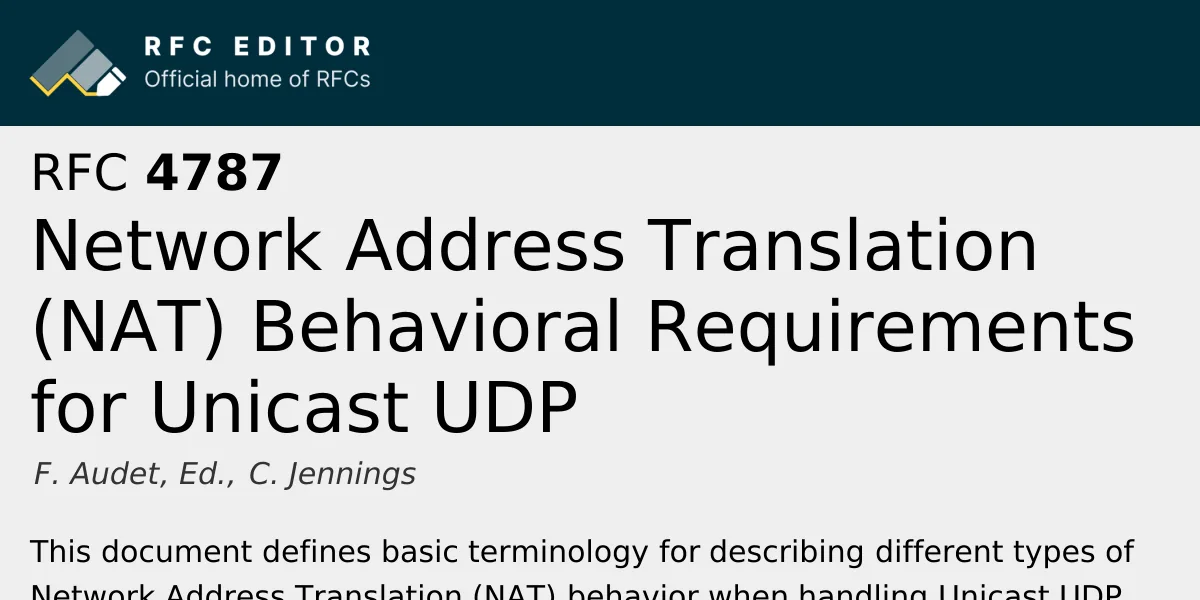
RFC 4787, authored by F. Audet and C. Jennings as BCP 127 in 2007, defined formal requirements for handling unicast UDP traffic through translation devices. The specification established standard terminology by distinguishing endpoint-independent mapping from address-dependent and port-dependent mapping behaviors. When a router implements endpoint-independent mapping, it reuses the same external public port for all outgoing packets sent from a specific internal port, regardless of the destination host [1].


Resolving Overlapping IP Subnets with DNS
Overlapping networks occur when two separate corporate subnets use identical RFC 1918 private address ranges and must connect after an acquisition or corporate merger. If both organizations configured their internal offices on the 171.68.200.0/24 subnet, devices on one side can’t communicate with devices on the other side using standard routing because routers do not differentiate internal hosts from external targets with the same numeric address. Viewing network address translation explained in corporate environments reveals how network administrators resolve overlapping subnets after corporate mergers without renumbering internal hosts [3].
Cisco introduced comprehensive support for translation in overlapping network topologies within Cisco IOS software version 11.2. To connect identical subnets without reconfiguring every local device, network administrators deploy boundary routers configured with dual translation pools named test-loop and test-dns. An internal host wishing to contact an external partner can’t route packets to the remote IP coordinate directly, so the client initiates a DNS lookup for the remote service domain name [3].
When the DNS query leaves the internal network, the router translates the client source address from 171.68.200.48 to 172.16.47.161 before forwarding the UDP packet to the external name server at 171.69.2.132 on port 53. When the name server replies, the router intercepts the DNS response payload and rewrites the embedded resource record address from 171.68.200.48 to 172.16.47.177. Subsequent ICMP ping packets or application datagrams exchange traffic seamlessly because the router translates both source and destination headers on every transit packet [3].
Load Sharing Across Server Pools Using NAT
In 1998, P. Srisuresh and D. Gan authored RFC 2391, detailing Load Sharing using IP Network Address Translation, commonly known as LSNAT. As commercial internet services expanded, individual web and mail servers struggled to handle high volumes of concurrent client connections. Rather than depending entirely on DNS round-robin techniques that update slowly and fail to reflect real-time server health, LSNAT routers distribute incoming session loads across server pools dynamically [4].
An LSNAT gateway presents a single virtual IP address to external internet clients while managing multiple physical servers in a private stub domain. When an inbound TCP SYN packet arrives at the virtual address, the router selects an available back-end server using round-robin, least-loaded, or weighted algorithms and rewrites the destination IP address to point to that specific server. The gateway maintains session state throughout the transaction, ensuring that all packets belonging to that TCP session reach the same physical machine until connection termination [4].
Session tracking requires the gateway to monitor protocol flags and timeouts carefully. The LSNAT device detects TCP connection teardowns when both halves of the communication exchange FIN control packets or when either side transmits a RST flag. For UDP traffic lacking explicit connection flags, gateways rely on configurable idle timers to retire dormant translation bindings. This centralized load distribution allows administrators to replace, upgrade, or add server hardware without altering public DNS configurations [4].
Transition Strategies Toward IPv6 Connectivity
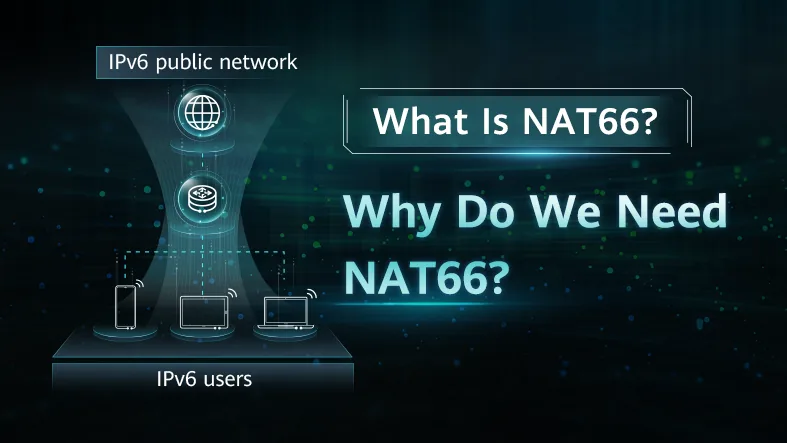
Because IPv4 address exhaustion has reached completion across all regional internet registries, service providers must support new IPv6 devices while maintaining reachability to residual IPv4 services. Huawei documentation outlines the evolution of translation technologies, illustrating how modern networks transitioned from traditional NAT and carrier-grade NAT444 architectures toward Dual-Stack Lite and NAT64 [8]. Carrier-grade gateways often process tens of millions of concurrent translation bindings on dedicated service cards to keep older services reachable [2].
NAT64 provides a vital transition bridge by translating IPv6 packet headers into IPv4 packets and vice versa, enabling modern IPv6-only client smartphones to access legacy IPv4 web platforms seamlessly. Network engineers deploy NAT64 in either stateless or stateful configurations depending on session requirements and routing scalability across carrier boundaries. Stateful NAT64 maintains translation state dynamically and supports both IPv6-initiated and IPv4-initiated flows, frequently pairing with interchassis redundancy to provide high availability across redundant gateway hardware [2].
Certain application layer protocols embed IP address coordinates directly inside the message payload, which breaks end-to-end communication when an edge router alters only the outer packet header [2]. Protocols such as the Session Initiation Protocol used in voice communications and the File Transfer Protocol require Application Level Gateways to parse application payloads [7]. ALGs inspect Layer 7 data streams, rewrite embedded IP addresses, allocate dynamic data ports, and synchronize secondary control sessions so that audio calls and file transfers proceed without interruption [2].
Stateless Prefix Translation in Modern Networks
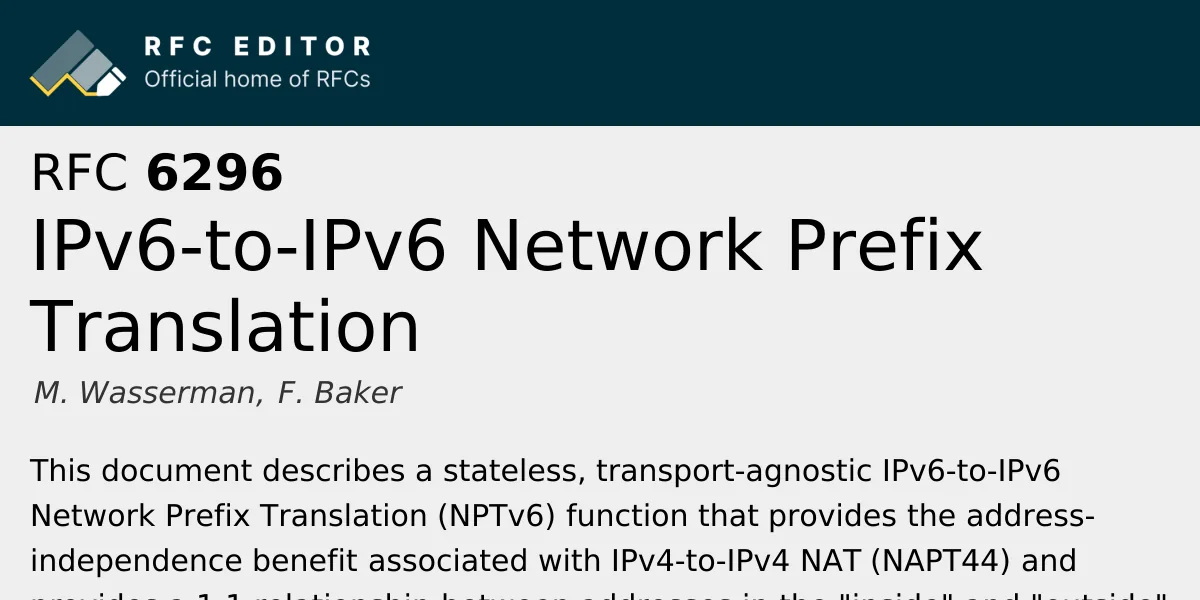
In native IPv6 deployments, network architects sought to achieve address independence without replicating the stateful connection tracking and port rewriting bottlenecks of IPv4. Margaret Wasserman and Fred Baker published RFC 6296 in 2011, establishing IPv6-to-IPv6 Network Prefix Translation, or NPTv6, as an experimental specification. Unlike traditional stateful translation, NPTv6 executes a stateless, transport-agnostic mapping between internal and external IPv6 prefixes [9].
NPTv6 operates through a one-to-one relationship between inside and outside address prefixes, leaving interface identifiers intact and preserving end-to-end reachability across the network layer. The translator employs a checksum-neutral mathematical algorithm that calculates a 16-bit offset value, adjusting the interface identifier so that transport layer checksums in TCP and UDP headers remain valid without recalculation. Looking at network address translation explained across modern IPv6 deployments clarifies why stateless prefix translation remains popular even when address scarcity no longer dictates network design [9].
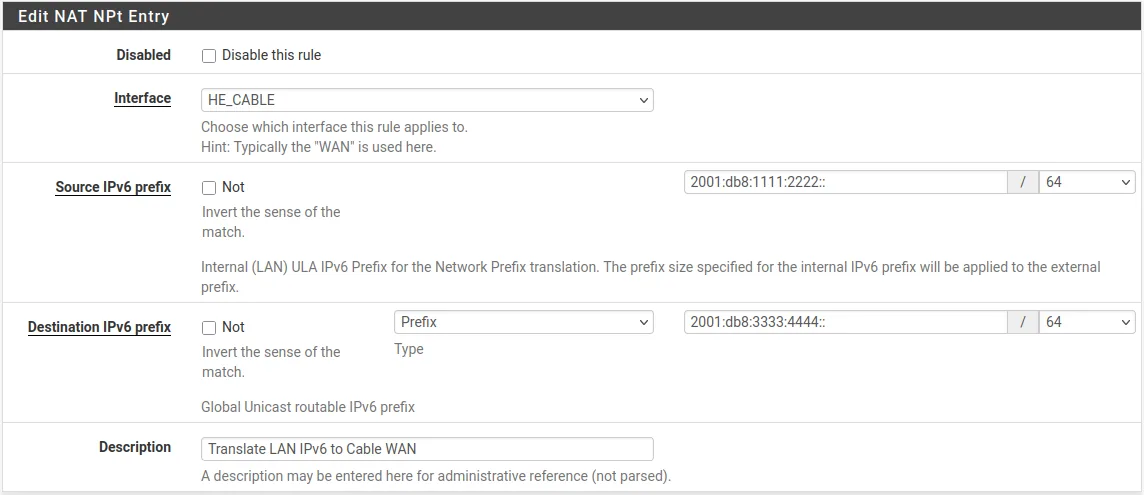
Stateless prefix translation proves valuable in multi-homed enterprise networks where edge routers connect to multiple upstream internet service providers. According to documentation from Netgate for pfSense software and VyOS operating systems, organizations can assign stable local prefixes such as fd00::/8 from RFC 4193 Unique Local Address space to internal devices. When traffic exits through different external interfaces, NPTv6 maps internal subnets to provider-assigned global prefixes, allowing organizations to switch providers or balance upstream links without renumbering internal networks [12].
- REPORT Audet, F., & Jennings, C. (2007). Network Address Translation (NAT) Behavioral Requirements for Unicast UDP (RFC 4787; BCP 127). Internet Engineering Task Force. [Article Link]
- WEBSITE Cisco. (2000). What Is Network Address Translation (NAT)? Cisco Systems. [Article Link]
- WEBSITE Cisco. (2005). Using NAT in Overlapping Networks. Cisco Systems. [Article Link]
- REPORT Srisuresh, P., & Gan, D. (1998). Load Sharing using IP Network Address Translation (LSNAT) (RFC 2391). Internet Engineering Task Force. [Article Link]
- ONLINE NEWS Cilloni, M. (2018). NAT66: The good, the bad, the ugly. APNIC Blog. [Article Link]
- REPORT Wasserman, M., & Baker, F. (2009). IPv6-to-IPv6 Network Address Translation (NAT66) (Internet-Draft draft-mrw-behave-nat66-02). Internet Engineering Task Force. [Article Link]
- WEBSITE H3C. (2018). Configuring NAT66. New H3C Technologies. [Article Link]
- WEBSITE Guo, Y. (2023). What Is NAT66? Why Do We Need NAT66? Huawei Technologies. [Article Link]
- REPORT Wasserman, M., & Baker, F. (2011). IPv6-to-IPv6 Network Prefix Translation (RFC 6296). Internet Engineering Task Force. [Article Link]
- WEBSITE Juniper Networks. (2023). Stateless Source Network Prefix Translation for IPv6. Juniper Networks. [Article Link]
- WEBSITE VyOS Project. (2024). NAT66(NPTv6). VyOS Documentation. [Article Link]
- WEBSITE Netgate. (2025). IPv6 Network Prefix Translation (NPt). Netgate Documentation. [Article Link]
- WEBSITE Wikipedia. (2026). Network address translation. Wikimedia Foundation. [Article Link]
- WEBSITE Wikipedia. (2026). IPv6-to-IPv6 Network Prefix Translation. Wikimedia Foundation. [Article Link]
Cover image: Bill Woodcock / Wikimedia Commons, CC BY-SA 4.0


