





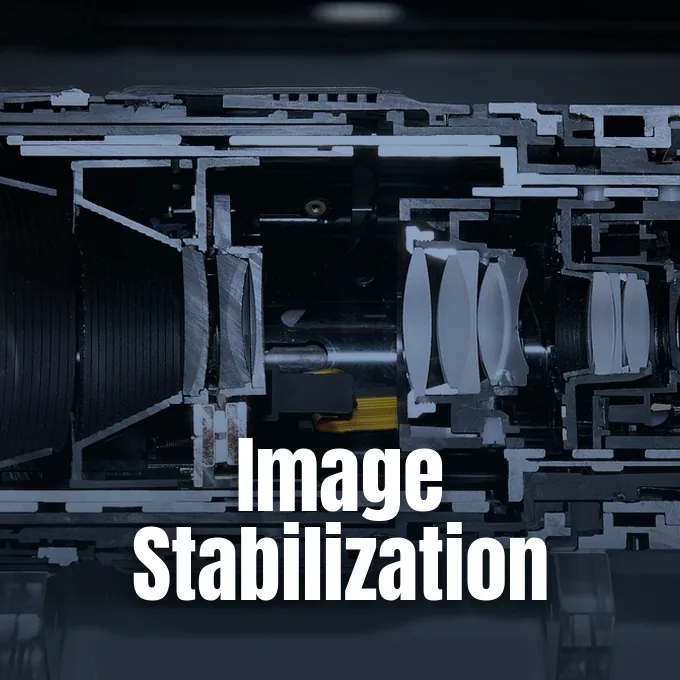
Image stabilization is a core camera technology that counters hand tremor to keep photographs sharp and video footage steady during handheld shooting. When photographers use slow shutter speeds in dim rooms or work with heavy telephoto lenses, even involuntary muscular twitches can smear fine details across the image sensor. Modern stabilization hardware uses tiny gyroscopic sensors, rapid microprocessors, and electromagnetic actuators to physically shift lens elements or the image sensor in real time. These corrections allow photographers to capture clean images at exposures several stops slower than handholding guidelines usually permit, expanding creative flexibility without relying on a bulky tripod.
- What Image Stabilization Does in Photography
- The Physics of Hand Tremor
- Optical Image Stabilization Inside the Lens
- Sensor-Shift Mechanics in Camera Bodies
- How Coordinated Stabilization Pairs Lens and Body
- Digital Frame Cropping for Video
- What CIPA Ratings Measure in the Lab
- When to Turn Image Stabilization Off
What Image Stabilization Does in Photography
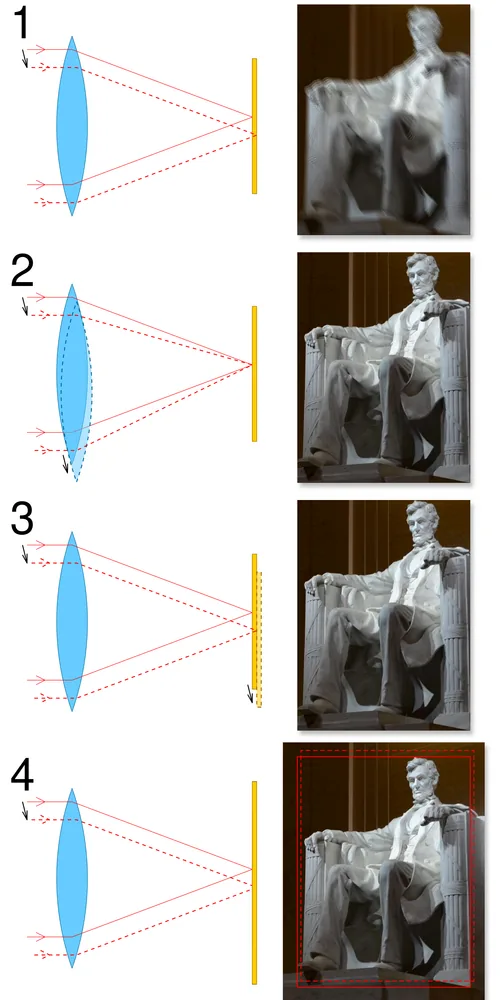
Every handheld exposure faces the risk of motion blur caused by small body movements while pressing the shutter button. Image stabilization works by sensing these physical shifts and instantly moving an optical element or the camera sensor in the opposite direction. The technology stabilizes the camera frame during exposure, but it can’t freeze moving subjects in the scene. A runner sprinting across the street or a bird taking flight will still blur if the shutter speed remains too slow, because stabilization only counters camera movement rather than subject motion [10]. To learn more about sensor exposure and camera mechanics, see our guide on how cameras work.
Photographers traditionally relied on the reciprocal rule (which states that minimum shutter speed should equal the reciprocal of the focal length in seconds). On a 100 mm lens, for example, safe handholding without stabilization requires a shutter speed of at least 1/100 second to avoid blur. With a stabilized system providing four stops of correction, that safe exposure threshold drops down to roughly 1/6 second while retaining sharp subject detail [8]. Shutter speeds can drop even lower on wide lenses.
DxOMark stabilization benchmarking protocols show that handholding success rates fall steeply when using longer focal lengths. At 300 mm without stabilization, the unaided success rate for sharp frames drops to 28% at 1/300 second. With six stops of correction enabled, that success rate rises to 94% at 1/8 second under controlled testing [2]. Handheld shooting in low light becomes practical.
The Physics of Hand Tremor
Why does hand tremor degrade image sharpness so quickly at long focal lengths? Human hands naturally tremble at frequencies between 1 and 12 Hz, with peak amplitude clustering between 6 and 8 Hz during physical exertion or fatigue. Even trained photographers holding a camera at arm’s length exhibit angular displacements averaging 0.15° per second. A 2017 study published in the IEEE Transactions on Instrumentation and Measurement measured hand motion across 127 adult subjects and found a median rotational velocity of 0.18° per second horizontally and 0.22° per second vertically under relaxed conditions. At a 400 mm full-frame equivalent focal length, that minute movement creates a projected blur trail of 13.7 pixels on a 45-megapixel sensor (such as the Canon EOS R5), which easily exceeds the single-pixel threshold for noticeable softness [2].
Handheld movement splits into angular rotation and translational shift. Angular motion consists of pitch and yaw, representing up-and-down tilt and side-to-side panning across the scene. These angular movements dominate image blur at standard shooting distances beyond half a meter. However, translational movement—where the camera moves along horizontal or vertical planes without tilting—becomes far more damaging during close-up photography. Measurements published in the Journal of Electronic Imaging show that translational motion accounts for up to 65% of total blur at macro distances like 0.2 meters with a 100 mm lens [4]. Standard gyroscopes miss pure translation.
Optical Image Stabilization Inside the Lens
Lens-based correction places moving glass directly within the optical path. Canon introduced the first commercial optical system in 1995 with the EF 75–300mm f/4–5.6 IS USM lens, while Nikon released its first vibration reduction lens in 2000 [2, 9]. Inside the lens barrel, two angular rate gyroscopes (measuring pitch and yaw) monitor rotation using the Coriolis effect. These gyroscopes feed analog signals into a microcontroller that calculates required lens displacement and drives voice-coil actuators to shift a floating compensation group perpendicular to the optical axis [2]. You can read how optical image stabilization counteracts shake across different optical systems.
By shifting optical elements before light reaches the sensor, lens systems correct the view before exposure occurs. This direct correction steadies the optical viewfinder image in digital single-lens reflex cameras, helping photographers frame distant wildlife or sports subjects without distracting frame wobble [7, 9]. Furthermore, lens-based systems allow engineers to tune the gyro sensitivity and actuator throw specifically for that particular focal length [4, 9]. Longer telephoto lenses benefit from specialized optical leverage where a small shift of a central element produces substantial angular correction at the image plane [3, 9].
The main drawback of optical stabilization remains added cost and bulk. Because each stabilized lens needs its own gyros, microprocessors, and electromagnetic voice-coil motors, buyers pay for dedicated stabilization hardware with every lens purchase [8, 9]. For instance, a stabilized Canon EF 70-200mm f/4L IS USM cost $1099, whereas the non-stabilized version sold for $599 [8]. Moving optical groups also add weight to the lens barrel.
Sensor-Shift Mechanics in Camera Bodies
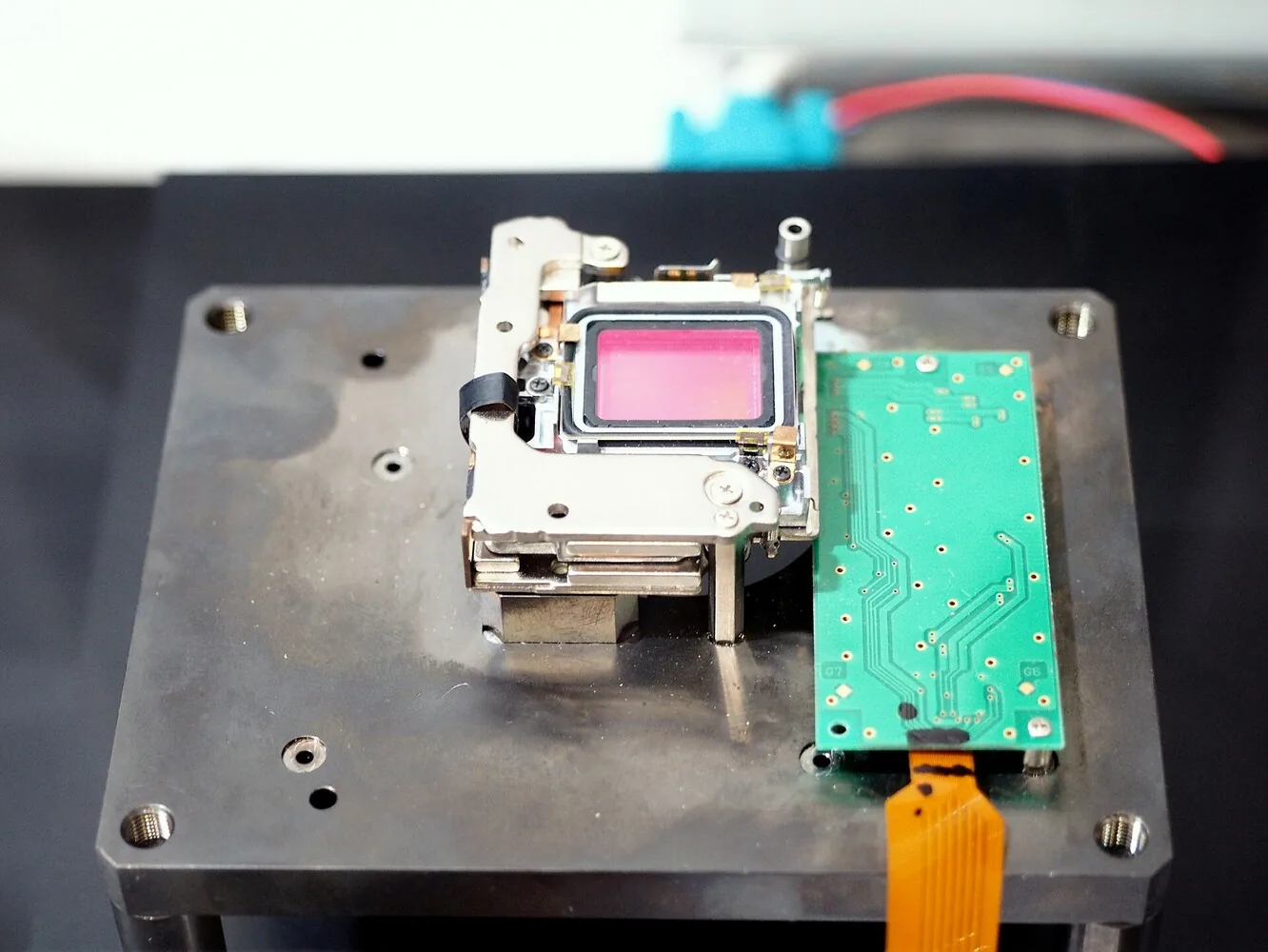
In-body image stabilization (often abbreviated as IBIS) shifts the camera sensor itself rather than moving lens elements. Minolta introduced the first sensor-shift system in 2003 with the DiMAGE A1, and Olympus later introduced five-axis sensor stabilization in 2012 with the OM-D E-M5. Sony then introduced the technology to full-frame cameras in 2014 with the α7 II [11, 12]. Sony senior manager Mark Weir said of their full-frame system: “It compensates for pitch and yaw, x and y translation, and roll…it’s the world’s first for a full frame sensor system” [11].
The sensor unit floats on a magnetic carriage suspended by voice-coil motors and precision bearings. Richard Pelkowski, product manager for Olympus America, said that “VCM motor technology has advantages in speed, movement accuracy and power consumption over conventional DC motors or Piezoelectric motors” [11]. In high-end cameras like the Sony Alpha 7R V, eight Hall-effect sensors monitor the carriage position 10,000 times per second, correcting movement with 0.003° angular resolution across a travel range of ±1.5 mm [2].
Sensor-shift stabilization works with almost any attached lens, including vintage manual primes mounted through mechanical adapters [2, 7, 9]. Because the sensor can rotate along the optical axis, IBIS corrects rotational roll that lens elements cannot address [3, 11]. In a 2022 University of Tokyo study, roll accounted for 37% of angular error during handheld shooting [2]. Lens-based systems cannot turn the projected image.


How Coordinated Stabilization Pairs Lens and Body
Rather than treating optical lens stabilization and in-body stabilization as competing designs, modern camera systems coordinate both mechanisms. Canon calls this feature Coordinated Control IS, OM System brands it as Sync IS, Panasonic uses Dual I.S., and Nikon designates it as Synchro VR. Microprocessors in the camera body and lens trade real-time sensor data across the electronic mount contacts, dividing compensation tasks so the two mechanisms do not correct the same shake twice [3].
Coordinated operation provides vital optical leverage at long focal lengths. A tenth of a degree of pitch tilt moves the image roughly 0.04 mm at 24 mm, but that same tilt moves the image about 1.0 mm at 600 mm. A camera sensor carriage has limited physical clearance before the sensor moves outside the clean center of the lens image circle. In coordinated systems, the lens correction group absorbs large angular swings, while the sensor carriage handles roll rotation, translational shift, and high-frequency vibrations [2, 3].
Lab measurements show the combined gain from this partnership. The OM System OM-1 Mark II achieves 8.5 stops of compensation with Sync IS using the M.Zuiko Digital ED 150-400mm f/4.5 TC1.25x IS PRO lens at a 300 mm full-frame equivalent focal length [3]. Canon’s RF 24–240mm f/4–6.3 IS USM paired with the EOS R5 similarly delivers 8 stops of combined correction at 240 mm [2]. Both systems together extend handheld range.
Digital Frame Cropping for Video
Electronic image stabilization (commonly known as EIS) relies entirely on software processing rather than physical movement of glass or silicon. When recording video, the camera captures an image slightly larger than the output resolution, using the border region as a buffer margin. By analyzing motion vectors from gyroscopes or frame-to-frame pixel differences, the internal processor shifts the recorded crop box to keep subjects stationary within the frame [1, 6].
Because digital stabilization requires no internal motors or floating carriages, it adds neither weight nor manufacturing expense to lenses or camera bodies [6]. It is widely used in action cameras like the GoPro HERO12 Black and smartphones like the Google Pixel 7 [1, 2]. However, the process imposes a permanent crop of 5% to 15% of the sensor area, narrowing the field of view [6]. In low light, digital image stabilization can also soften textures or introduce perspective distortion known as the jelly effect [1, 2].

Digital stabilization also extends into post-production video editing suites. In software like Apple’s Final Cut Pro for Mac, video editors apply automated stabilization using tools such as InertiaCam or SmoothCam to smooth translation, rotation, and scale axes across shaky clips. These algorithms analyze successive frames and transform pixels to remove jitter, though extreme corrections can cause black borders along frame edges [13]. Physical stabilization during shooting remains cleaner.
What CIPA Ratings Measure in the Lab
Camera manufacturers rate stabilization performance in stops using standardized test protocols established by the Camera & Imaging Products Association (known as CIPA) [2, 3, 7]. Under the DC-011 and TC-010 standards, a test camera is mounted to a motorized rig that replays 32 seconds of recorded human hand tremor sampled at 500 Hz. The rig tests different vibration waveforms based on whether the total camera and lens mass falls below 400 grams or exceeds 600 grams [3].
The test rig photographs a chart of black and white edges at a shooting distance equal to 20 times the 35 mm equivalent focal length across hundreds of exposures. Technicians measure edge blur against baseline frames captured with the rig stationary and stabilization switched off. The final CIPA rating indicates how many stops of shutter speed a photographer can surrender before average blur crosses a designated sharpness threshold [3]. Each stop represents a doubling of exposure time.

Comparing ratings across different camera generations requires care due to changes in test criteria. The 2015 CIPA standard evaluated yaw and pitch shake only at the center of the frame, accepting images if blur stayed under 63 micrometers. The 2024 revision tightened that threshold to 20 micrometers, added roll vibration to the shake waveform, and introduced a secondary measurement at 60% image height. Because off-center sharpness drops faster during motion, the newer test standard makes high stop numbers harder to earn [3, 4].
When to Turn Image Stabilization Off
Although image stabilization assists handheld photography in dim light, leaving it enabled in certain shooting situations can degrade picture quality. When a camera is mounted firmly onto a sturdy tripod, the system gyroscopes detect zero external motion [2, 4, 5, 7]. In older lenses without automated detection, internal feedback loops can mistake normal motor vibrations for external shake, causing the actuators to hunt and introduce micro-jitter into an otherwise steady exposure [4, 5, 7]. Modern lenses often auto-detect tripods, but manual deactivation avoids errors [2, 7, 12].
Stabilization also provides little benefit at high shutter speeds. Once exposure speeds climb past 1/500 second or 1/1000 second, the shutter curtain opens and closes so fast that human hand tremor cannot register as motion blur during the frame [4, 8, 10]. Keeping stabilization active at high speeds can introduce minor softness from element movement while draining valuable battery reserves [5, 8, 12]. Canon RF stabilized lenses draw 220 to 350 mW during active use, raising surface temperatures and reducing battery life in cold weather [2].
Finally, intentional camera movement requires selecting the correct stabilization mode. Standard stabilization fights intentional camera panning, treating smooth lateral tracking as unwanted shake [5, 7]. Many telephoto lenses include a dedicated Mode 2 or panning setting that disables horizontal damping while preserving vertical correction to keep tracked subjects sharp against blurred backgrounds [4, 7, 12]. Nikon VR lenses also offer an active mode designed specifically for shooting from moving vehicles or boats [12]. Knowing when to adjust settings ensures crisp results.
- ONLINE NEWS Shaw, R.-T. (2023). What is image stabilization? OIS, EIS, and HIS explained. Android Authority. [Article Link]
- WEBSITE Kito, J. (2026). Image Stabilization Explained: How It Works and When to Use It. Frame and Focal. [Article Link]
- ONLINE NEWS Cooke, A. (2026). How Image Stabilization Works: Magnets, Gyros, and Floating Glass. Fstoppers. [Article Link]
- WEBSITE Vance, N. (2026). Image Stabilization Explained: How It Works, When It Helps, and What to Expect. Frame and Focal. [Article Link]
- WEBSITE Mishra, J. (2021). What is Image Stabilization and Vibration Reduction? ExpertPhotography. [Article Link]
- WEBSITE King, D. (2026). Image Stabilization Camera: IBIS, OIS & EIS Explained. Amateur Photographer Guide. [Article Link]
- WEBSITE Porter, A. (2026). Image Stabilization Explained: What It Fixes and What It Misses. Photography Talk. [Article Link]
- ONLINE NEWS Guinness, H. (2017). What Is Image Stabilization, and How Does It Work? How-To Geek. [Article Link]
- WEBSITE Collier, J. (2023). What Is Image Stabilization? (How and When to Use it). Shotkit. [Article Link]
- ONLINE NEWS James, A. (2021). What is image stabilization, and how does it work? Digital Camera World. [Article Link]
- ONLINE NEWS Gampat, C. (2014). A Comparison of How Olympus and Sony’s 5 Axis Stabilization Work. The Phoblographer. [Article Link]
- WEBSITE Wikipedia contributors. (2026). Image stabilization. Wikipedia. [Article Link]
- WEBSITE Apple Inc. (2026). Correct shaky video in Final Cut Pro for Mac. Apple Support. [Article Link]
- WEBSITE Discovercameras Editor. (2026). What Is Image Stabilization in Cameras? Types, Benefits, and How It Works. Discovercameras. [Article Link]


