





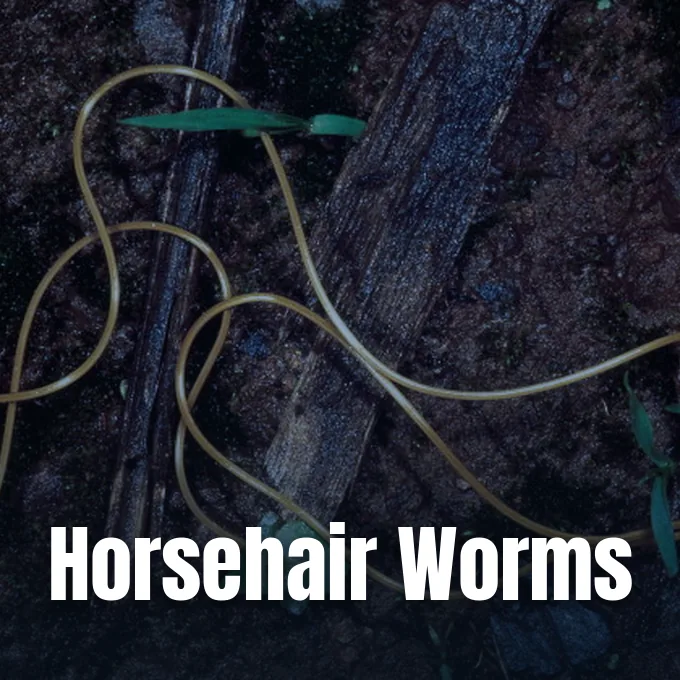
Horsehair worms are extremely slender parasitic invertebrates belonging to the phylum Nematomorpha that spend their juvenile lives developing inside land-dwelling arthropods [1]. As larvae, they feed on host tissues and grow quietly within the insect body cavity, but as maturing adults, they require freshwater habitats to complete their reproductive cycle [2]. By altering the host’s neurological functions, these parasites compel terrestrial insects like crickets and praying mantises to seek open water and plunge straight into streams or ponds [11].
What Are Horsehair Worms?
Taxonomists have named around 361 living species in the phylum Nematomorpha, though field biologists like Andreas Schmidt-Rhaesa estimate total diversity could reach 2,000 species [5, 10]. Adult specimens are unsegmented and cylindrical. While most measure between 10 and 100 centimeters in length with a thin diameter of 1 to 3 millimeters, rare individuals grow up to 120 centimeters long without changing in thickness from end to end [2, 4]. Their body color ranges from pale tan to dark black [4]. Adult horsehair worms lack any distinct head segmentation, presenting a blunt front end and a slightly swollen tail tip [2].
These organisms occur in fresh waters on every continent except Antarctica. They inhabit clear streams, lakes, garden ditches, and seasonal puddles [4]. While adults crawl through wet mud or swim through weeds, their larvae live as internal parasites inside arthropods such as crickets and ground beetles [1, 11]. In North America, the University of Florida documented eleven species, noting that the worm Gordius robustus frequently infects the Mormon cricket, Anabrus simplex [2].
People often refer to these animals as hairworms or Gordian worms, names based on their wire shape and tangled mating habits [8]. Unlike true roundworms in the phylum Nematoda, adult nematomorphs lack an excretory system, possess a degenerate gut that functions poorly if at all, and rely on an internal nerve ring. They move by slow, undulating muscular waves passing along the body wall [5]. Their existence relies on a split life cycle where aquatic eggs yield tiny larvae that must later return to water as adults [11].
The Myth of Spontaneous Generation
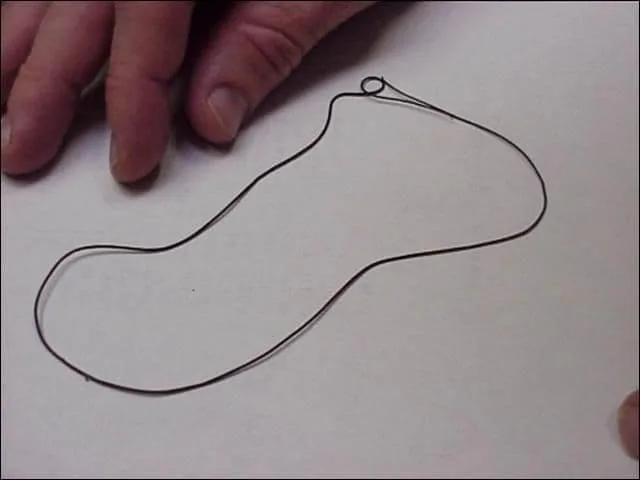
The common name for horsehair worms dates back centuries to an era when rural folklore explained biological phenomena through spontaneous generation [1]. Farmers and stable hands in Europe and North America regularly found these long, dark, twisting threads in wooden livestock troughs where horses drank [2]. Because the worms matched the dark color of horse tail hair, rural folklore held that loose horse hairs fell into the water and came alive [1, 8]. In reality, parasitized crickets had drowned in the troughs, releasing the parasites into the basin [1].
Formal scientific study began when Swedish naturalist Carl Linnaeus named the genus Gordius in 1758 to classify the freshwater species Gordius aquaticus. For more than a century, zoologists grouped these creatures with roundworms under older names like Gordiacea or within obsolete taxa such as Entozoa and Nemathelminthes. In 1886, Czech zoologist František Vejdovský established the name Nematomorpha and elevated the group to the rank of phylum, drawing from the Greek words nema, meaning thread, and morphe, meaning shape [4, 5]. Vejdovský found that their internal anatomy, embryonic development, and parasitic larval habits set them apart from other vermiform invertebrates [4].
Modern evolutionary analyses place Nematomorpha within the clade Nematoida as the closest living sister group to Nematoda, with both phyla nested within Ecdysozoa where animals share a layered cuticle that molts during development [4]. Fossils remain scarce. Paleontologists have recovered fossilized hairworms preserved in mid-Cretaceous Burmese amber dated to roughly 100 million years ago. Earlier Lower Cambrian organisms like Maotianshania hint at deep evolutionary roots [11].
Internal Anatomy of the Adult Worm
Adult nematomorphs display a simplified internal body plan adapted to a brief, non-feeding adult existence [5]. Their body wall consists of a thin epidermis covered by a thick, multilayered cuticle that protects them from injury. Beneath the epidermis lies a robust layer of longitudinal muscle fibers, which gives rise to hollow tubular extensions known as the rete system [4]. Adult worms possess no circular muscles. Because they lack circular musculature, they cannot expand and contract their bodies like earthworms, relying instead on longitudinal contractions to create slow sinusoidal undulations through the water [5]. Adult horsehair worms possess a narrow diameter of only 1 to 3 millimeters that stays uniform along their entire length [4].
The outer layer of the cuticle often carries microscopic raised structures called cuticular areoles, which look like tiny bumps, papillae, or warts under scanning electron microscopy. In many species, particular areoles bear an apical spine that acts as a touch sensor, while others contain central pores. Zoologists rely on areole patterns as key traits for species identification [4].
Internally, adult hairworms lack circulatory, respiratory, and excretory organs [5]. Their digestive tract is degenerate and largely non-functional, with a mouth that is often sealed shut and a pharynx that forms a solid cellular plug or a cuticularized tube [4, 11]. Rather than eating food orally, mature worms absorb dissolved nutrients from surrounding water across their body wall. Their nervous system consists of an anterior cerebral ganglion situated around the pharynx in a head region known as the calotte, supported by a single ventral nerve cord that runs down the body inside an epidermal tract [4].
Freshwater and Marine Lineages
The phylum Nematomorpha divides cleanly into two orders that inhabit separate biomes. The order Nectonematoidea contains only the single marine genus Nectonema, which currently includes five recognized species [4, 5]. Unlike freshwater forms, adult Nectonema lead a pelagic life in open marine waters, drifting through the North Atlantic, the Mediterranean Sea, and parts of the Pacific Ocean near Japan and New Zealand [4]. They swim by using a double row of natatory bristles [11].
Marine horsehair worms utilize decapod crustaceans as their hosts during their larval phase. Biologists George Poinar and Annette Brockerhoff described Nectonema zealandica from rock crabs, Hemigrapsus edwardsi, in New Zealand waters, while other studies documented larvae inside Jonah crabs, Cancer borealis, along the Atlantic coast. The larvae feed within the crab hemocoel, taking nutrients from host blood until they reach full size and burrow out into the sea [4]. Adult Nectonema possess a spacious body cavity and single gonads that help maximize egg production in marine currents [11].
The vast majority of hairworms belong to the freshwater order Gordioidea, which comprises nineteen genera split between two families: Gordiidae and Chordodidae. Gordiids lack areoles and possess a single ventral nerve cord. In contrast, chordodids feature complex cuticular areoles and represent the most diverse branch of the phylum, with genera like Chordodes and Gordionus. In North America, researcher Andreas Schmidt-Rhaesa documented Gordionus lineatus parasitizing millipedes in Ohio, while other scientists identified Gordius terrestris living in moist garden soil [5, 13].


The Four-Stage Life Cycle
The life cycle of a freshwater hairworm progresses through four distinct stages: egg, pre-parasitic larva, parasitic larva, and free-living adult. During spring, adult females deposit millions of eggs within slender, gelatinous strings wrapped around water plants or rocks [1, 2]. Depending on water warmth, the embryos take between 15 to 80 days to hatch into free larvae. These newly hatched larvae measure only about 100 micrometers in length, carrying a snout armed with rings of cuticular hooks and sharp oral stylets [4, 5]. Pre-parasitic larvae cannot swim far through open water, so they sink to the mud bottom where they crawl over sediment [4].
Direct ingestion of larvae by a host happens occasionally when land insects drink water [1, 2]. More commonly, aquatic insect larvae—such as mayfly nymphs, caddisfly larvae, and chironomid midges—ingest the free-swimming parasites [5, 11]. The larva burrows through the gut wall, enters host tissues, and encysts into a dormant protective sphere that can survive for a full year [4, 11].
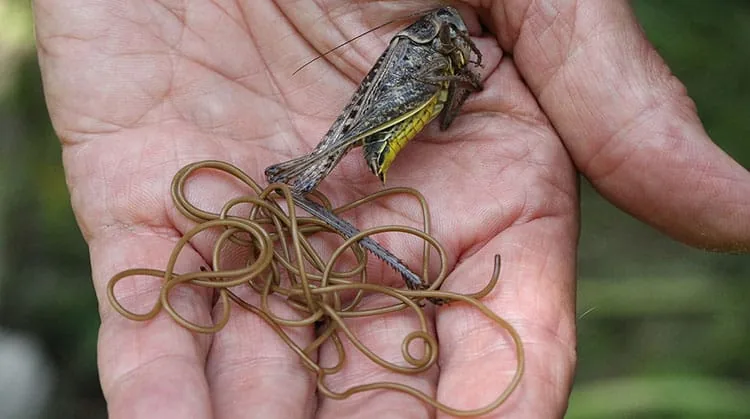
When the aquatic insect matures, undergoes metamorphosis, and flies out of the water, it carries the viable cyst onto land. The horsehair worms resume growth when a predatory land insect, like the cricket Nemobius sylvestris, ground beetles of the family Carabidae, or a praying mantis, eats the infected adult vector [7, 11, 14]. Inside the gut, the larva excysts, penetrates the hemocoel, and begins absorbing nutrients from bodily fluids. Over the next four to twenty weeks, the juvenile grows, molts, and fills the host body cavity, disrupting organ function and preventing female insects from producing eggs [2, 4].

How Horsehair Worms Control Host Behavior
When juvenile horsehair worms finish their physical growth inside a land host, they face an evolutionary barrier: they must reach water to breed, but their insect hosts naturally avoid drowning. To solve this problem, nematomorphs manipulate host behavior, driving land insects directly into aquatic habitats. Field tests by French biologist Frédéric Thomas showed that infected crickets are twenty times more likely to jump into water than uninfected insects [11].
Research published in the International Journal for Parasitology by Frédéric Thomas and his team revealed the neurochemical mechanisms underlying this behavioral takeover in wood crickets infected by the hairworm Paragordius tricuspidatus. The researchers discovered that infected crickets displayed lower levels of neurotransmitters and amino acids in their brains, with changes in taurine, valine, and tyrosine correlating closely with the manipulative process. Histological analysis of the cricket’s mushroom bodies showed a two-fold increase in neurogenesis, indicating that the parasite actively alters host brain structure [7]. According to Thomas and his colleagues, “infected insects may first display an erratic behaviour which brings them sooner or later close to a stream and then a behavioural change that makes them enter the water”. In Japan, mantises infected by Chordodes seek horizontally polarized light reflecting from water surfaces [11].
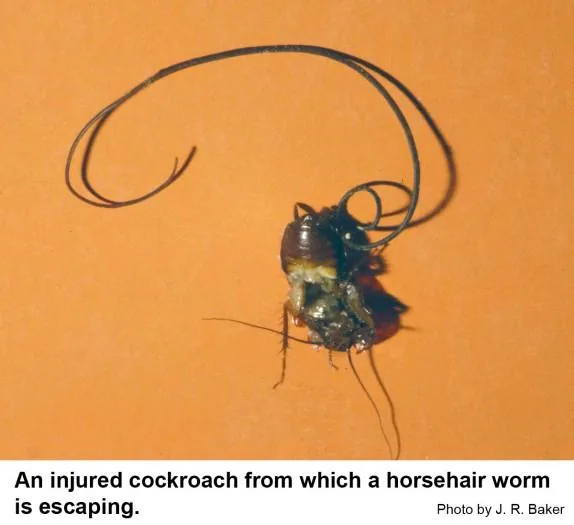
As soon as the host touches water, the adult worm breaks through the insect’s thin body wall or cloacal opening, wriggling out into the stream [1, 11]. The emergence leaves the host insect hollow and mortally wounded, causing it to die shortly after the parasite leaves [1, 5]. If a fish or frog swallows the insect before the worm escapes, the parasite can crawl out through the predator’s mouth, nose, or gill slits to reach safety [5, 11].
Breeding Knots in Freshwater
Adult hairworms dedicate their brief lives to finding mates in freshwater streams or ponds. Because currents scatter individuals emerging into open water, highly active males swim through the water column while detecting chemical pheromone scents released by sedentary females [4, 5]. When multiple worms congregate in the same pool, they coil together into a tight, writhing ball of dozens of entangled bodies [4]. This tangled mass inspired the common name Gordian worms (after the ancient Greek legend), because unraveling the dense cluster seems impossible [1, 5]. Males seek partners actively. Circling around receptive females, a male horsehair worms partner initiates sperm transfer by wrapping his posterior lobes around her body [4].
During copulation, a male wraps his lobes around the female, depositing a spermatophore near her cloacal pore. Sperm cells then migrate into the female’s seminal receptacle for internal fertilization [4, 5]. Entomologist Gerald Thorne estimated in 1940 that a single female of Gordius robustus in Utah produced approximately 27 million eggs during her reproductive period [2]. After egg laying ends, adult worms perish from exhaustion [5].
While sexual reproduction represents the rule among nearly all nematomorphs, researchers discovered a notable exception in East Africa. In 2012, biologists Ben Hanelt, Matthew Bolek, and Andreas Schmidt-Rhaesa described Paragordius obamai from Kenya, identifying it as the first known parthenogenetic species in the phylum Nematomorpha. By producing viable female offspring without male fertilization, this species bypasses the difficulty of finding mates in sparse host populations [12]. In temperate regions where seasons change, adult worms can overwinter beneath stones, buried inside damp soil, or under submerged organic debris until spring warmth stimulates active breeding [2, 4].
Why Horsehair Worms Appear in Domestic Water
Homeowners often report discovering horsehair worms wriggling inside swimming pools, bathroom toilets, pet water dishes, garden sinks, and bird baths. Because these thin, dark worms appear without an obvious explanation, residents often suspect that parasites have infested their tap water. In reality, the worms enter household plumbing through incidental insect visitors rather than municipal water systems. Drowned crickets or cockroaches simply release the mature parasites into the basin [1].
Despite their alarming size and sinuous movements, horsehair worms pose zero health risk to humans, household pets, livestock, or garden plants. Their parasitic physiology needs an arthropod host during larval development, making them completely incapable of parasitizing vertebrate tissues [1, 2]. While rare historical cases in Japan recorded accidental pseudoparasitism when people swallowed contaminated pond water, the worms simply pass harmlessly through the gut without establishing an infection [11]. Extension entomologist James Baker at North Carolina State University emphasizes that no chemical pesticides are necessary to manage hairworms in residential settings. Simple physical removal and standard domestic pest control for crickets resolve household occurrences [1].
Beyond domestic curiosities, horsehair worms play a significant regulatory role in natural freshwater ecosystems. In Japanese mountain streams, ecological researchers found that hairworms driving infected orthopterans into water provided up to 60 percent of the annual energy intake for the endangered Kirikuchi char. When hairworm populations declined, the fish relied far more heavily on benthic stream invertebrates, triggering cascade effects throughout the aquatic food web. These enigmatic parasites serve as ecological bridges between land and water, showing how microscopic manipulators shape entire natural communities [8, 11].
- WEBSITE Baker, J. (2019). Horsehair Worm. NC State Extension Publications. [Article Link]
- WEBSITE Capinera, J. L. (2024). Horsehair Worms, Hairworms, Gordian Worms, Nematomorphs, Gordius spp. (Nematomorpha: Gordioidea). Featured Creatures, University of Florida IFAS. [Article Link]
- WEBSITE Integrated Taxonomic Information System. (2026). Nematomorpha. [Article Link]
- WEBSITE Wright, J. (2025). Nematomorpha: Horsehair worms. Animal Diversity Web. [Article Link]
- WEBSITE Ramel, G. (2020). Phylum Nematomorpha: Horsehair Worms Explained. Earth Life. [Article Link]
- WEBSITE Bugs With Mike. (2026). Nematomorpha Meaning in Entomology: Definition and Examples. [Article Link]
- ACADEMIC JOURNAL Thomas, F., Ulitsky, P., Augier, R., Dusticier, N., Samuel, D., Strambi, C., Biron, D., & Cayre, M. (2024). Biochemical and histological changes in the brain of the cricket Nemobius sylvestris infected by the manipulative parasite Paragordius tricuspidatus (Nematomorpha). International Journal for Parasitology. [Article Link]
- WEBSITE Smith, L. (1997). Nematomorpha: Hair worms, Gordian worms, horsehair worms. Bumblebee.org. [Article Link]
- WEBSITE Australian Biological Resources Study. (2011). Phylum Nematomorpha: Gordian Worms, Horse-hair Worms. Australian Faunal Directory. [Article Link]
- WEBSITE Schmidt-Rhaesa, A., & Boyko, C. B. (2024). Nematomorpha. Fauna Europaea. [Article Link]
- WEBSITE Wikipedia contributors. Nematomorpha. Wikipedia, The Free Encyclopedia. [Article Link]
- ACADEMIC JOURNAL Hanelt, B., Bolek, M. G., & Schmidt-Rhaesa, A. (2012). Going Solo: Discovery of the First Parthenogenetic Gordiid (Nematomorpha: Gordiida). PLoS ONE, 7(4), e34472. [Article Link]
- ACADEMIC JOURNAL Schmidt-Rhaesa, A., Farfan, M. A., & Bernard, E. C. (2009). First Record of Millipeds as Hosts for Horsehair Worms (Nematomorpha) in North America. Northeastern Naturalist, 16(1), 125-130. [Article Link]
- ACADEMIC JOURNAL De Villalobos, L. C., Ribera, I., & Downie, I. S. (1999). Hairworms found in Scottish agricultural land, with descriptions of two new species of Gordionus Muller (Nematomorpha: Gordiidae). Journal of Natural History, 33(12), 1767-1780. [Article Link]


