





For developers asking what is Vulkan API, the short answer is that it operates as an open cross-vendor graphics standard built for direct GPU access. Maintained by The Khronos Group, the framework strips away the heavy driver layers that defined older tools like OpenGL. High-end gaming rigs and mobile devices feature multi-core CPUs paired with fast graphics chips, yet older software struggled to feed those execution units without stalling the main processor thread. The Vulkan API solves this bottleneck by handing control of device memory, command queues, and thread coordination directly to application code [1].
- What Is Vulkan API?
- Origins Rooted in AMD Mantle Architecture
- How Vulkan API Manages Hardware Threads
- SPIR-V Shaders and Thinner Device Drivers
- Comparing Older Frameworks with Vulkan API
- Explicit Memory Heaps and Resource Pipelines
- Cross-Platform Support from Consoles to Handhelds
- Software Rendering in Academic Research
What Is Vulkan API?
The Vulkan API is a low-level graphics and compute programming interface that lets software communicate with graphics hardware with minimal driver overhead. Unlike legacy graphic drivers that make guesses about how to schedule work and store textures, the Vulkan API expects game engines to specify these operations in clear code. The Khronos Group brought hardware and software leaders together in San Francisco to build this standard from scratch, targeting predictable frame times and maximum chip efficiency. The specification gives applications direct control over graphic pipelines, letting CPU cores build rendering commands in parallel without stumbling over driver locks [1].
This explicit design marks a sharp contrast with older graphics models. OpenGL relied on a global state machine where changing a single texture or blend state could alter later draw calls within an entire rendering context. In contrast, the Vulkan API treats hardware resources as immutable objects that engines bake into pipeline states before sending tasks to the graphics card. “Vulkan does not replace traditional APIs, but it provides another choice for developers,” said Neil Trevett, president of the Khronos Group and vice president at NVIDIA, pointing out that explicit resource handling allows smooth performance in the hands of skilled engineers [1].
Because drivers do less background guessing, coders take on more setup duties. Teams must track sync states, manage memory chunks, and build command buffers early. This extra setup needs more lines of code. Yet it prevents sudden frame drops. Clear hardware visibility keeps game speeds stable on Linux, Android, and Windows [5].
Origins Rooted in AMD Mantle Architecture
The roots of the Vulkan API lie in early industry efforts to remove PC driver bottlenecks. During the development of the Frostbite engine for the Battlefield series, AMD collaborated with game studio EA DICE to design Mantle, a low-overhead interface tailored for Radeon graphics cards. Mantle proved that console-style hardware access on personal computers could unlock higher frame rates by bypassing bloated driver layers. Rather than keeping the breakthrough proprietary, AMD chief architect Raja Koduri led the decision to donate the Mantle source code and API specification to The Khronos Group in May 2015 to jumpstart an open, cross-vendor standard [1].
Khronos announced the initiative under the working title glNext before officially naming it Vulkan at the Game Developers Conference in 2015. Over a busy eighteen-month build cycle, major hardware and platform vendors including Apple, ARM, Google, Intel, NVIDIA, Qualcomm, and Valve contributed code and engineering feedback to shape the 1.0 specification. Valve co-founder Gabe Newell championed the project to ensure open graphics alternatives flourished on Linux and SteamOS. “Due to Vulkan’s cross platform availability, high performance and healthy open source ecosystem, we expect to see rapid uptake by software developers, far exceeding the adoption of similar APIs which are limited to specific operating systems,” Newell said [1].
Studio Croteam validated the framework by porting its philosophical puzzle game The Talos Principle to Vulkan. The port proved that a studio title could move from legacy drivers to explicit GPU control while retaining visual fidelity. “Vulkan in just one sentence? The endless war between performance and portability is finally over!” said Dean Sekulic, graphics engine specialist at Croteam [1].
How Vulkan API Manages Hardware Threads
Older graphics libraries struggle on multi-core chips because they route draw commands through a single thread context. Even when a gaming PC features eight or sixteen CPU cores, an older OpenGL driver serializes draw tasks on the main CPU thread, creating a bottleneck that leaves powerful graphics cards idle. The Vulkan API breaks this wall by decoupling command recording from command submission. An application can launch multiple worker threads, each writing draw calls into separate command queues and command buffers without waiting for sister threads to finish [1].
Once worker threads finish their command buffers, the engine dispatches the completed batches to GPU queues in a coordinated pass. Because the CPU skips state validation during submission, driver overhead drops sharply. NVIDIA senior vice president Tony Tamasi noted that NVIDIA GPUs gained driver support on the day Vulkan launched, helping studios eliminate frame drops in draw-heavy scenes. In simulations sensitive to micro-stuttering, explicit control over queue submission keeps frame delivery smooth and steady [1].

This multi-threaded model scales effectively onto mobile silicon with asymmetric CPU configurations. Many smartphone chips combine high-power cores with energy-saving cores under ARM big.LITTLE designs. As ARM graphics research director Tom Olson explained, mobile graphics must balance high frame rates against battery life, and the Vulkan API helps ARM Mali GPUs sustain high efficiency. By allowing studios to generate command buffers on lightweight energy-efficient cores, the API prevents chips from overheating during prolonged mobile play [1].
SPIR-V Shaders and Thinner Device Drivers
A major technical leap in the Vulkan API ecosystem is the adoption of SPIR-V (Standard Portable Intermediate Representation). In OpenGL, game studios distribute shader programs as plain GLSL text strings, forcing hardware vendors to build and ship full C-style language compilers inside their device drivers. This requirement bloated driver install sizes, sparked driver bugs across different GPU brands, and caused jarring shader compilation stutters during gameplay. SPIR-V replaces text shaders with a standardized pre-compiled binary format that drivers ingest quickly without complex source parsing [2].
Developers build shaders ahead of time using offline compilers like Google shaderc or Khronos glslang before distributing their software. The graphics card driver receives clean binary bytecode, meaning it only needs to convert intermediate instructions into device machine code. This pipeline cuts loading times, protects proprietary shader algorithms from extraction, and lets teams write shaders in GLSL, HLSL, or custom languages without breaking cross-vendor compatibility [13].
Thinner device drivers also mean hardware makers spend less time chasing compiler errors in game releases. Intel Open Source Technology Center vice president Imad Sousou confirmed that Intel backed Vulkan by delivering certified drivers for three generations of Intel graphics hardware at launch. To aid debugging, LunarG CEO Karen Ghavam announced the LunarG Vulkan SDK for Windows and Linux, which provides validation layers that catch memory leaks, invalid state bindings, and API errors during engine testing [1].

Comparing Older Frameworks with Vulkan API
Choosing between graphics interfaces involves balancing upfront coding effort against runtime control. OpenGL remains practical for simple utilities, school assignments, and quick demos because the driver handles memory allocation, state tracking, and sync automatically. In the Vulkan API, drawing even a single colored triangle needs configuring instances, selecting GPUs, creating logical queues, setting up swapchains, and declaring pipeline barriers across hundreds of lines of code. For large game studios, however, that first coding investment pays off in deterministic frame timing and broad hardware reach [5].
When compared with Microsoft DirectX 12, the Vulkan API shares a similar explicit command model, but it provides a clear advantage in platform flexibility. DirectX 12 remains confined to Windows and Xbox consoles, leaving mobile and open-source platforms unsupported. Vulkan runs natively on Windows 7, Windows 10, Linux, Android, and Tizen. On Apple hardware, where macOS and iOS mandate Apple Metal, the open-source MoltenVK library created by Bill Hollings at The Brenwill Workshop translates Vulkan commands into native Metal calls, letting studios support Mac platforms without rewriting graphics engines from scratch [9].
Earlier APIs like DirectX 11 relied on implicit driver multi-threading that struggled to distribute work on multi-core chips. The Vulkan API eliminates those hidden driver bottlenecks. Studios gain direct access to hardware queues, unlocking higher visual throughput [4].
Explicit Memory Heaps and Resource Pipelines
Memory management in the Vulkan API is completely explicit, handing allocation choices to engine architects. In OpenGL, calling buffer creation commands prompts the driver to allocate and page memory silently. In Vulkan, the driver exposes distinct memory heaps and memory types that reflect underlying silicon layouts. AMD GPUOpen technical guides explain that modern cards separate high-speed device-local video RAM from host-visible system memory used for CPU uploads. Coders must query these memory heaps, bind memory to image resources, and handle defragmentation manually to prevent VRAM exhaustion during heavy gaming scenes [7].
Resource synchronization requires equal precision. Because graphics chips run commands asynchronously across compute and raster units, drivers will not stop an operation from writing to a texture while a draw pass is still reading it. The Vulkan API asks developers to place pipeline barriers, execution dependencies, and semaphores to coordinate data hazards. In January 2020, Khronos released Vulkan 1.2, integrating timeline semaphores into the core spec to give programmers a single integer counter for synchronizing tasks across multiple CPU threads and asynchronous GPU queues [13].
Subsequent updates kept refining how the standard handles graphics work. In January 2022, Khronos launched Vulkan 1.3, which introduced dynamic rendering to eliminate rigid render pass and framebuffer objects. This update also made synchronization features mandatory, reducing device fragmentation. On December 3, 2024, Khronos released Vulkan 1.4, consolidating core features to maintain a reliable base for game engines on desktop and mobile devices [13].
Cross-Platform Support from Consoles to Handhelds
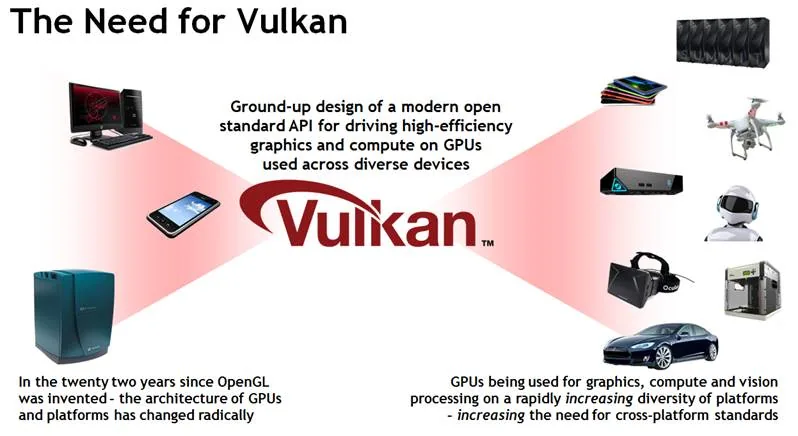
A major strength of the Vulkan API is its ability to scale from compact mobile chips up to high-end desktop hardware. Google added Vulkan support to Android 7.0 Nougat, while Qualcomm product director Micah Knapp announced conformant drivers for Snapdragon 820 chips with embedded Adreno 530 GPUs. When Nintendo released its hybrid gaming hardware, the console included certified Vulkan support alongside OpenGL 4.5 and OpenGL ES for its NVIDIA Tegra X1 chip. As Eurogamer reports revealed, the Switch GPU clocks down from 768 MHz when docked to 307.2 MHz in handheld mode, demanding tight code optimization to maintain smooth 720p and 1080p output [6].
Balancing thermal limits and clock frequencies is crucial on portable hardware, a reality explored in technical coverage of how the Nintendo Switch balances power and play across docked modes. Hardware capabilities continue to evolve as newer portable systems adopt variable refresh rates, a trend visible in recent analyses of how Zelda: Ocarina of Time VRR arrives on Switch 2 in docked mode. Clean low-overhead execution helps games sustain target frame rates without triggering aggressive battery drain or thermal throttling [6].

The standard also powers affordable maker computers. In November 2020, Raspberry Pi founder Eben Upton announced that the V3DV Mesa driver built by Igalia engineer Iago Toral achieved official Vulkan 1.0 conformance on Raspberry Pi 4, passing more than 100,000 Khronos conformance tests [8]. This milestone enabled hobbyists to run vkQuake3 at over 100 frames per second on low-cost boards [13].
Software Rendering in Academic Research
Beyond desktop PCs and gaming handhelds, the Vulkan API serves high-performance computing and research labs where dedicated GPU hardware is unavailable. Software renderers like Mesa Lavapipe map Vulkan instructions to Gallium and LLVM to run graphics pipelines directly on CPUs. Research teams use headless Lavapipe builds to run automated unit tests and simulate complex data sets. In parallel computing research, I. K. Kasmeridis and V. V. Dimakopoulos created an OpenMP translator that compiles data-parallel code into Vulkan compute shaders, bringing GPGPU offloading to embedded mobile chips [12].
Universities have also incorporated the Vulkan API into computer science curricula. In a study published in Computers & Graphics, researchers J. Unterguggenberger, B. Kerbl, and M. H. Wimmer documented how teaching Vulkan provides students with an authentic look into GPU hardware architecture. Although the verbose API demands substantial upfront effort compared to OpenGL, mastering explicit memory and synchronization prepares students for engineering roles in game development and graphics research [10].
Meanwhile, graphics researchers Min-Hyuk Kim and Nakhoon Baek analyzed hybrid Vulkan pipelines, proving that pairing ray tracing extensions with older raster methods delivers superior frame rates in complex animations [11]. In popular titles such as Quake II RTX and Wolfenstein: Youngblood, NVIDIA developers used Vulkan Ray Tracing extensions to compute reflections and shadows while maintaining high visual performance [4]. These research and industry milestones confirm that the Vulkan API remains a vital open standard for graphics and compute [13].
- PRESS RELEASE The Khronos Group. (2016). Khronos Releases Vulkan 1.0 Specification. [Article Link]
- WEBSITE The Khronos Group. (2022). Khronos Vulkan Registry. [Article Link]
- ONLINE NEWS Armasu, L. (2015). Khronos Group Announces The Next-Generation ‘Vulkan’ Graphics And Compute API. Tom’s Hardware. [Article Link]
- WEBSITE NVIDIA Developer. (2023). Vulkan Modern GPU API. [Article Link]
- WEBSITE NVIDIA Developer. (2023). Transitioning from OpenGL to Vulkan. [Article Link]
- ONLINE NEWS Palumbo, A. (2016). Nintendo Switch Officially Supports Vulkan, OpenGL 4.5 & OpenGL ES. Wccftech. [Article Link]
- WEBSITE AMD GPUOpen. (2026). Using Vulkan Device Memory. [Article Link]
- WEBSITE Upton, E. (2020). Vulkan update: we’re conformant! Raspberry Pi. [Article Link]
- WEBSITE Molten. (2026). MoltenVK: Run Vulkan on iOS and OS X. [Article Link]
- ACADEMIC JOURNAL Unterguggenberger, J., Kerbl, B., & Wimmer, M. H. (2022). Vulkan All the Way: Transitioning to a Modern Low-Level Graphics Api in Academia. Computers & Graphics, 111, 155-165. [Article Link]
- ACADEMIC JOURNAL Kim, M., & Baek, N. (2026). A Hybrid Approach for Vulkan-Based Ray Tracing Implementations. Revista Internacional de Métodos Numéricos para Cálculo y Diseño en Ingeniería, 42(2). [Article Link]
- ACADEMIC JOURNAL Kasmeridis, I. K., & Dimakopoulos, V. V. (2026). High-level Programming of Vulkan-based GPUs Through OpenMP. International Journal of Parallel Programming, 54(1-2). [Article Link]
- WEBSITE Wikipedia. (2026). Vulkan. [Article Link]


