





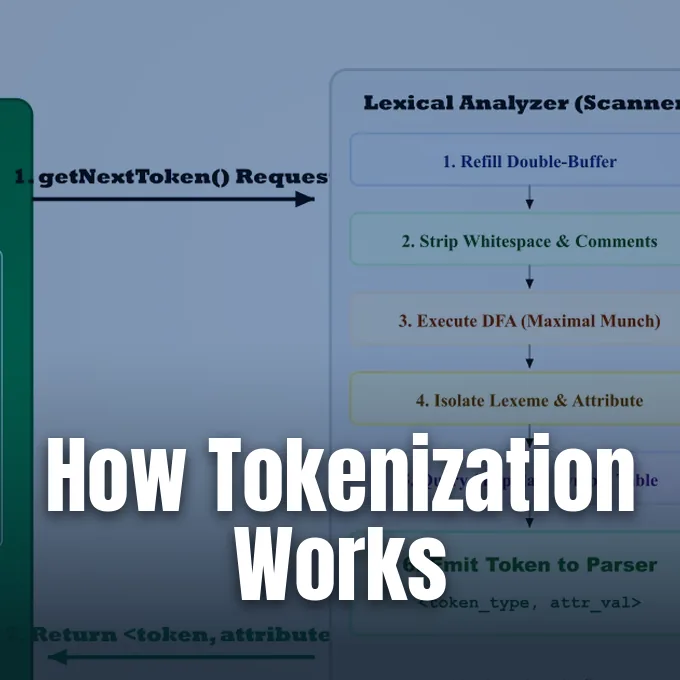
Computer programs cannot read human sentences or code files as unified ideas without first splitting raw text into discrete syntax tokens. Understanding how tokenization works across modern software systems explains why compiler frontends and text parsing tools break linear symbol streams into clean building blocks. Scanners isolate keywords, variable names, numeric values, and punctuation marks before parsers construct an abstract syntax tree. Early scanning serves as the main gateway between input source code and syntax parsers, removing blank spaces and turning raw input text into structured tokens [1].
- Foundations of How Tokenization Works
- Tokens, Lexemes, and Patterns
- Buffer Management in Lexical Scanners
- Automata in How Tokenization Works
- Handling Whitespace and Formatting Comments
- Linguistic Scanners in Python Pipelines
- Model Parsing in Golang Applications
- Lexical Analysis Versus Probabilistic Tokenizers
Foundations of How Tokenization Works
A lexical analyzer, commonly built as a lexer or scanner, acts as the first phase in a compiler frontend to process raw source code in a single linear pass. As researcher Narayanam Dubey explains for PerfectNotes, grouping raw symbols into structured tokens cuts the incoming data volume for later compiler stages by nearly 80 percent [1]. Understanding how tokenization works at this level clarifies why the parser directs scanning by issuing an on-demand getNextToken() request whenever it needs a new terminal symbol to expand a grammar rule. Instead of inspecting each byte repeatedly, the parser receives compact token records that link categorical symbols with resolved attributes. Clear separation keeps character formatting rules away from syntax analysis, ensuring that the grammar engine evaluates clean language structures rather than messy input files [4].
Table-driven scanners process text in linear time. A deterministic finite automaton scans every input letter using constant-time array lookups, keeping throughput stable across source files regardless of grammar size [1]. If a symbol violates defined rules, the scanner reports a lexical error. Compilers stop invalid files before parsing begins [4].
Lexers also serve tools beyond compilers. Code linters, prettyprinters, and syntax editors use identical scanners to inspect source text without compiling it. In a classic C language assignment such as x = a + b * 2, the scanner outputs eight separate tokens. It isolates variable names, math operators, an integer literal, and a semicolon into clean objects [4].
Tokens, Lexemes, and Patterns
Compiler theory separates patterns, lexemes, and tokens. While a formal regular expression rule defining valid character sequences is known as a pattern, the concrete slice of UTF-8 or ASCII source code that actually matches that pattern during execution is termed a lexeme. A token is an abstract grammatical structure consisting of a category name and an optional attribute value passed directly to the parser stack [1]. When tokenizing the expression net_worth_future = (assets – liabilities); the engine turns raw strings into tokens matching IDENTIFIER, EQUALS, OPEN_PARENTHESIS, MINUS, CLOSE_PARENTHESIS, and SEMICOLON. Parsers build syntax trees directly from these discrete tokens without re-evaluating raw characters [4].
What happens when numbers or variable names match valid patterns? The scanner evaluator inspects the matched lexeme to compute output values [4]. As Dubey notes in PerfectNotes, for numeric literals such as 60 or 3.14159, the scanner turns ASCII text into an IEEE 754 binary floating-point representation. For identifiers, the scanner queries a central symbol table. It inserts unseen names at unique integer indices [1].
Central symbol tables keep memory usage lean. Subsequent compiler components reference variables through compact 4-byte integer pointers rather than running slow string comparisons across large codebases [1]. Language keywords such as while, if, or return carry no attribute values. Their categorical token name provides all the grammatical data that syntax parsers need to execute production rules during syntax analysis [4].
Buffer Management in Lexical Scanners
Reading input bytes one by one directly from a disk creates severe input latency that stalls compilation pipelines. Production scanners solve this problem by implementing a double-buffering scheme with two memory blocks of 4 KB each, matching the operating system disk block size. The engine uses two pointers, lexeme_begin and forward, to track text boundaries in memory. Examining how tokenization works inside memory buffers shows that when the forward pointer hits the edge of one buffer half, an asynchronous system call reloads the alternate buffer half from disk. Using fast pointer arithmetic lets the scanner read arrays of symbols in memory with constant-time efficiency while completely avoiding lookahead boundary faults across buffer transitions [1].
Injecting an EOF sentinel byte at each buffer edge optimizes inner scanning loops. Without sentinels, the engine runs two conditional branch checks for every letter to verify buffer boundaries and lexeme ends. With a sentinel, both checks collapse into one test. At 2.5 million characters per second, this optimization saves about 2.5 million branch checks each second [1].
Scanners apply the Maximal Munch rule, also known as the longest match rule, to resolve ambiguous symbol sequences. The scanner consumes the longest valid string before emitting a token. When encountering the character >, the scanner checks whether next letters form >= or >>=. If no further state transition exists, the scanner retracts to its last accepting state [1].
Automata in How Tokenization Works
Examining state machine theory shows how tokenization works under practical runtime demands. Regular expression rules cannot run directly on computer hardware without conversion into formal state machines. Compiler build tools compile regular expressions into a Nondeterministic Finite Automaton using Thompson’s construction in linear time and memory space proportional to the original expression length. Ken Thompson’s algorithm connects atomic state units with empty-string epsilon transitions to model union, concatenation, and Kleene closure loops. Because an NFA can sit in multiple states at once for a single input letter, physical computer chips cannot run it directly in a single pass [1].
Compilers convert non-deterministic models into deterministic machines using subset construction, also called powerset construction. This algorithm groups sets of NFA states reached via epsilon moves into unified states of a Deterministic Finite Automaton. In each DFA state, every input symbol triggers exactly one transition. The resulting state graph runs in predictable linear time [1].
John Hopcroft’s minimization algorithm runs in O(N log N) time to merge equivalent DFA states [1]. Minimization produces a minimal table-driven scanner. The resulting state table plugs into lexer generators such as lex or flex. However, finite-state machines cannot track nested recursive syntax, such as matching parentheses. That structural work is left for full parsers [4].


Handling Whitespace and Formatting Comments
In most programming languages, whitespace characters and inline comments carry no grammatical meaning for syntax evaluation. Lexical grammars define spaces, tabs, carriage returns, newlines, and comment markers like // or /* as specific pattern rules. Scanners discard these non-significant elements at the lexical layer, keeping parsers from needing bloated grammar rules to handle arbitrary blank spaces between keywords and operators [1]. In the 1960s, early programming languages such as ALGOL eliminated spaces and comments during an initial line reconstruction pass, but modern compiler architectures carry out this cleanup directly inside the lexer [4].
Off-side rule languages treat indentation as significant syntax structure [4]. In Python, the CPython lexer tracks line indentation depths and generates explicit INDENT and DEDENT tokens to mark code blocks [1]. An extra space or missing tab alters program logic, making whitespace scanning essential for phrase structure analysis [4].
Software tools also preserve comments. Because code prettyprinters and automated refactoring linters cannot discard developer notes without damaging documentation, their lexer evaluators retain comment strings and line offsets rather than deleting them from the token stream. The engine passes these preserved tokens into the syntax tree so source code can be reformatted cleanly [4].
Linguistic Scanners in Python Pipelines
Text tokenization plays a central role when processing human language data in computational linguistic pipelines. The Natural Language Toolkit, widely known as NLTK, provides a Python environment for text analysis across four distinct linguistic tiers. Level 1 performs lexical analysis by breaking raw documents into clean word tokens and filtering out high-frequency stop words that carry minimal semantic value for downstream processing. Level 2 studies morphological structures through word stemming and lemmatization. Level 3 inspects syntax through part-of-speech tagging and sentence parse trees, while Level 4 detects semantic entities across corpora. In NLTK, word_tokenize() and sent_tokenize() rely on the punkt_tab model to split sentences and words cleanly [2].
NLP pipelines frequently remove high-frequency stop words. NLTK contains stop word corpora across 16 languages, allowing scripts to filter out common words like “the”, “a”, and “in”. Stemmers like Porter, Lancaster, and Snowball strip suffixes rapidly, whereas WordNetLemmatizer uses the WordNet database and omw-1.4 to return real dictionary roots [2].
Part-of-speech taggers assign grammatical categories using the averaged_perceptron_tagger_eng model. In a test sentence about European officials issuing a 5.1 billion dollar fine to Google on a Wednesday, the tagger assigns the cardinal number tag CD to the dollar amount. The ne_chunk() function uses these tags to detect named entities, identifying people like Robert Downey Jr. or Chris Evans, organizations like IBM or Marvel Studios, locations like Boston or Jordan, and artifacts such as the Boeing 747 [2].
Model Parsing in Golang Applications
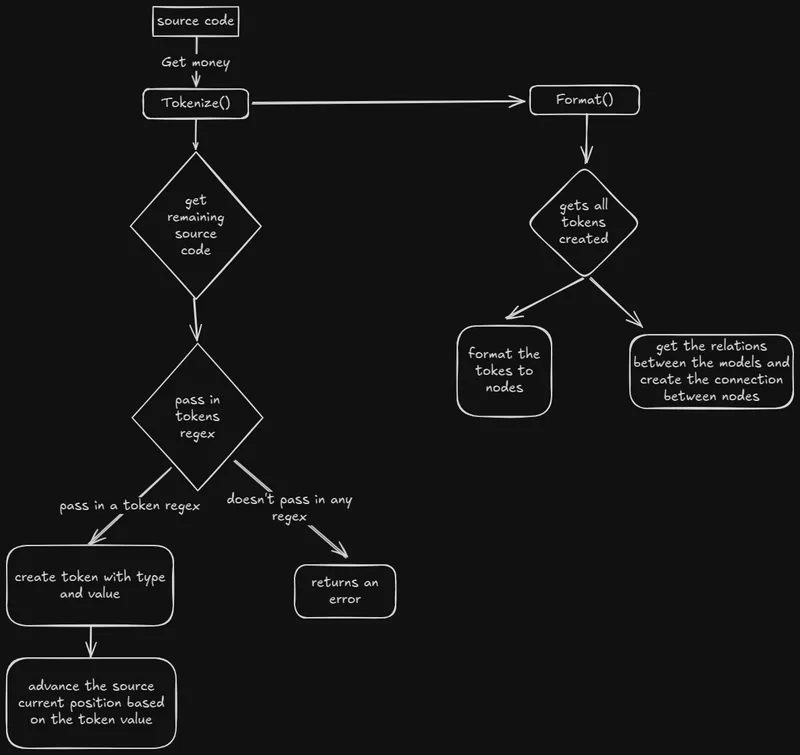
Tokenization concepts also power modern web backend utilities and database schema tooling. Software developer Victor Hugo showed how lexical analysis principles can be built from scratch in Golang to create visual data tools. Hugo wrote an API service in Golang that parses schema files written for Prisma database models, converting relational definitions into structured node objects for visual web diagrams. His scanner tokenizes model declarations into typed components, isolating table identifiers, column attributes, and relational foreign keys before forwarding structured data to a web frontend where an interactive canvas displays connected model nodes. Prisma schema parsing illustrates how tokenization works outside standard programming language compilers [3].
Hugo’s lexer scans input text sequentially while tracking character read positions. When the scanner identifies a word matching model syntax, it packs the data into a struct with type and value fields. The scanner then advances its position index to read the next token. Pointer loops match classic compiler token emission [3].
Formatting completes the scanning cycle. After the Golang service formats model tokens into higher-level objects containing column attributes and relational keys, the backend sends structured JSON node data to the web frontend where the diagram canvas renders visual entity nodes interactively. Victor Hugo’s project demonstrates how custom lexers help developers parse domain schemas for modern applications [3].
Lexical Analysis Versus Probabilistic Tokenizers
Traditional lexical scanners and modern large language models handle text tokens differently based on algorithmic goals. Traditional lexical tokenization relies strictly on a deterministic lexical grammar. Scanners match character sequences against predefined regular expressions to produce symbolic tokens, such as identifiers, keywords, and operators. In contrast, tokenizers in large language models split text using probabilistic subword algorithms. Furthermore, language model tokenizers perform a secondary step that converts subwords into numerical vector indices suitable for neural network embeddings and high-dimensional matrix operations. Traditional lexers pass symbolic structures directly to syntax parsers without converting words into floating-point semantic embeddings [4].
Language structure also influences how tokens map to words. In analytic languages like English, a rule-based NLP token often corresponds to a single dictionary word. For instance, an input sentence about a quick brown fox jumping over a lazy dog contains 43 individual characters that the scanner separates into 9 distinct tokens using space delimiters. In fusional languages, however, single words carry multiple morphemes [4].
Can a regular expression handle every text structure that modern software parses? It cannot. Because regular expressions and finite-state machines lack memory stacks, they cannot count matching parentheses or parse recursive syntax [4]. Modern software systems rely on tokenization as an efficient first-pass filter [1]. By turning unstructured symbol streams into categorized tokens, scanners allow downstream syntax parsers and machine learning models to process structured data reliably across diverse software applications [4].
- WEBSITE PerfectNotes Team, & Dubey, N. (2026, July 22). Lexical Analysis: Tokens, DFA & NFA Explained. PerfectNotes. [Article Link]
- WEBSITE Alzeer, K. (2020, January 1). NLP LinguisticAnalysis Guide. [Article Link]
- ONLINE NEWS Hugo, V. (2025, March 5). Lexical analysis / tokenization. DEV Community. [Article Link]
- WEBSITE Wikipedia contributors. (n.d.). Lexical analysis. Wikipedia, The Free Encyclopedia. [Article Link]


