





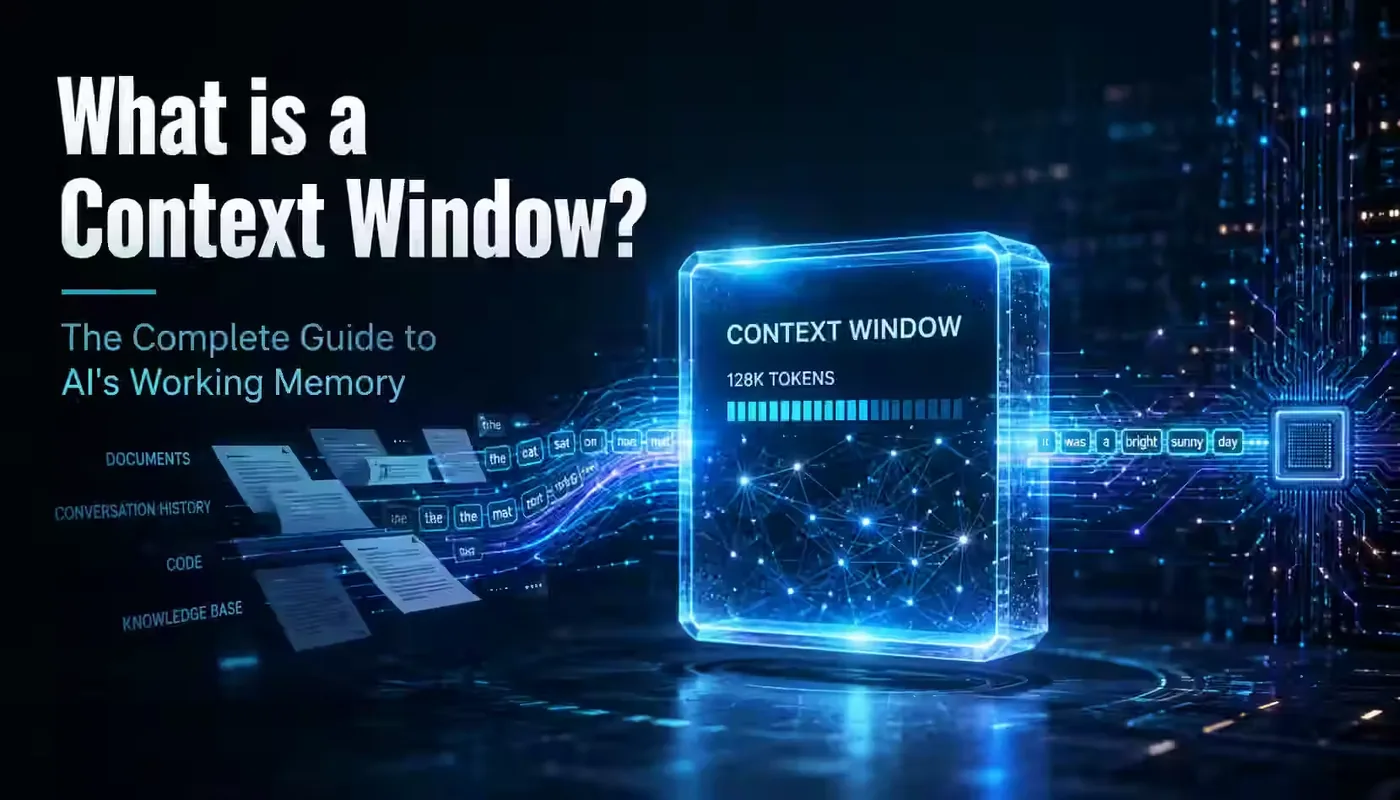
An llm context window sets the total volume of text, counted in discrete tokens, that an artificial intelligence model can hold in working memory during one run, determining how much dialogue history it retains. Models do not store this data on a disk; they clear the workspace after each reply, meaning old text vanishes from active calculation. When an input grows too large, earlier tokens drop from view, leaving the assistant unable to recall earlier rules that governed user interactions at the beginning of the conversation. The token limit governs whether an assistant can read a long contract or forgets its opening guidelines during a work session [1].
Working Memory in Language Models
Dave Bergmann at IBM said a model’s context length acts like human short-term memory, holding facts to answer questions. In operating systems, context refers to interface menus like the Windows 11 context menu, but language models define context strictly as a finite window of numerical tokens that bounds active processing. All data sent to an assistant shares this space [2].
Everything in a request shares this single budget, including system prompts, chat logs, user queries, and external documents retrieved to supply extra facts for retrieval augmented generation pipelines [2]. When an input exceeds this cap, the model cannot read anything beyond the edge. Ashish Dubey at TrueFoundry compared this boundary to an office desk that holds only a set number of paper sheets, meaning that when new pages land on the desk, older sheets fall off and vanish. The system does not slowly forget older facts; it simply cannot see tokens that sit outside its frame. Text pushed off the desk ceases to exist for future turns, meaning the network cannot reference that data again [9].
Stanford HAI researchers said in an AI guide that a chatbot starts hallucinating once prompt volume outgrows context space, leading to incorrect answers when earlier conversation details drop from active memory. For instance, Stanford HAI tracks tools like Noora, a chatbot built to help people with autism practice social skills. If chat history overflows, an assistant forgets prior user constraints. Fixed token limits separate neural models from database software that stores records permanently between sessions [1].
How Tokenizers Process Text Sequences
Instead of reading raw words or letters, neural networks convert text into numerical chunks called tokens, where each token can represent a single punctuation mark, a subword unit, or an entire term [2]. GeeksforGeeks guides show that unhappiness splits into three subwords: un, happi, and ness. This design helps models parse rare words without needing giant dictionaries. Tokens keep vocabulary sizes small [3].
Different models use different tokenization schemes. Classical systems like BERT use WordPiece with 512 tokens, Google’s T5 relies on SentencePiece, and OpenAI models use Byte Pair Encoding to balance vocabulary coverage with compute speed [3]. Developers track token counts with libraries like tiktoken for GPT-4o, or Anthropic client tools for Claude Opus 4 and Claude Sonnet 4, verifying token budgets before sending prompts [7]. Hugging Face also provides a Tokenizer Playground where engineers test how different models segment identical sentences. Punctuation, spaces, and rare character combinations turn into unique token IDs before neural processing starts, giving networks stable numerical inputs [2]. Different tokenizers yield different token totals [7].
English text averages about 0.75 words per token, so a 500-word email uses about 650 tokens, and an 80,000-word book takes roughly 107,000 tokens during automated analysis [4]. Non-Latin scripts face higher token costs. Dave Bergmann at IBM reported that an identical sentence in Telugu required over seven times more tokens than in English, despite having fewer letters, because tokenizers split complex non-Latin scripts less efficiently. Because of this gap, non-English prompts fill context budgets much faster [2].
Attention Layers and Quadratic Scaling
Transformer systems read tokens through self-attention layers. Each token checks similarity scores against all prior tokens in a sequence [2]. Venus Kohli at TechTarget explained that attention heads calculate mathematical weights for neighboring tokens, which helps models link distant ideas without confusing pronouns or grammatical subjects in long passages. Attention weights help models resolve ambiguous terms accurately [5].
Standard self-attention computation scales quadratically with sequence length, meaning that when an engineer doubles a prompt from 2,000 tokens to 4,000 tokens, the graphics processor must perform four times as many calculations to build the attention matrix [2]. When sequence length grows by 10 times, computing demand jumps by 100 times, as reported by Articsledge, which rapidly drains high-bandwidth memory on server clusters during sustained inference runs [4]. As IBM researchers noted, computing costs grow by a factor of four when context length doubles, making long-sequence inference much slower for live chatbots. Memory bandwidth on graphics chips sets hard boundaries on context size [2].

Engineers built new positional encodings so models can track word order across longer sequences without ballooning computing costs. In a study published in Applied Sciences, Li and colleagues showed that segmented base adjustment for rotary position embeddings helps models like Pythia-2.8B retain accuracy across long texts in the Proof-pile dataset. By adjusting embedding bases in individual dimensions, SBA-RoPE preserves local syntax while tracking token order over extended ranges [13].
LLM Context Window Growth Over Time
Early neural systems had modest boundaries. When Google introduced BERT and OpenAI released GPT-1 in 2018, both models supported only 512 tokens. In 2019, GPT-2 doubled that size to 1,024 tokens, and GPT-3 expanded to 2,048 tokens in 2020. When OpenAI debuted ChatGPT with GPT-3.5 in late 2022, its window held 4,096 tokens, which grew to 8,192 tokens in early 2023 with GPT-3.5-Turbo as conversational demand increased [4].
The dimensions of the llm context window expanded swiftly after 2023. OpenAI upgraded GPT-4 to 128,000 tokens, matching a 250-page book. Google DeepMind launched Gemini 1.5 Pro with a context span of 1 million tokens, allowing users to parse roughly 750,000 words in a single query across complex documents. Meta AI released Llama 3.1 with 128,000 tokens, followed by Llama 3.2 at 128,000 tokens and Llama 4 Scout with 10 million tokens running on a single NVIDIA H100 accelerator [4]. Meanwhile, Mistral AI released Mistral Large 2 with 128,000 tokens, and DeepSeek introduced DeepSeek-R1 with 128,000 tokens [2, 3]. Long context turned into a core battleground for AI labs, giving researchers direct access to entire literature archives [4].
Frontier models reached wider limits in 2025 and 2026. Anthropic upgraded Claude Sonnet 4 to 1 million tokens in August 2025, while OpenAI gave GPT-5 a 400,000-token input window and 128,000 output tokens to handle large technical workloads [4]. Magic AI announced an experimental model with a 100-million-token window, equal to roughly 750 novels or 10 million lines of code. These large windows allow systems to inspect codebases without splitting files [6].


The Lost in the Middle Problem
Bigger token allowances do not mean models read all text with equal care. In an unreviewed preprint paper titled Lost in the Middle: How Language Models Use Long Contexts, Liu and colleagues found that models retrieve facts best when target data appears at the beginning or end of an input. When target facts sit in the middle of long prompts, recall degrades sharply. Liu observed this degradation in both multi-document question answering and key-value retrieval benchmarks [10].
Simple search tests often hide comprehension weaknesses. To test deeper reasoning, Hsieh and co-authors built RULER, an unreviewed preprint benchmark testing 17 long-context models on multi-hop tracing and aggregation beyond vanilla needle-in-a-haystack tasks. While all tested models advertised context sizes of 32,000 tokens or more, only half kept good accuracy at 32,000 tokens in RULER. For example, the authors tested models like Yi-34B and observed large drops on multi-step tasks. Raw token capacity does not prove reliable reasoning [11].
Engineers call this drop context rot, where extra text drowns out key signals [8]. Teams address this issue by placing instructions and evidence at the very top or bottom of prompts, ensuring that important rules remain close to the point where text generation begins. Technicians repeat format rules at the end of a prompt to reinforce them right before text generation starts. Prompt design matters as much as window size [7].

Managing LLM Context Window Budgets
Every API call operates under a shared limit that covers both input prompt tokens and generated output tokens. If a developer sends a 120,000-token prompt to an llm context window limited to 128,000 tokens, only 8,000 tokens remain for the model’s answer, risking an abrupt cutoff if output exceeds that margin. If generation exceeds that space, the request stops with an error. Developers use max_tokens settings to protect output room [7].
Multi-modal inputs take up large chunks of context space. Vision encoders convert images into 500 to 2,000 tokens per image, so sending 10 high-resolution images can use 20,000 tokens before prompt text begins, quickly crowding available buffer space. Transcribing a one-hour audio podcast uses roughly 30,000 to 40,000 tokens [7]. Desktop tools that run AI assistants, like setups where the Gemini app for Windows reads screen content, pass interface states into context, which adds to token accumulation during multi-turn workflows. Anthropic docs note that models like Claude Sonnet 4.6 accept up to 600 images or PDF pages in a single 1M-token call [8]. Careful token budgeting prevents failed calls in production, keeping agent loops running smoothly [7].
Models like Claude Sonnet 5 and Claude Haiku 4.5 include built-in context awareness, tracking remaining capacity with tags like <budget:token_budget>. For long conversations, developers use server-side compaction to summarize older messages into compact summaries. Compaction preserves key facts while freeing token space for new questions. This setup keeps multi-day assistant chats stable [8].
Inference Costs and Latency Tradeoffs
Large prompts cost money because AI providers bill per token for input and output. Articsledge pricing data shows OpenAI charges $30 per million input tokens and $60 per million output tokens for GPT-5. Anthropic lists Claude Sonnet 4.5 at $3 for input and $15 for output per million tokens, while Claude Opus 4.1 costs $15 for input and $75 for output across standard API endpoints. Providers host Llama 3.1 at $0.60 for input and $0.90 for output per million tokens. Large context calls add up fast [4].
When teams analyze big documents repeatedly, API fees can burn budgets without careful planning. A review of a 500-page corporate contract containing 650,000 tokens costs about $2.03 on Claude Sonnet 4, which grows to thousands of dollars across full portfolio audits [4]. Software makers also limit AI load by making features optional, as when Microsoft made Copilot optional in Windows 11 search controls. Long prompts demand serious server power and electricity [5].
Engineers use prompt caching to cut bills on repetitive prompts. Both OpenAI and Anthropic store computed key-value pairs for up to five minutes, discounting cached tokens by up to 90 percent [4, 7]. Cached system prompts or code files cut latency and lower token bills [7]. TrueFoundry AI Gateway provides routing and observability to track token costs across models in production [9].
Real-World LLM Context Window Benchmarks
Model cards often boast big numbers, but real performance can fall short. In a 2026 study published in Advances in Artificial Intelligence and Machine Learning, researcher Paulsen tested differences between maximum context windows and maximum effective context windows across hundreds of thousands of test cases. Paulsen reported that several models failed with as few as 100 tokens, and most suffered severe accuracy drops by 1,000 tokens. Effective capacity often falls far below advertised numbers [12].
Big windows also bring security risks. Anthropic reported in an April 2024 paper that larger context windows increase vulnerability to many-shot jailbreaking, as attackers embed numerous adversarial examples to bypass model safety rules [2]. But large windows also unlock unique results. Google DeepMind showed that Gemini 1.5 Pro could translate Kalamang—a language with fewer than 200 speakers—using a single grammar book in context without any prior training on that tongue. Long context solves tasks that training data missed [6].
A successful deployment of an llm context window depends on curating what goes into prompts [8]. Teams combine retrieval tools, sliding windows, and caching to get high accuracy without giant bills [7]. TrueFoundry, IBM, and Anthropic recommend testing effective recall before sending massive prompts to production models [8, 9]. Quality context matters more than raw token volume [7].
- WEBSITE Stanford Institute for Human-Centered Artificial Intelligence. (2026). What is a Context Window?. Stanford HAI AI Definitions. [Article Link]
- WEBSITE Bergmann, D. (2024). What is a context window?. IBM Think. [Article Link]
- WEBSITE GeeksforGeeks. (2025). Tokens and Context Windows in LLMs. GeeksforGeeks Computer Science Portal. [Article Link]
- WEBSITE Articsledge. (2026). What is a Context Window? AI Memory Explained (Complete Guide). Articsledge Technology Guides. [Article Link]
- WEBSITE Kohli, V. (2023). Context window. TechTarget Enterprise AI. [Article Link]
- WEBSITE Coursera Staff. (2025). What Is an AI Context Window?. Coursera Articles. [Article Link]
- WEBSITE Mljourney. (2026). LLM Context Window Explained: Tokens, Limits, and How to Work Within Them. ML Journey. [Article Link]
- WEBSITE Anthropic. (2025). Context windows. Claude Platform Documentation. [Article Link]
- WEBSITE Dubey, A. (2026). What Is a Context Window and How Does It Work?. TrueFoundry Glossary. [Article Link]
- PREPRINT Liu, N. F., Lin, K., Hewitt, J., Paranjape, A., Bevilacqua, M., Petroni, F., & Liang, P. (2023). Lost in the Middle: How Language Models Use Long Contexts. arXiv. [Article Link]
- PREPRINT Hsieh, C., Sun, S., Kriman, S., Acharya, S., Rekesh, D., Jia, F., Zhang, Y., & Ginsburg, B. (2024). RULER: What’s the Real Context Size of Your Long-Context Language Models?. arXiv. [Article Link]
- ACADEMIC JOURNAL Paulsen, N. (2026). Context Is What You Need: The Maximum Effective Context Window for Real World Limits of LLMs. Advances in Artificial Intelligence and Machine Learning, 6(1), 1-26. [Article Link]
- ACADEMIC JOURNAL Li, R., Xu, J., Cao, Z., Zheng, H., & Kim, H. (2024). Extending Context Window in Large Language Models with Segmented Base Adjustment for Rotary Position Embeddings. Applied Sciences, 14(7), 3076. [Article Link]


