





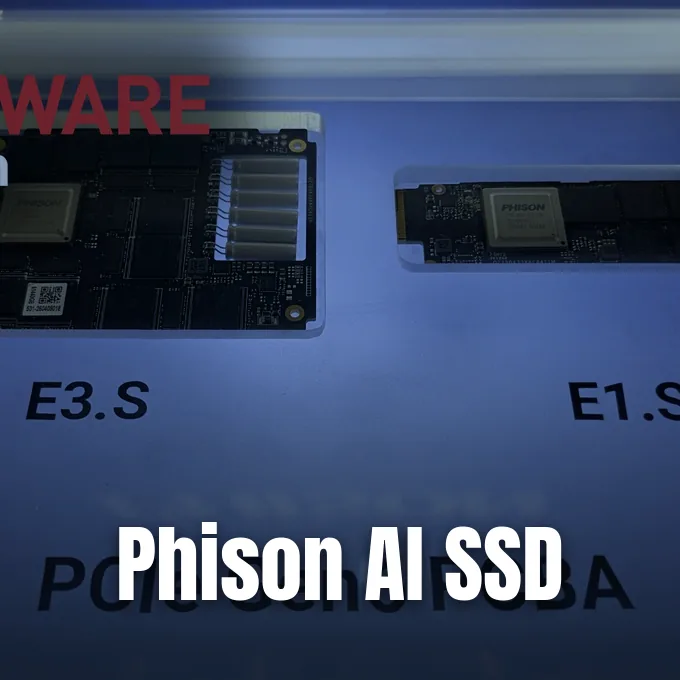
Taiwanese controller maker Phison detailed an on-drive computing design featuring an integrated neural processing unit and 64GB of high-speed memory at the Supercomputing 2026 conference in Chicago. The Phison AI SSD runs machine learning jobs right where files live, scanning and trimming raw datasets before passing results to host CPUs [1, 2]. “The next era of computing won’t be defined by processing power alone, but by how efficiently we can move, process and store the data that fuels it,” said Michael Wu, president of Phison US [2].
How the Phison AI SSD Is Built
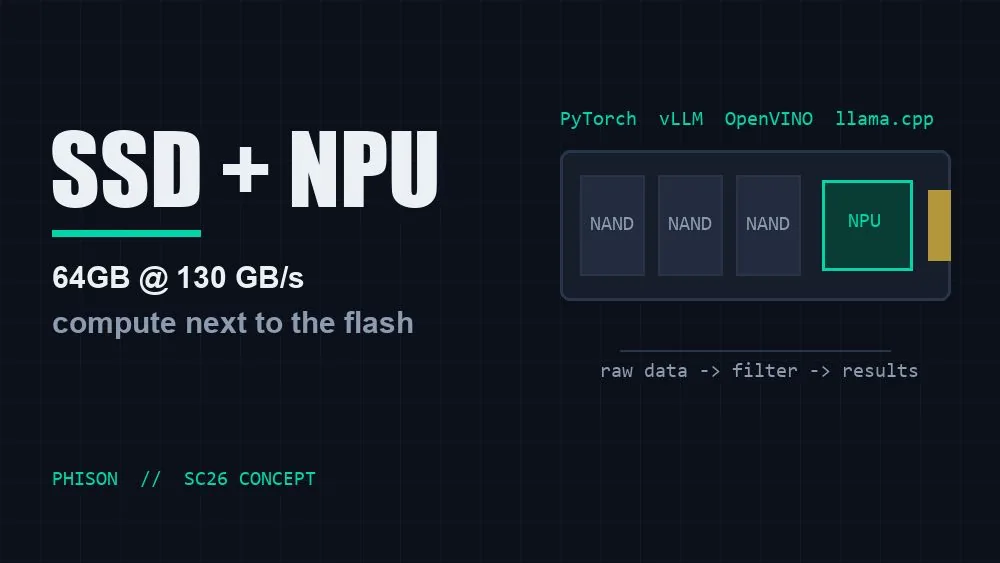
The Phison AI SSD pairs NAND flash with an NPU and 64GB of onboard memory running at 130 GB/s [1, 2]. Hardware Busters reported that the design puts memory right next to the NAND flash to run inference tasks where data lives [2]. That link is slower than the memory on Nvidia DGX Spark, but it delivers more than four times the transfer speed of a standard PCIe 6.0 interface [1].
Phison rates the NPU at 36,800 DMIPS (Dhrystone Million Instructions Per Second), an old integer test from the 1980s instead of a TOPS figure [1, 2]. The score likely reflects companion Arm Cortex CPU cores tasked with drive logic rather than the AI engine itself. At Computex, Phison showed its Topaz card carrying eight NPUs rated at 40 TOPS each, but this drive uses a different setup [1].
Engineers built the drive to run search tasks and machine learning jobs without hauling terabytes over PCIe lines, letting it scan contents in parallel and return only relevant rows. Phison hasn’t named the controller silicon or host link [1, 2]. The firm said that “many of the products and features mentioned are still in development” and will arrive as teams finalize the silicon [1]. Putting compute beside NAND flash helps cut bus traffic jams [2]. It lets data centers filter big queries before bytes reach system RAM. Phison hasn’t named the memory type, though reports link LPDDR5X to its earlier hardware [1].
On-Drive Framework Support
Software flexibility marks the biggest change from older smart storage drives that stalled in labs. Previous computational storage products leaned on vendor-specific APIs and custom SDK tools, creating high setup walls for developers. This drive supports standard tools including PyTorch, vLLM, OpenVINO, and llama.cpp straight out of the box [1, 2]. Phison said developers can build pipelines “without specialized programming tools” [1].
Parallel scanning lets the drive rip through unstructured files and return small answers instead of full tables. Phison claims this sorting cuts host data transfers by 10 to 100 times for suitable workloads, freeing host CPU cycles for other tasks [1, 2]. The 100x figure led headlines, but Hardware Busters noted the 10 to 100 range better reflects real storage variability. String searches see huge cuts, while complex math yields smaller gains [2].
Key details about host communication remain secret. Phison hasn’t shared driver stacks, command sets, or whether host systems see the NPU as an NVMe device or a PCIe accelerator [1, 2]. The drive won’t replace a discrete server GPU for big training runs. Instead, it tackles fast data reduction right beside flash cells [2].

Why the Phison AI SSD Matters
Putting compute on storage isn’t a new concept, but earlier designs tripped over custom software hurdles. In 2018, Samsung launched its SmartSSD with an onboard FPGA, updating it in 2022 with an AMD Xilinx Versal FPGA. Samsung reported broad performance gains across database tasks, stating its drive cut execution times by over half, slashed power use by up to 70%, and eliminated as much as 97% of server CPU overhead on scan queries. Yet buyers had to write custom FPGA bitstreams for each workload. The drive later disappeared from Samsung’s active lineup [1].
ScaleFlux took a narrower route. It embedded compression logic into SSD controllers so servers see standard NVMe drives without code updates, reaching production volume at hyperscalers. Writing in All About Circuits in 2025, Phison CTO Sebastien Jean said past efforts stalled because “each use case is highly unique and it’s simply not scalable”. Jean called running full Linux on storage a “pie-in-the-sky approach” [1].
Jean calculated that a server rack with 90 PCIe 6.0 SSDs could chew through stored data at 2.5 TB/s without slowing host CPUs. Standard server setups move every read over PCIe buses, following principles explained in technical guides detailing how silicon and platters store data in enterprise storage tiers. The Phison AI SSD reflects this targeted approach by running common neural frameworks instead of full operating systems, balancing speed with simple software setup [1].
Mixed Media Flash Design
Phison also revealed a second storage architecture at SC26 named the Phison Mixed Media SSD. This design combines fast pSLC cache flash and roomy QLC NAND behind a single 16-channel controller, using standard NVMe setups without special host software [1, 2].
The pSLC tier runs 4-bit QLC cells in 1-bit mode, trading raw storage room for high write endurance and speed. At an SC26 panel, Jean said the drive manages SLC endurance blocks separately from QLC capacity by placing each tier in its own NVMe namespace. Operating systems send heavy write streams to SLC blocks while keeping read-heavy files in QLC areas. In a 24-drive server using four separate cache SSDs, losing one cache drive kills 25% of cache capacity. Phison said spreading cache across every drive cuts failure losses to just 4% [1, 2].

Competitors have tested similar split tiers. Kioxia showed a Mixed Mode idea at FMS 2025 with a 1:4 pSLC-to-QLC ratio, noting clients want 0.5% to 2% pSLC with parity protection between drives. DapuStor validated its dual-mode J5060 QLC drive with up to 1.2TB of pSLC room, while Solidigm uses a host translation layer called CSAL to manage sequential writes. Enmotus showed its FuzeDrive P200 consumer SSD at CES 2020 using Phison silicon, marking an early step toward mixed storage [1].
Future Controller Roadmaps
Phison paired its prototypes with updates on its upcoming X3 enterprise controller, also known as the PS5303. Built for PCIe 6.0 x4 and NVMe 2.3, the X3 Gen6 controller hits 28 GB/s in sequential reads and reaches 6.8 million IOPS, delivering close to double what today’s Gen5 drives offer [1, 2]. Phison also pointed to its PS7161, the first PCIe 6.0 redriver on the PCI-SIG Integrators List [2]. Storage makers Micron and Samsung already sell PCIe 6.0 drives, while Marvell prepares its Bravera SC6 chip [1].
Future targets push speeds much higher. Nvidia set a goal of 100 million IOPS for PCIe 7.0 using 512-byte reads instead of 4KB blocks. Jean said Phison is “very optimistic” about reaching that speed, but warned that smaller blocks on current NAND take “eight times as much power,” pushing drive draws into the 140 to 180 watt range. Jean added that PCIe 7.0 drives could hit “50, 56 gigabytes per second,” letting a 32-drive chassis reach 1.8 TB/s for supercomputing tasks [1].
Phison gave no launch dates. The company hasn’t named prices or sampling windows for either the AI SSD or the Mixed Media design [1, 2]. Both remain testbeds showing how memory and controllers can evolve to handle big AI datasets [1]. Whether these drives leave demo booths and win server racks will depend on data center trials in 2027 [2].
- ONLINE NEWS Downing, S. (2026, November 20). Phison details SSD with a built-in NPU and 64GB of memory that supports AI frameworks on the drive. Tom’s Hardware. [Article Link]
- ONLINE NEWS Crmaris. (2026, November 21). Phison’s Computational SSD Puts an NPU and 64GB of Memory Right Next to the NAND. Hardware Busters. [Article Link]


