





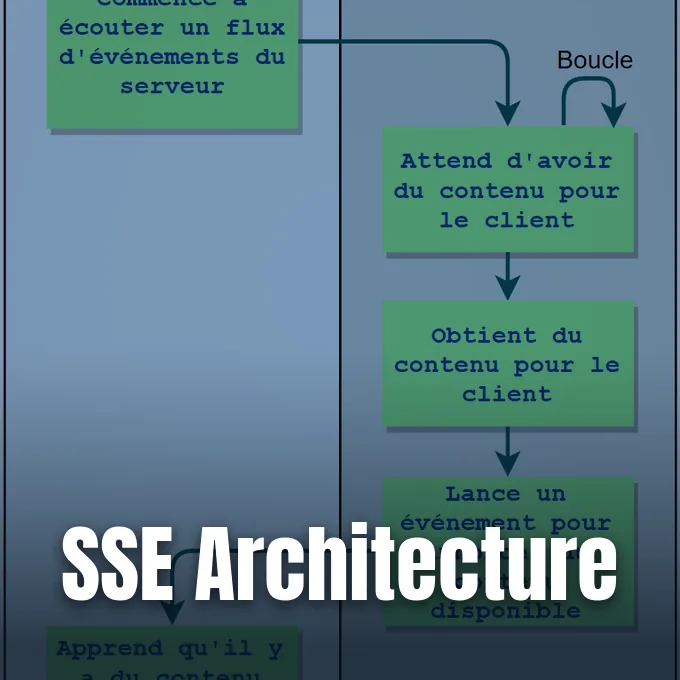
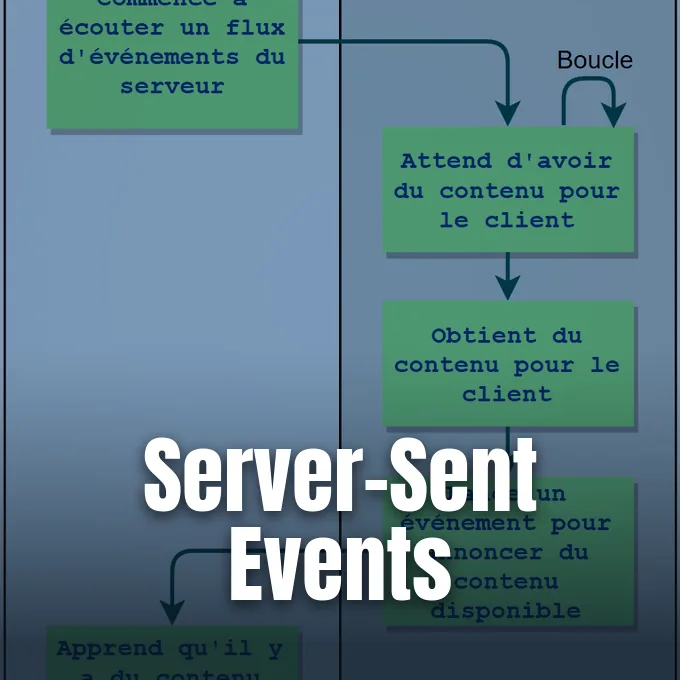
The server-sent events architecture defines a persistent one-way pipeline that lets an HTTP server push live text updates to client browsers over standard web connections without repetitive client requests. Early web tools relied on wasteful poll cycles. In contrast, this model keeps a single channel open so the backend can send structured records as events unfold. Browsers listen for incoming data without extra background daemons. Because client apps only need to process incoming messages, this model simplifies data delivery for operational dashboards, continuous sensor feeds, and live news updates across diverse networked environments [10].
- Server-Sent Events Architecture in Modern Browsers
- How HTTP Streaming Replaced Early Web Polling
- EventSource API for Client Link Management
- Plain Text Formatting in SSE Architecture
- Browser Socket Limits Across Multiple Tabs
- How Server-Sent Events Architecture Scales in Distributed Systems
- When to Choose SSE Over Full-Duplex WebSockets
- State Recovery for Resilient Real-Time Applications
Server-Sent Events Architecture in Modern Browsers
At the core of this design is the text/event-stream media type. Once a browser opens a link, the channel stays active for future messages. Servers push text blocks at will. Native browser tools parse incoming payloads without custom binary wrappers. Client scripts register simple event callbacks to handle incoming updates as they arrive from the remote host, processing structured payloads without installing custom background daemons or extra binary framing layers [10].
The formal standardization of this streaming mechanism began when Ian Hickson introduced the concept within the WHATWG Web Applications 1.0 proposal in 2004. The Opera web browser team implemented an early experimental version called Server-Sent Events in September 2006 to prove that web clients could receive server pushes without third-party browser plug-ins. The World Wide Web Consortium advanced the specification through successive drafts until publishing Server-Sent Events as an official recommendation on February 3, 2015. W3C maintained an open text format so that intermediate proxies, corporate firewalls, and logging systems could inspect message traffic without relying on specialized decompression filters or proprietary decoders [10]. Transparent wire formatting helped the technology spread across modern web platforms.
Backends handling high-frequency data streams must manage backpressure to avoid flooding slow browser clients with dense event bursts that can overwhelm client-side JavaScript execution queues. Web apps use client buffering and event batching to merge multiple records into single transmissions. Adaptive rate controls stabilize client memory under heavy load. Browsers retain smooth user interfaces while receiving rapid data from the network [10].
How HTTP Streaming Replaced Early Web Polling
Why did web teams seek alternatives to early AJAX polling? Standard polling forced client browsers to send repeated HTTP requests at fixed intervals, asking the server if fresh data was ready, which generated empty responses whenever backend variables remained unchanged [7]. Most requests returned empty payloads. Every idle poll consumed CPU cycles and server bandwidth without adding value. Unnecessary network traffic strained server capacity during peak usage hours.
To limit the waste of short polling, web engineers developed long polling workflows commonly known as Comet or a hanging GET. In this pattern, the server accepts an incoming client request and holds the TCP socket open until fresh data arrives. Once information is ready, the server transmits its response and closes the socket, forcing the browser to open a new request immediately to wait for subsequent data. Eric Bidelman noted on web.dev that developers often relied on clumsy hacks, such as appending script tags to hidden iframes, to keep streaming channels active without standard browser support [7].
Server-sent events solved these transport flaws by keeping a single HTTP link open for steady updates. The channel stays open after each payload. The browser manages reconnections natively and sends a special Last-Event-ID header after network drops, allowing web servers to resume message delivery without dropping state or repeating previously seen records [7]. Web coders write simple event listeners instead of coordinating fragile polling loops.
EventSource API for Client Link Management
On the frontend, client scripts interact with streaming servers through the native EventSource API. A browser opens a link by passing a target URL to the constructor. Earlier research on server-sent events delivering real-time browser updates outlines how client listeners process incoming text channels, illustrating how event callbacks dispatch structured payloads into user interfaces. Developers listen for default message events or register listeners for custom event types.
The EventSource interface inherits directly from EventTarget and exposes three distinct connection states through its read-only readyState property, representing CONNECTING as zero, OPEN as one, and CLOSED as two. A successful HTTP handshake updates the status code to one, signifying an OPEN channel ready to process incoming event payloads. If network trouble occurs or client code calls the close method, the status updates to two for CLOSED. MDN Web Docs explains that developers can bind custom callbacks to open and error events to track connection health dynamically during application execution without building custom socket monitors [9].
Security rules apply to streaming endpoints just like standard fetch calls. EventSource requests follow same-origin rules, requiring Cross-Origin Resource Sharing headers for remote hosts, while developers set the withCredentials flag to true to send cross-origin cookies and authentication credentials [9]. The interface also runs smoothly inside Web Workers without stalling main thread UI rendering.
Plain Text Formatting in SSE Architecture
The wire format used by server-sent events relies on plain text encoded with UTF-8. Servers package messages into discrete text blocks separated by pairs of newline characters. Lines starting with a colon act as keep-alive comments. These heartbeat pings stop network proxies and routers from dropping idle client connections [8].
Each message block contains specific field names followed by a colon and text values, supporting event, data, id, and retry lines. When a message contains multiple consecutive data lines, the browser parser concatenates them with newline characters before firing the event callback, allowing backends to stream multi-line JSON objects without syntax corruption. MDN Web Docs notes that backends can also define custom event names, directing the browser to fire specific named event listeners rather than generic message handlers across the client application [8]. A single streaming channel can deliver administrative alerts, user notifications, and telemetry updates in parallel.
Native error recovery is a key strength of this wire format. When a channel drops, the browser waits three seconds before reconnecting. Servers alter this pause by sending a retry field with a millisecond count, like 10000 for ten seconds. The browser transmits its last event ID upon reconnecting to resume the stream [7].

Browser Socket Limits Across Multiple Tabs
Vendor support for the EventSource interface is solid across modern desktop and mobile operating systems. Compatibility tables on Can I use show that Google Chrome added support in version 6, Mozilla Firefox in version 6, Apple Safari in version 5, and Opera in version 11.5 [6]. Microsoft Edge adopted native support with its Chromium overhaul in version 79, while Android Browser 4.4 followed early on.
Desktop browsers enforce a strict limit of six connections per host domain, meaning multiple open tabs pointing to one web app can rapidly exhaust available sockets when running over legacy HTTP/1.1 infrastructure. If a user opens seven browser tabs connected to an HTTP/1.1 stream, the seventh tab hangs indefinitely because earlier tabs hold all available channels. Both Google Chrome and Mozilla Firefox marked this socket limitation as permanent for HTTP/1.1. In contrast, modern deployments over HTTP/2 resolve this issue by multiplexing streams over a single TCP socket, supporting up to 100 concurrent streams by default without exhausting client browser sockets [8].
Proxy servers and reverse caches can block live data delivery if configured without streaming settings. Web servers like NGINX buffer incoming responses before sending chunks to clients. Backends prevent this delay by sending an X-Accel-Buffering header set to no alongside no-cache directives. Developers flush server output buffers after each event to prevent unwanted queue delays [8].
How Server-Sent Events Architecture Scales in Distributed Systems
Beyond web clients, modern distributed backends use this streaming model for live notifications. S. Vinoski showed in IEEE Internet Computing how the Yaws web server, built in Erlang, manages massive subscriber loads for social feeds and server alerts across concurrent network clients [1]. Erlang handles lightweight processes with tiny memory footprints. Yaws keeps thousands of concurrent event channels open without crashing host operating system thread pools.
In a 2024 smart agriculture study published in Scientific African, A. Morchid, B. Et-taibi, Z. Oughannou, and R. E. Alami used SSE to track soil moisture and weather conditions for irrigation management in Africa. The engineering team paired an ESP32 microcontroller with DHT22 temperature and humidity sensors to stream live climate metrics to base stations, pushing updates only when environmental variables crossed critical operational thresholds [2]. Event-driven streaming lowered power draw on remote embedded hardware while helping local growers maintain stable crop yields.
In IFAC-PapersOnLine, L. de la Torre, J. Chacón, D. Chaos, S. Dormido, and J. Sánchez assigned the server role to a plant and the client role to a controller for event-based automation. Physical hardware pushes alerts only when process variables shift past deadband thresholds. Network traffic fell while feedback loops remained stable [3].
When to Choose SSE Over Full-Duplex WebSockets
System designers compare server-sent events and WebSockets by evaluating whether a system needs two-way communication or simple one-way streaming. Developers who configure downstream alerts often examine how webhooks work to stream real-time application events between decoupled services. When a browser only needs stock prices, sports scores, or continuous log feeds, one-way channels avoid extra operational complexity. Upstream client requests travel through standard HTTP POST calls.
WebSockets shine in fast multiplayer gaming, shared drawing apps, and interactive chat where rapid two-way data exchange is mandatory. The WebSocket standard opens a full-duplex TCP link that bypasses standard HTTP semantics after an initial protocol upgrade. Server-sent events run over normal HTTP ports, pass through corporate firewalls without special firewall rules, and work seamlessly with existing load balancers that already handle standard web traffic. WebSockets also lack native reconnection logic, forcing developers to build custom heartbeat checks, exponential backoff timers, and reconnection handlers manually from scratch inside client scripts [7].
Should engineering teams always default to full-duplex sockets? Teams reduce maintenance overhead by choosing server-sent events whenever data flow runs primarily from server to client. Coders gain automatic reconnection, message routing, and event identification without adding heavy third-party client libraries. Teams pair an EventSource stream with standard fetch calls to create a clean architecture with fewer moving parts [7].
State Recovery for Resilient Real-Time Applications
Modern web platforms require fault tolerance so brief network dropouts do not damage application state. In a 2026 study in Applied Sciences, R. Katagiri, T. Sone, S. Aihara, and T. Kawamura built an extensible Digital Curling research platform using REST APIs and server-sent events architecture. The system paired stateless server workers with database-backed state persistence to preserve match history. In a 24-hour benchmark, the platform recovered from all 290 timeout-induced communication failures with 100% reconnection success and a mean recovery time of about one second across all active matches. During a 50-trial server restart evaluation, every match resumed with full state consistency, and the platform completed 60 hours of continuous operation at Expo 2025 Osaka, Kansai without system failures [4].
Mobile enterprise apps also rely on predictable state recovery during cellular handoffs. In the Journal of Computational Analysis and Applications, S. K. Penchala analyzed server-sent events architecture for secure IoT device connectivity on iOS, finding that one-way channels reduced mobile battery consumption. Event IDs allowed handheld devices to resume data feeds reliably after dropouts [5].
Scaling tests on the Digital Curling platform proved the efficiency of this streaming approach under heavy load. The platform achieved near-linear scaling, reaching 1.97 times throughput across two server workers under concurrent traffic. Because individual event streams consume minimal memory, development teams can support thousands of connected users per node. Automated client reconnects paired with lightweight state persistence make the technology a durable choice for long-term web deployments [4].
- ACADEMIC JOURNAL Vinoski, S. (2012). Server-Sent Events with Yaws. IEEE Internet Computing, 16(5), 98-102. [Article Link]
- ACADEMIC JOURNAL Morchid, A., Et-taibi, B., Oughannou, Z., Alami, R. E., Qjidaa, H., Jamil, M. O., Boufounas, E., & Abid, M. R. (2024). IoT-enabled smart agriculture for improving water management: A smart irrigation control using embedded systems and Server-Sent Events. Scientific African, 27, e02527. [Article Link]
- ACADEMIC JOURNAL Torre, L. d. l., Chacón, J., Chaos, D., Dormido, S., & Sánchez, J. (2019). Using Server-Sent Events for Event-Based Control in Networked Control Systems. IFAC-PapersOnLine, 52(9), 260-265. [Article Link]
- ACADEMIC JOURNAL Katagiri, R., Sone, T., Aihara, S., & Kawamura, T. (2026). A Resilient and Extensible Digital Curling Platform Using Server-Sent Events and REST APIs. Applied Sciences, 16(14), 6886. [Article Link]
- ACADEMIC JOURNAL Penchala, S. K. (2025). Leveraging Server-Sent Events Architecture for Secure IoT Device Connectivity: An Enterprise-Grade Approach with iOS Platform Integration. Journal of Computational Analysis and Applications, 34(12). [Article Link]
- WEBSITE Can I use. (2026). Server-sent events browser support tables. [Article Link]
- WEBSITE Bidelman, E. (2010). Stream updates with server-sent events. web.dev. [Article Link]
- WEBSITE MDN Web Docs. (2026). Using server-sent events. [Article Link]
- WEBSITE MDN Web Docs. (2025). EventSource. [Article Link]
- WEBSITE Wikipedia. (n.d.). Server-sent events. [Article Link]
Cover image: Mrharispe / Wikimedia Commons, CC BY-SA 4.0


