




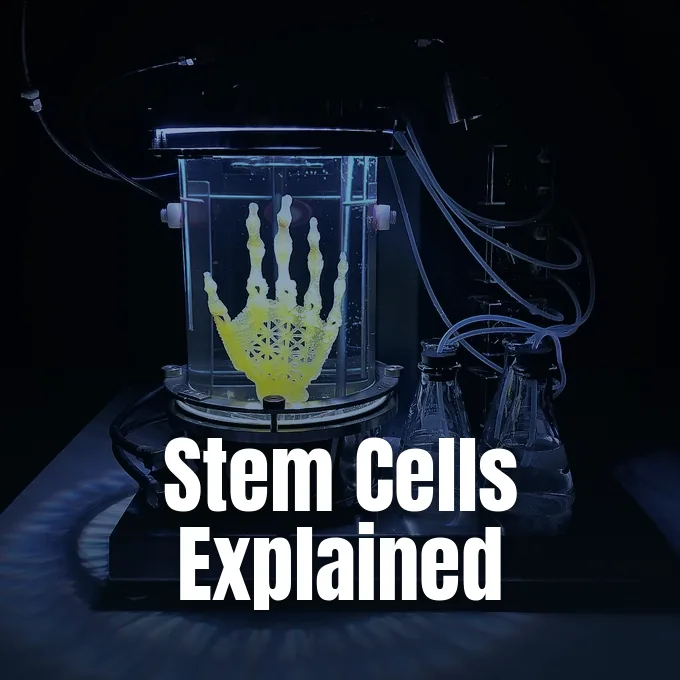
What are stem cells and why do they hold such value in modern biology? In simple terms, these unspecialized cells can renew themselves through repeated cell division and mature into functional cells that build bodily tissue. While most cells in the human body carry out set jobs within organs, stem cells preserve developmental potential and act as an internal repair system. Canadian researchers first proved these dual properties in bone marrow during the 1960s, showing that unspecialized cells can rebuild damaged blood networks [2].
What Are Stem Cells?
Biologists Theodor Boveri and Valentin Haecker coined the phrase stem cell in the late nineteenth century to describe ancestral cells that give rise to distinct lineages. Decades later, Canadian scientists Ernest McCulloch and James Till at the University of Toronto gave the concept a rigorous experimental foundation. Working at the Ontario Cancer Institute in the early 1960s, McCulloch and Till injected bone marrow cells into irradiated mice and observed visible nodules forming in their spleens. Joined by Andrew J. Becker and senior researcher Louis Siminovitch, the Toronto team proved in Nature in 1963 that each nodule arose from a single self-renewing blood stem cell capable of generating all blood types, confirming that unspecialized cells can rebuild tissue systems [1].
To meet the biological definition of a stem cell, a cell must possess self-renewal and differentiation potency. Self-renewal lets the cell divide through asymmetric division, producing one identical stem cell and one daughter cell committed to maturing into a specific tissue. These dividing cells rely on telomerase, a protein that restores chromosome ends and extends division counts beyond the normal Hayflick limit. Without that protective action, dividing lines would quickly wear down their chromosome ends and stop reproducing [2].
Adult tissues keep small reservoirs of these cells inside local microenvironments called niches. Unlike transient progenitor cells that can divide only a set number of times, true stem cells keep long-term proliferative potential. They remain quiet until injury calls them to replenish lost blood, skin, or gut lining. Progenitor cells outnumber them in daily maintenance [2].

Degrees of Developmental Potency
Potency measures the range of differentiated cell types that a given stem cell can generate when guided by developmental cues. At the very summit stands the fertilized egg or totipotent zygote, which holds the unique capacity to divide and construct a complete, viable organism. During the first week of mammalian development, the dividing embryo forms a hollow sphere called the blastocyst that contains between 50 and 150 cells, or about 300 cells in some species. This early structure splits into two separate parts: an outer layer called the trophoblast that produces supporting placental tissues, and an inner cell mass (ICM) that forms the entire embryo proper [1].
Cells inside the inner cell mass are pluripotent embryonic stem cells that can turn into nearly every cell type in the adult body. During gastrulation, these cells separate into three primary germ layers known as ectoderm, mesoderm, and endoderm. The ectoderm forms skin and nerves, the mesoderm builds bone and muscle, and the endoderm lines internal organs. They can produce more than 200 distinct mature cell varieties but can’t form extra-embryonic tissues like the placenta [2].
As organs form, developmental potency narrows into multipotent and unipotent adult forms. Multipotent cells produce several related cell types within a single family, such as blood progenitors that generate red cells, white cells, and platelets. In contrast, unipotent satellite cells in muscle tissue generate only muscle fibers, yet they still retain the defining capacity for self-renewal [1].
Early Embryos and Adult Niches
In 1981, British biologists Martin Evans and Matthew Kaufman isolated and cultured embryonic stem cells from mouse blastocysts. This laboratory method let researchers delete or alter target genes within cultured cells before placing them back into growing embryos. The resulting murine genetic models let medical researchers study how specific mutations disrupt human health [1].
Seventeen years later in 1998, American biologist James Thomson succeeded in deriving the first human embryonic stem cell lines from donated blastocysts. His work offered a source of human cells for drug testing and disease research, but it ignited debate because harvesting inner cell mass cells destroyed the early embryo. Several nations supported derivation under strict rules, while others prohibited public funding for any research using newly created embryonic lines [1].

United States policy shifted on March 9, 2009, when President Barack Obama signed Executive Order 13505 at the White House. The presidential directive lifted constraints on federal support for human embryonic stem cell research that had been established on August 9, 2001, explicitly revoking Executive Order 13435 from June 20, 2007. Under Section 3 of the order, the Secretary of Health and Human Services and the Director of the National Institutes of Health received 120 days to review existing guidelines and issue updated guidance establishing ethical safeguards for federally backed studies. The decision allowed American laboratories to use public grants to investigate approved human embryonic stem cell lines as well as adult tissue sources [12].
Reprogramming Cells with Genetic Factors
For decades, biologists believed that once a cell matured into a specialized tissue, its internal genetic programming was fixed forever. British researcher Sir John Gurdon challenged that view in the early 1960s by transplanting the nucleus of a differentiated frog intestinal cell into an unfertilized egg that had its own nucleus removed. When that reconstructed egg developed into a healthy adult frog, Gurdon proved that mature cells keep the full genetic instructions to build an entire body [1].
In 2006, Japanese stem cell scientist Shinya Yamanaka and his research team at Kyoto University achieved an equivalent reprogramming feat using mammalian skin cells without needing eggs. By altering the expression of just four transcription factors in adult mouse fibroblasts, the Kyoto team returned specialized skin cells to an embryonic-like pluripotent state. Yamanaka termed these reprogrammed units induced pluripotent stem cells (iPS cells). This discovery provided a way to generate patient-matched pluripotent cells without destroying embryos, leading Yamanaka and Gurdon to share the Nobel Prize in Physiology or Medicine in 2012, only six years after Yamanaka’s initial publication in the journal Cell [1].
Biologist Rudolf Jaenisch proved the therapeutic value of reprogrammed cells in living animals. His team took tail cells from mice with sickle cell anemia, converted them into iPS cells, corrected the gene defect, and turned them into healthy blood precursors. When transplanted back into the sick mice, the corrected cells resolved the disease without triggering immune rejection [1].

Approved Uses of Blood Stem Cells
The earliest clinical stem cell therapy occurred in 1958 when French oncologist Georges Mathé performed bone marrow infusions on five Yugoslavian nuclear workers exposed to lethal radiation at the Vinča Nuclear Institute. The transplanted marrow restored their collapsed blood systems, and all five workers survived. Today, hematopoietic stem cell transplantation serves as standard medical care for blood cancers like leukemia, lymphoma, and multiple myeloma, as well as blood disorders like aplastic anemia and sickle cell disease. Doctors also use transplants to treat select solid pediatric tumors, including neuroblastoma and Ewing sarcoma, when intensive chemotherapy wipes out the child’s bone marrow [4].
In most cancer applications, the transplant does not attack malignant tissue directly. Instead, it rescues the body after intensive chemotherapy and radiation destroy both tumor cells and healthy bone marrow. Once infused into a vein, blood stem cells travel through the circulation to marrow cavities, where they restart production of red cells, white cells, and platelets. In leukemia patients, donor white blood cells can also trigger a beneficial graft-versus-leukemia effect that attacks lingering cancer cells [4].
Clinicians classify transplants into three distinct categories based on donor origin. An autologous transplant returns the patient’s own stored cells, an allogeneic transplant uses cells from another matched person, and a syngeneic procedure uses cells from an identical twin. Transplants draw blood-forming cells from three anatomical sources: marrow aspirates, circulating peripheral blood, and banked umbilical cord blood [4].

How Bone Marrow Donors Are Matched
Allogeneic transplants require close immune compatibility between donor and recipient to prevent life-threatening rejection. Technicians examine blood samples for human leukocyte antigens (HLAs), which are specialized surface proteins that train immune cells to differentiate self from foreign tissue. Because full siblings inherit genetic markers from the same parents, a brother or sister represents the best chance of finding an HLA match. Even so, only about 30 percent of patients find a suitable donor inside their family, leaving the remaining 70 percent reliant on volunteer databases like the National Marrow Donor Program (NMDP) to locate an unrelated match [3].
Healthy volunteers between ages 18 and 60 can join registries through an online signup or local drive, submitting a cheek swab or small blood sample. Most modern stem cell donations occur through peripheral blood collection rather than surgery. Donors receive five days of daily injections to move stem cells from bone marrow into circulating blood. During leukapheresis, blood passes through an apheresis machine that separates out white blood cells containing stem cells and returns red cells into the donor’s other arm [3].
Surgical bone marrow harvests take liquid marrow from pelvic bones under general anesthesia. The hospital procedure lasts about an hour and causes temporary lower back bruising, with the body replenishing lost marrow within four to six weeks. A primary post-transplant risk is graft-versus-host disease, where donor immune cells attack host organs, prompting doctors to use immune-suppressing drugs or laboratory T-cell depletion [4].
Neural Repairs in Animal Models
Beyond established blood procedures, scientists are examining whether neural and stromal cells can repair organs damaged by degenerative disease. In July 2009, neuroscientists Frank LaFerla and Mathew Blurton-Jones at the University of California, Irvine, reported promising results in the Proceedings of the National Academy of Sciences. Working at the UCI Institute for Memory Impairments and Neurological Disorders, the team injected mouse neural stem cells into the brains of aged mice with advanced Alzheimer’s disease. One month following cell injections, the treated mice performed significantly better on memory tests than untreated counterparts, providing hope for dementia research [10].
Brain examinations revealed that only 6 percent of injected stem cells became neurons, with the vast majority maturing into astrocytes and oligodendrocytes. The cognitive improvement did not come from growing replacement neurons or eliminating amyloid plaques. Instead, the cells produced brain-derived neurotrophic factor (BDNF), a protein that caused existing neurons to sprout new synaptic connections. Supported by $3.6 million from the California Institute for Regenerative Medicine, the study proved that stem cells can act as nurse cells that restore injured neural pathways [10].

Stem cell applications have also helped wildlife recovery. In September 2010, an injured female maned wolf struck by a truck arrived at the Brasília Zoo with multiple fractures. Veterinarian Rafael Bonorino injected stem cells near the broken bones, enabling the animal to stand within hours, stop pain drugs within days, and heal her leg in three weeks—half the normal recovery time [8].
Safety Risks from Unregulated Stem Cells
Despite genuine laboratory progress, the commercial marketing of unproven cellular interventions presents acute risks to desperate patients. The United States Food and Drug Administration regulates all regenerative products, and currently the only FDA-approved stem cell treatments consist of blood-forming stem cells derived from umbilical cord blood for hematopoietic disorders. The FDA has repeatedly warned consumers that unapproved treatments advertised for Alzheimer’s disease, Parkinson’s disease, multiple sclerosis, ALS, arthritis, and autism have not been shown to be safe or effective. Consumers who experience harmful side effects can file official complaints through the FDA’s MedWatch adverse event reporting program [5].
Consumer protection authorities have stepped in against deceptive commercial claims. In October 2018, the Federal Trade Commission reached a settlement with Dr. Bryn Jarald Henderson, Regenerative Medical Group, and Telehealth Medical Group in California. Regulators showed that the defendants charged consumers up to $15,000 for initial therapies and up to $8,000 for follow-up treatments without scientific testing. Under the agreed settlement, Henderson and his businesses were barred from making deceptive claims and required to pay more than $500,000 in consumer refunds [7].
Medical tourism creates further severe health dangers, as documented by researchers at the Rocky Mountain Multiple Sclerosis Center at the University of Colorado School of Medicine. In October 2022, an American patient traveled to Baja California, Mexico, for spinal injections of donor umbilical cord stem cells to treat multiple sclerosis. Days later, she developed life-threatening Mycobacterium abscessus meningitis that required eight weeks of hospital testing to identify and months of intensive multi-drug therapy led by physicians Andrew B. Wolf and Daniel M. Pastula [6].
- ONLINE NEWS Ferreira, L. M. R. (2014, January 2). Stem cells: A brief history and outlook. Science in the News, Harvard University. [Article Link]
- WEBSITE Wikipedia contributors. (2024). Stem cell. Wikipedia, The Free Encyclopedia. [Article Link]
- WEBSITE MedlinePlus Medical Encyclopedia. (2024, June 9). Bone marrow (stem cell) donation. U.S. National Library of Medicine. [Article Link]
- WEBSITE National Cancer Institute. (2015, April 29). Stem cell and bone marrow transplants for cancer. National Institutes of Health. [Article Link]
- REPORT U.S. Food and Drug Administration. (2020, July 22). Consumer alert on regenerative medicine products including stem cells and exosomes. U.S. Department of Health and Human Services. [Article Link]
- ACADEMIC JOURNAL Wolf, A. B., Money, K. M., Chandnani, A., Daley, C. L., Griffith, D. E., Chauhan, L., Coffman, N., Piquet, A. L., Tyler, K. L., Zimmer, S. M., Montague, B. T., Mann, S., & Pastula, D. M. (2023). Mycobacterium abscessus meningitis associated with stem cell treatment during medical tourism. Emerging Infectious Diseases, 29(8), 1640-1644. [Article Link]
- WEBSITE Tressler, C. (2018, October 18). FTC takes aim at deceptive stem cell therapy claims. Federal Trade Commission Consumer Advice. [Article Link]
- ONLINE NEWS Boyle, R. (2011, January 15). Injured Brazilian wolf is first wild animal treated with stem cells. Popular Science. [Article Link]
- ONLINE NEWS Ballantyne, C. (2009, February 19). Fetal stem cells cause tumor in a teenage boy. Scientific American. [Article Link]
- ONLINE NEWS University of California, Irvine. (2009, July 22). Neural stem cells may rescue memory in advanced Alzheimer’s, mouse study suggests. ScienceDaily. [Article Link]
- ONLINE NEWS Labuschaigne, M., & Pepper, M. S. (2015, August 21). South Africa’s struggle to control sham stem cell treatments. The Conversation. [Article Link]
- REPORT The White House. (2009, March 9). Executive Order 13505: Removing barriers to responsible scientific research involving human stem cells. [Article Link]
- WEBSITE Wikipedia contributors. (2024). Mesenchymal stem cell. Wikipedia, The Free Encyclopedia. [Article Link]
- WEBSITE Wikipedia contributors. (2024). Stem-cell therapy. Wikipedia, The Free Encyclopedia. [Article Link]
Cover image: ArtistAmyKarle1 / Wikimedia Commons, CC BY-SA 4.0


