





Medical clinicians addressing the question of what is tinnitus describe the condition as the conscious perception of sound without an outside acoustic source. The phantom noise often sounds like ringing, buzzing, roaring, clicking, or hissing in the head. The percept lacks an outside acoustic origin. While common after loud music, the sensation stems from changes in central brain networks instead of physical ear vibrations in the auditory canal. Recent clinical surveys show that 10 to 25% of adults report the symptom during their lives, with chronic cases harming sleep, mood, and daytime focus across years of life [1].
- What Is Tinnitus?
- Cochlear Nerve Degeneration Mechanisms
- How Central Circuits React to Ringing in the Ears
- Subjective Perceptions Versus Objective Sounds
- Ototoxic Drugs Behind Ringing
- Why Ringing in the Ears Disrupts Daily Rest
- Sound Masking and Retraining Methods
- Bimodal Neuromodulation in Clinical Trials
What Is Tinnitus?
The medical term derives from the Latin verb tinnire, which translates as “to ring.” Clinical teams recognize two spoken forms, tih-NITE-us and TIN-uh-tus. Brief ringing often follows loud noise. When the phantom sound lasts for three months or longer, ear specialists classify the symptom as a chronic auditory issue that requires structured clinical evaluation and guidance [1].
Large population surveys published in The Lancet Regional Health – Europe mapped the scope of this auditory issue across twelve European nations. Supervised by research teams at University Hospital Regensburg and the University of Nottingham, the multinational project surveyed 11 427 adults with standardized diagnostic questions. Surveyed countries included Bulgaria, England, France, Germany, Greece, Ireland, Italy, Latvia, Poland, Portugal, Romania, and Spain. Supported by the UNITI, ESIT, and GENDER NET Plus projects, study co-author Michael Akeroyd reported that any form of ear noise troubled 14.7 percent of adults, which means roughly 65 million European citizens live with the phantom sound [12]. Bothersome noise troubled 6 percent of participants, while 1.2 percent suffered from severe symptoms that harmed work routines, mental health, and general well-being.
Perceived sounds vary between the left and right ears. In data reviewed by Yvonne Chan in Discovery Medicine, about 34 percent of patients heard noise in only one ear, whereas 22 percent had equal sounds on both sides. A majority of patients perceive high-frequency sounds registering past 3,000 hertz, though low humming, clicking, or rushing water can also occur [7]. Listeners frequently strain when speaking with friends or colleagues in busy rooms.

Cochlear Nerve Degeneration Mechanisms
Auditory scientists long wondered why people with normal hearing tests still hear phantom ringing. A study directed by Stéphane F. Maison at the Massachusetts Eye and Ear Infirmary examined cochlear neural degeneration to solve this puzzle. As reported in Scientific Reports, the team tested 294 adult participants between 18 and 72 years of age who had normal pure-tone thresholds up to 8 kilohertz. Tests used an Interacoustics Equinox 4.0 system with DD45 and HDA200 headphones. Recordings delivered 100-microsecond clicks at 125 or 110 dB pSPL while electrical signals were amplified 100,000 times by computer hardware. Hidden nerve damage occurs even when sensory hair cells appear fully functional [3].
Standard clinical audiograms miss this hidden injury because low-spontaneous-rate nerve fibers do not assist in detecting faint tones in quiet acoustic booths. Overexposure to sound strips away these delicate synapses between inner hair cells and spiral ganglion neurons. At Karolinska Institutet, researcher Christopher Cederroth examined how noise trauma damages middle ear structures during podcast discussions with Andreas Andersson and Cecilia Odlind. Reporting for ScienceAlert, Jess Cockerill said that animal studies used neurotrophins to help auditory nerves heal themselves [6].
When peripheral sensory signals drop, central auditory stations alter their firing rates. In research published in Cell and Tissue Research, authors J. J. Eggermont and L. E. Roberts showed that cochlear trauma triggers the process, but lasting phantom sound comes from changes in central auditory pathways. Auditory neurons that lose normal input develop unprompted firing and greater synchrony across neighboring frequency maps. Deprived of normal signals, the central auditory cortex reorganizes its tonotopic areas to sustain phantom sound [17].
How Central Circuits React to Ringing in the Ears
Scientists explain phantom sounds through central gain adjustment. When injured cochlear fibers send weaker impulses up the brainstem, central stations boost their volume. In the Massachusetts Eye and Ear study, patients with constant noise showed weaker middle-ear muscle reflexes, which normally contract to shield delicate inner ear tissues from loud low-frequency noises [3]. This reflex pattern reflects altered brainstem feedback loops.
As central gain increases, internal neural static turns into a conscious tone. Specialists at the Cleveland Clinic note that this amplification easily becomes a draining loop for patients. Poor sleep and stress elevate nervous system arousal, which in turn makes the auditory cortex sharper to internal noise. When the phantom sound feels louder, people struggle to sleep. This sleep loss produces daytime fatigue and frustration that further weaken their emotional patience and reduce their capacity to focus on daily tasks at home or work. Patients often worry about severe illnesses, but an otolaryngologist, or ENT doctor, can rule out conditions such as Ménière disease or head injuries [2].

Brain scans reveal that chronic phantom sounds engage networks outside the hearing system. Neuroimaging studies supported by the National Institutes of Health reveal abnormal functional connectivity between the primary auditory cortex and nonauditory brain centers that regulate human emotional responses, focused attention, and stress memory. When the limbic system views the sound as a threat, the brain cannot filter it out [1]. Fear and hypervigilance prevent auditory habituation.
Subjective Perceptions Versus Objective Sounds
Doctors group ear noise into subjective and objective categories. Subjective cases account for over 99 percent of all clinical visits, where only the patient hears the sound. Writing in Discovery Medicine, Yvonne Chan said that objective noise involves a physical sound made by body tissues near the ear. Because a true mechanical sound exists, an examining physician can often detect the noise by placing a stethoscope over the patient’s neck, skull, or ear canal during a physical examination [7].
Pulsatile noise is the most common objective form, beating in time with the pulse. Clinical guidance on MedlinePlus indicates that turbulent blood flow passing through narrowed carotid arteries, dural arteriovenous malformations, or skull base paragangliomas generates rhythmic pulses that match the heartbeat. An MRI or CT scan helps doctors inspect vessels and correct the underlying issue [4]. Surgical repair often silences the sound.
Objective sounds can also arise from muscle twitches inside the ear. Spasms of the tensor tympani or stapedius muscles make sharp clicking noises. Palatal myoclonus causes similar clicks during soft palate contractions. In exceptionally rare cases, cochlear outer hair cells vibrate on their own to create spontaneous otoacoustic emissions, which sensitive miniature microphones can measure directly inside the human ear canal. Such emissions explain about 4 percent of objective cases [14].

Ototoxic Drugs Behind Ringing
Over 260 medications can trigger ear noise as an unwanted side effect. In her book When the Hearing Gets Hard, author Elaine Suss grouped these drugs into clear categories. Recognized culprits include high doses of aspirin, loop diuretics such as furosemide or bumetanide, and potent aminoglycoside antibiotics including gentamicin, streptomycin, and neomycin that destroy sensory hair cells [18]. Certain drugs cause permanent inner ear damage.
Patients often seek pharmaceutical relief, but the American Tinnitus Association confirms that no drug holds approval to cure phantom ear noise. Physicians sometimes prescribe antidepressants like nortriptyline or antianxiety drugs like clonazepam off-label to ease distress and help with sleep. However, these psychoactive drugs carry side effects and may lower neural plasticity, making it harder for the brain to adapt to sound naturally over time [8]. Clinical supervision remains necessary for patients taking psychiatric medications.
Because prescription cures are lacking, researchers study protective supplements. In Acta Biomedica Atenei Parmensis, Riccardo Nocini, Giuseppe Lippi, and Camilla Mattiuzzi reviewed six trials involving 176 patients taking melatonin. Their statistical meta-analysis revealed that patient disability scores on the validated Tinnitus Handicap Inventory dropped by 12.5 points [9]. Antioxidant melatonin supplementation improves sleep quality and reduces daily symptom burden.

Why Ringing in the Ears Disrupts Daily Rest
While many people adapt to mild ear ringing, chronic noise can harm daily life. Writing on Patient.info, Dr. Toni Hazell and Dr. Surangi Mendis cited NHS England figures showing that 10 percent of adults experience ear noise. The noise becomes moderately intrusive for 2.8 percent of people and severely intrusive for 1.6 percent [13]. The noise disrupts normal daily activities for 0.5 percent of the population.
Catastrophic phantom noise creates severe psychological distress for vulnerable individuals. In a survey of 292 clinic patients in the United Kingdom, 15.75 percent reported suicidal thoughts within two weeks. Unceasing phantom sounds deprive the brain of quiet restorative rest, fostering severe mental exhaustion, chronic anxiety, and clinical depression among vulnerable individuals who find themselves unable to escape the internal noise [14].
Nighttime brings the greatest struggle for patients. In a quiet bedroom, the lack of ambient sound makes the phantom noise seem louder, preventing peaceful rest. The National Institute on Deafness and Other Communication Disorders suggests using tabletop sound machines, bedroom fans, or phone apps playing rain or ocean sounds to soften the contrast between the room and the ear [1]. Soft background sounds mask intrusive tones.
Sound Masking and Retraining Methods
Sound therapies help the brain handle internal noise. Dr. Jack Vernon pioneered wearable sound generators in the 1970s, proving that white noise can mask phantom tones. Between 70 and 90 percent of clinical patients experience residual inhibition, an acoustic phenomenon first observed in 1903 where listening to a matched sound temporarily quiets internal ringing for brief intervals [15]. Silence brings brief psychological relief.
Tinnitus Retraining Therapy was formulated by P. Jastreboff to promote habituation over 12 to 24 months. The method pairs directive counseling with wearable sound devices. These devices emit low-level broadband noise. Directive educational counseling trains patients to understand that phantom auditory signals present no physical danger, while wearable sound generators help the central nervous system reclassify the persistent ringing as neutral sensory background [16]. Richard Tyler of the University of Iowa also developed Tinnitus Activities Treatment to help patients manage sleep and concentration.

Guidelines from the National Institute for Health and Care Excellence in the United Kingdom recommend cognitive behavioral therapy for tinnitus distress. Specialized psychological therapy trains patients to identify unhelpful catastrophizing beliefs, manage autonomic stress reactions, and develop practical coping mechanisms through structured individual consultations, group workshops, or therapist-guided digital smartphone applications [13]. Structured counseling alters cognitive habits.
Bimodal Neuromodulation in Clinical Trials
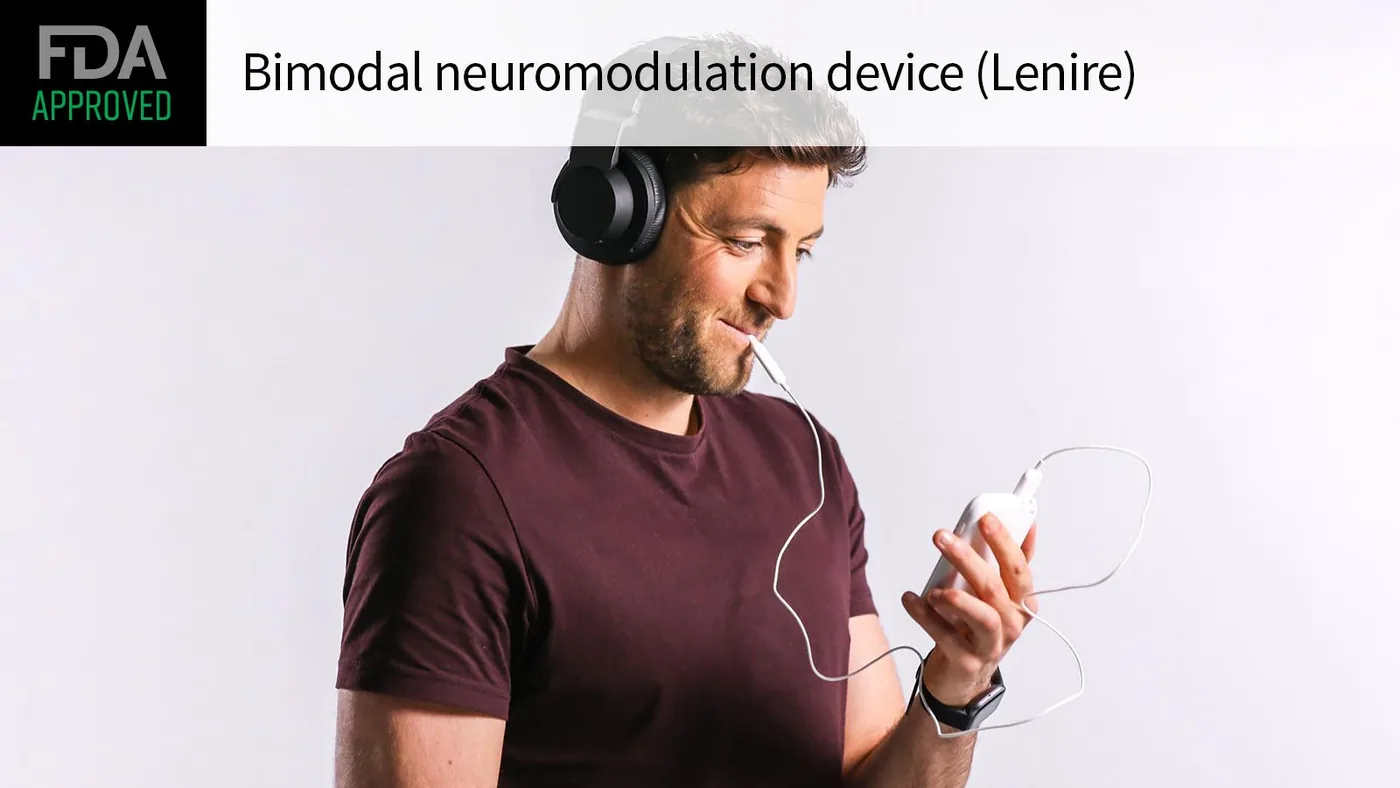
Clinical research now explores bimodal neuromodulation. The technique combines sounds with electrical pulses to sensory nerves. Hubert Lim at the University of Minnesota helped build a system that plays audio tones while stimulating touch nerves on the tongue. Publishing in Science Translational Medicine, researchers reported that delivering synchronized acoustic tones and tongue shocks drives beneficial neuroplasticity that rewires overexcited auditory pathways and suppresses phantom noise [5]. Susan Shore at the University of Michigan tested a similar method using head and neck stimulation. Rilana Cima at Maastricht University and teams at St. James’s Hospital in Dublin also track neuromodulation trials.
In March 2023, the Food and Drug Administration granted de novo clearance to Lenire, a tongue stimulation device made by Neuromod Devices in Dublin, Ireland. Chief executive officer Ross O’Neil guided the commercial rollout following the successful TENT-A3 trial of 112 adults. Over the six-week trial regimen, 82.4 percent of participants adhered strictly to their daily therapy schedule, with 79.4 percent achieving clinically meaningful symptom improvements on the Tinnitus Handicap Inventory [10]. The previous TENT-1 and TENT-2 studies supported device safety.
Such tools may ease costs for healthcare programs. Quinn Everts reported in Drug Topics that ear ringing affects 2.7 million former service members, making it the top service-connected disability. The Department of Veterans Affairs paid over $4.9 billion in compensation for the condition in 2022. Audiologist Jason Leyendecker of Audiology Concepts LLC and the Tinnitus and Hyperacusis Clinic of Minnesota said that bimodal therapy delivers clinical gains in six weeks, expanding treatment capacity across clinics [11]. Modern devices bring practical clinical hope.
- WEBSITE National Institute on Deafness and Other Communication Disorders. (2024). What Is Tinnitus? — Causes and Treatment. [Article Link]
- WEBSITE Cleveland Clinic. (2017). What Is That Noise (and Why Doesn’t It Stop)? [Article Link]
- ACADEMIC JOURNAL Vasilkov, V., Caswell-Midwinter, B., Zhao, Y., De Gruttola, V., Jung, D. H., Liberman, M. C., & Maison, S. F. (2023). Evidence of cochlear neural degeneration in normal-hearing subjects with tinnitus. Scientific Reports, 13. [Article Link]
- WEBSITE MedlinePlus. (2026). Tinnitus: MedlinePlus Medical Encyclopedia. [Article Link]
- ONLINE NEWS Kwon, D. (2020). New Tinnitus Treatment Alleviates Annoying Ringing in the Ears. Scientific American. [Article Link]
- ONLINE NEWS Cockerill, J. (2023). Tinnitus Could Be Our Brain’s Way of Coping With Nerve Damage. ScienceAlert. [Article Link]
- ACADEMIC JOURNAL Chan, Y. (2009). Tinnitus: Etiology, Classification, Characteristics, and Treatment. Discovery Medicine, 8(42), 133-136. [Article Link]
- WEBSITE American Tinnitus Association. (2022). Medications. [Article Link]
- ACADEMIC JOURNAL Nocini, R., Henry, B. M., Lippi, G., & Mattiuzzi, C. (2024). Effect of melatonin supplementation on tinnitus: systematic literature review and meta-analysis: Melatonin and Tinnitus. Acta Biomedica Atenei Parmensis, 95(2). [Article Link]
- ONLINE NEWS George, J. (2023). First Bimodal Neuromodulation Device for Tinnitus Gets FDA Nod. MedPage Today. [Article Link]
- ONLINE NEWS Everts, Q. (2023). FDA Grants De Novo Approval to Non-Invasive Tinnitus Treatment Device. Drug Topics. [Article Link]
- ONLINE NEWS CORDIS. (2022). Almost 15 % of Europe’s adults have a ringing in their ears, say researchers. European Commission. [Article Link]
- ONLINE NEWS Hazell, T., & Mendis, S. (2024). Tinnitus. Patient.info. [Article Link]
- WEBSITE Wikipedia contributors. (2026). Tinnitus. Wikipedia, The Free Encyclopedia. [Article Link]
- WEBSITE Wikipedia contributors. (2026). Tinnitus masker. Wikipedia, The Free Encyclopedia. [Article Link]
- WEBSITE Wikipedia contributors. (2026). Tinnitus retraining therapy. Wikipedia, The Free Encyclopedia. [Article Link]
- ACADEMIC JOURNAL Eggermont, J. J., & Roberts, L. E. (2015). Tinnitus: animal models and findings in humans. Cell and Tissue Research, 361(1), 311-336. [Article Link]
- WEBSITE Bekman, S. (2021). What are some ototoxic drugs?. Stason.org. [Article Link]


