




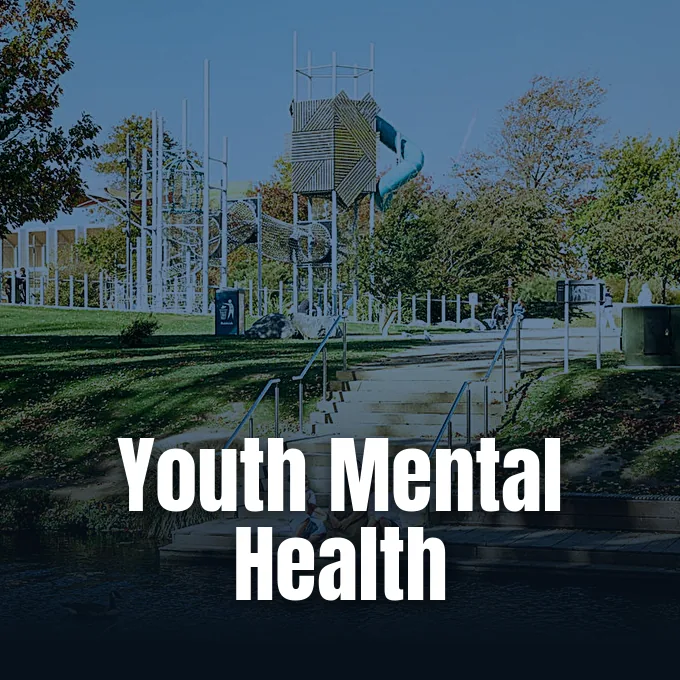
Does the layout of a town shape how young people experience emotional distress and youth strain? Health studies show that youth mental health links to local open spaces, tying daily well-being to urban design and street amenities. While older clinical studies often looked at personal habits alone, recent spatial data reveals that street design exerts a clear influence on growing age groups. In New Zealand, a national study following 957,381 young people found that health-promoting natural spaces reduce the odds of emotional disorders, whereas clusters of fast-food and alcohol shops heighten clinical risk [1].
- How Built Surroundings Shape Youth Mental Health
- Mapping Neighborhood Features with the Healthy Location Index
- Why Health-Constraining Outlets Harm Youth Mental Health
- Can Environmental Disasters Alter Youth Mental Wellbeing?
- Distinguishing Social Ruptures from Natural Disaster Recovery
- Designing Resilient Communities for Adolescent Well-Being
How Built Surroundings Shape Youth Mental Health
Urban settings surround young people with streets, retail shops, and public areas that quietly guide daily habits. At the University of Canterbury (known in Māori as Te Whare Wānanga o Waitaha), researchers tracked how these built features relate to mental well-being over time. Instead of treating a city block as passive ground, the study examined how living near specific amenities alters emotional health during formative transitions between childhood and adulthood. Dr. Lukáš Marek, a researcher in the School of Earth and Environment at the University of Canterbury, explained that physical surroundings matter fundamentally because different town layouts generate starkly unequal developmental opportunities across local communities [1].
“The main message is that the environment actually matters,” Marek said, explaining that people who experience better settings tend to have better mental health. He added that what counts as a good setting can vary for different cultural groups. Personal experiences differ [1].
While past public health work focused on school connectedness protecting high school mental health within classrooms, spatial researchers argue that street design shapes safety, mobility, and outdoor access after the school day ends. When streets lack safe paths and open meeting spots, young people face compounding social pressures that classroom programs alone cannot resolve. The Canterbury team showed that planning for resilient youth mental health needs a complete view of local spaces. “If we want to plan for better mental health, we need to consider what is in the area as a whole,” Marek said [1].

Mapping Neighborhood Features with the Healthy Location Index
To measure how local streets affect well-being, the team used the Healthy Location Index (HLI). This tool brings together ten features of built and natural spaces, sorting amenities into health-promoting assets and health-constraining venues [1].
On the health-promoting side, the index incorporates access to supermarkets selling fresh food, places for physical activity, green parks, and blue spaces such as rivers, lakes, and coastlines. Health-constraining features include fast-food outlets, alcohol retail stores, and commercial gambling venues. Using administrative and health records from 2013 to 2018, the investigators followed a national cohort of 957,381 young people aged 10 to 24 in New Zealand. The researchers linked individual health data to spatial maps to observe whether living near particular amenities altered medical diagnoses as adolescents grew up. Statistical models adjusted for household income, access to doctors, age, sex, and ethnicity. Even after controlling for economic disparities, local street features still predicted clinical outcomes [1].
This broad view revealed patterns that smaller studies missed. Associate Professor Matt Hobbs, from the Faculty of Health at the University of Canterbury, explained that tracking nearly one million people helped build a clearer picture of how place shapes youth well-being. “Where young people live shapes the opportunities and exposures they experience every day,” Hobbs said. He added that building healthier towns is about creating spaces that make healthy choices easy [1].
Why Health-Constraining Outlets Harm Youth Mental Health
The clearest trend in the New Zealand data centered on the harm linked to health-constraining retail venues. Young people living in areas with many fast-food outlets, liquor stores, and gambling halls had higher odds of emotional disorders than peers in healthier areas. The pattern held across regions [1].
Hobbs stated that the geographical findings showed clear ties between harmful retail hubs and acute emotional crises among young residents. “Young people living in areas with less access to those health-constraining features had lower odds of emotional disorders, while living in predominantly health-constraining environments was associated with higher odds,” Hobbs said. The study also detected higher odds of hospital admissions for substance abuse and self-harm in these areas. These patterns align with research into cannabis and behavioral risk research across cohorts, showing how easy access to mood-altering products heightens psychological distress during formative years when young brains undergo rapid neural reorganization [1].

Natural spaces offered protective benefits across social backgrounds. Having access to green parks and blue waterfronts was linked to lower rates of emotional disorders and better youth mental health. Yet Marek warned that planting trees alone will not cure mental strain if parks feel unsafe or cut off from homes. “It is not always as simple as saying build more of one thing,” Marek said. Planners must ask whether young people can reach those spaces [1].


Can Environmental Disasters Alter Youth Mental Wellbeing?
While day-to-day street layouts build a steady foundation for mental well-being, acute ecological disasters can abruptly upend community life and trigger lasting behavioral strain. In a complementary nine-year investigation published in Alcohol, Clinical and Experimental Research, Dr. Lynsay Ayer and colleagues evaluated how large-scale ecological and public health disasters reshape mental health and substance abuse patterns over time. The research focused on 941 study participants in the Gulf Coast region of the United States who survived multiple successive crises, including the Deepwater Horizon oil spill, severe hurricanes, and the COVID-19 pandemic. Repeated interviews over nearly a decade revealed distinct psychological trajectories that emerge when physical environments undergo sudden destruction [2].
Survivors did not respond in identical ways. The Gulf Coast cohort sorted into four distinct trajectories of alcohol use and mental strain. Half of the surveyed population fell into an elevated stable group that maintained high alcohol consumption throughout the nine-year period, while one-third exhibited low stable use [2].

Roughly 10% began with heavy drinking and decreased their consumption over time, whereas another 10% started with low consumption and steadily escalated their alcohol intake. These shifting behavioral patterns carried clinical implications: people in the elevated stable and increasing drinking groups suffered from steadily worsening depression over the study timeline. Furthermore, participants in both the elevated stable and decreasing drinking categories reported rising illness anxiety as environmental recovery dragged on. The data showed that chronic uncertainty feeds persistent psychological strain [2].
Distinguishing Social Ruptures from Natural Disaster Recovery
A notable insight from the disaster investigation centers on how different categories of catastrophes evoke contrasting psychological responses across affected populations. Exposure to human-caused industrial disasters like the Deepwater Horizon oil spill and systemic disruptions like the COVID-19 pandemic correlated strongly with escalating alcohol misuse and anxiety [2].
Because technological accidents and pandemics are marked by institutional mistrust, economic ambiguity, and enforced social isolation, they erode the shared community bonds that typically cushion traumatic events. Survivors frequently reported feeling isolated within fractured neighborhoods, leading vulnerable individuals to self-medicate emotional distress through substance use. Natural weather disasters, by contrast, generated markedly different community dynamics across the Gulf Coast. Following catastrophic hurricanes, residents experienced immediate physical destruction but often benefited from collective rebuilding efforts that brought neighbors together in mutual aid and shared recovery. Ayer noted that natural disasters tend to evoke civic solidarity, as shared hardship prompts communities to rebuild damaged infrastructure cooperatively [2].

This lingering strain mirrors the bodily changes seen in studies examining early-life stress and maladaptive behaviors under chronic hardship. When pollution ruins jobs and closes public shores, long uncertainty undermines healthy coping mechanisms. Ayer and her team recommended that public health authorities systematically investigate both resilient and vulnerable sub-populations to identify the community characteristics that best protect youth mental health in turbulent times [2].
Designing Resilient Communities for Adolescent Well-Being
The converging findings from New Zealand and the Gulf Coast prove that safeguarding adolescent psychological health demands sustained investments in physical community design. Because young people spend their most formative years navigating localized spaces between home, school, and social hubs, municipal zoning decisions function as de facto mental health policies. Hobbs reiterated that fostering healthy populations requires municipal leaders to design neighborhoods that make positive choices effortless while strictly minimizing exposure to commercial venues that compromise psychological well-being. Restricting alcohol shops, fast-food outlets, and gaming venues near homes gives youth a safer start in life [1].
Simultaneously, municipal planners must prioritize the equitable distribution of high-quality green parks and accessible blue waterfronts across urban corridors. Marek explained that creating localized geospatial databases provides city planners with empirical tools to make evidence-based zoning choices. “We are building an evidence base that can be very localized,” Marek said [1].
Marek added that spatial models can guide city planning, housing density standards, and adolescent welfare strategies. By incorporating the Healthy Location Index into municipal guidelines, local governments can evaluate proposed developments through a clinical lens, ensuring that expanding cities nurture rather than deplete youth mental health. Ultimately, translating geospatial and disaster epidemiology into healthier towns requires closing the gap between psychiatric research and urban design, protecting future generations of young people from preventable psychiatric illness [1, 2].
- ACADEMIC JOURNAL Marek, L., Bowden, N., Wiki, J., Kokaua, J., Ruhe, T., Theodore, R., Boden, J., Thabrew, H., Hetrick, S., Milne, B., & Hobbs, M. (2026). Interconnected environments and the mental health of young people in Aotearoa New Zealand: a longitudinal geospatial study. Journal of Exposure Science & Environmental Epidemiology. [Article Link]
- ACADEMIC JOURNAL Ayer, L., Atshan, S., Seelam, R., Ghosh‐Dastidar, B., Harding, A. B., Parker, A., & Parks, V. (2026). Alcohol Use Trajectories Across Disasters: Associations With Depression and Illness Anxiety. Alcohol, Clinical and Experimental Research, 50(10). [Article Link]
APA 7: TWs Editor. (2026, October 13). How Built Environments Influence Youth Mental Health. PerEXP Teamworks. https://perexpteamworks.com/en/youth-mental-health-living-environments/


