





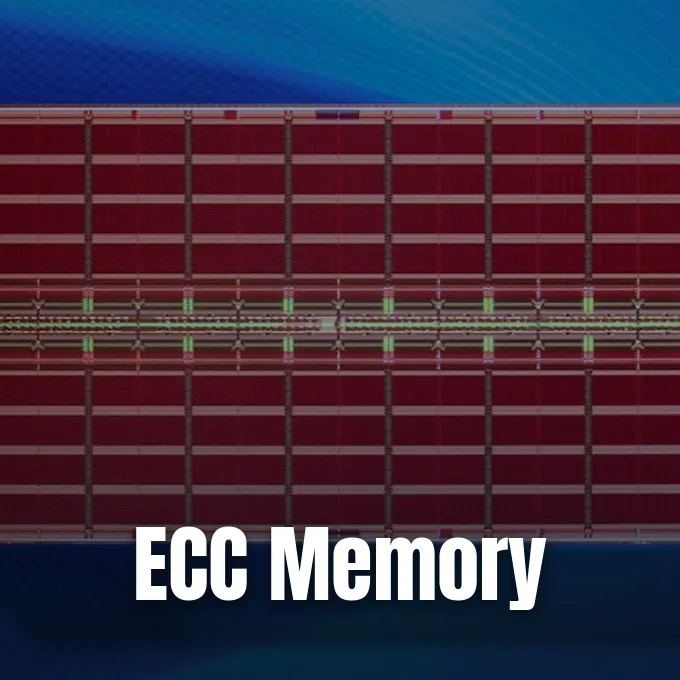
ECC memory protects enterprise servers and scientific hardware by finding and repairing bit flips before corrupted numbers reach the operating system. Dynamic random-access memory stores information as electrical charges inside capacitor cells, but background radiation and thermal noise can flip a stored binary one to a zero [4]. While consumer DDR4 modules pass bad bits to the processor, error-checking hardware identifies the damaged cell and restores the true value on the fly. Server uptime depends on this correction [1].
- Origins of Radiation-Induced Soft Errors
- How ECC Memory Detects Single-Bit Errors
- How SECDED Syndrome Decoding Operates
- Side-Band and Inline Memory Layouts
- On-Die Protection in DDR5 Devices
- Why Memory Scrubbing Stops Error Buildup
- Hardware Requirements for Running ECC Memory
- How Attackers Bypass ECC Memory with Rowhammer
Origins of Radiation-Induced Soft Errors
Memory errors fall into two groups known as hard errors and soft errors. Hard errors stem from silicon defects or broken circuit traces that permanently destroy a cell’s charge retention [2]. Soft errors are transient flips caused by electrical interference or background radiation [4]. Silicon cells survive intact.
Because cosmic radiation intensifies with altitude, systems operating above sea level face higher error rates. Atmospheric neutron flux is about 3.5 times higher at an elevation of 1.5 kilometers and climbs to 300 times higher at commercial cruising altitudes between 10 and 12 kilometers. When the Cassini-Huygens spacecraft flew following its 1997 launch, its two flight recorders carried 2.5 gigabits of commercial DRAM that logged roughly 280 single-bit errors every day. That baseline quadrupled on November 6, 1997, after a solar particle event detected by the satellite GOES 9 swept past the instruments. A Google server study at the SIGMETRICS/Performance ’09 conference recorded 25,000 to 70,000 errors per billion device hours per megabit, finding that over 8% of DIMMs suffer errors each year [4].
When an unprotected bit flips, the system rarely warns the user before saving bad data. In a plain spreadsheet, a byte storing the ASCII character 8 (binary 0011 1000) can flip its lowest bit to become 9 (binary 0011 1001), silently corrupting numbers without crashing. While compile-time tools like the Rust borrow checker eliminate software bugs in code, they cannot shield memory cells from environmental radiation. Unchecked flips in production environments cause corrupted database records and sudden kernel halts [1, 4].
How ECC Memory Detects Single-Bit Errors
Basic parity checking served as the earliest defense against memory corruption, but it could only spot odd numbers of flipped bits. A parity system tallies the ones in a data word and stores an extra bit to mark whether the total is even or odd [4]. Single parity bits cannot identify which cell flipped [1].
Unlike basic parity, true ECC memory uses a cluster of redundant check bits calculated over overlapping segments of the payload. During a write operation, the processor forwards raw data to the integrated memory controller on the CPU die. The controller calculates an error-correcting code based on the incoming byte pattern and routes both the payload and the newly generated code lines over the memory bus. Both components are then stored together inside DRAM chips for future retrieval [1].
When the processor requests stored information, the memory controller pulls data bits and check bits from the DRAM ranks. The controller recomputes the expected code from received data and compares it against stored check bits. If both codes match, data flows straight to the execution cores. But if background radiation flipped a bit, the controller uses the code difference to repair the damaged bit on the fly [1]. Research by Kim et al. (2016) showed that protecting data lines alone is not enough; their All-Inclusive ECC architecture revealed that unprotected clock, control, command, and address (CCCA) lines still leave gaps during high-speed transfers. Bus signals require comprehensive checking [9].
How SECDED Syndrome Decoding Operates
Most enterprise systems rely on a mathematical design known as SECDED, which stands for single-bit error correction and double-bit error detection [1, 2]. SECDED architectures typically use Hamming codes, where parity check bits cover overlapping groups of data bits. In standard server hardware, memory controllers pair 64 bits of raw payload data with 8 check bits [1, 4].
When reading stored words, the controller evaluates incoming bits through a parity-check matrix to produce a binary value called a syndrome. If the syndrome calculates to zero, every bit arrived in its intended state. When the syndrome is non-zero, the controller uses that output to index a syndrome lookup table. In a basic Hamming (7,4) code with four data bits (d1 through d4) and three parity bits (p1 through p3), a calculated syndrome of 111 maps to the error vector 0000001, which tells the hardware that data bit d4 contains an inverted charge [1].

Once the syndrome table pinpoints the faulty bit, the controller flips that single binary position back to its true state before delivering data to the CPU. But if two bits flip at the same time, the syndrome flags an uncorrectable error because two corrupted bits cannot be uniquely isolated by an 8-bit Hamming code [1, 4]. Rather than passing bad data into software calculations, the system halts execution or triggers a kernel panic to prevent database corruption [1]. To address scaling limits in nanoscale manufacturing, Shin et al. (2016) proposed adaptive ECC schemes that reconfigure check bits to withstand transistor variability and low operating voltages [10]. Flexible codes keep memory reliable as cells shrink.
Side-Band and Inline Memory Layouts
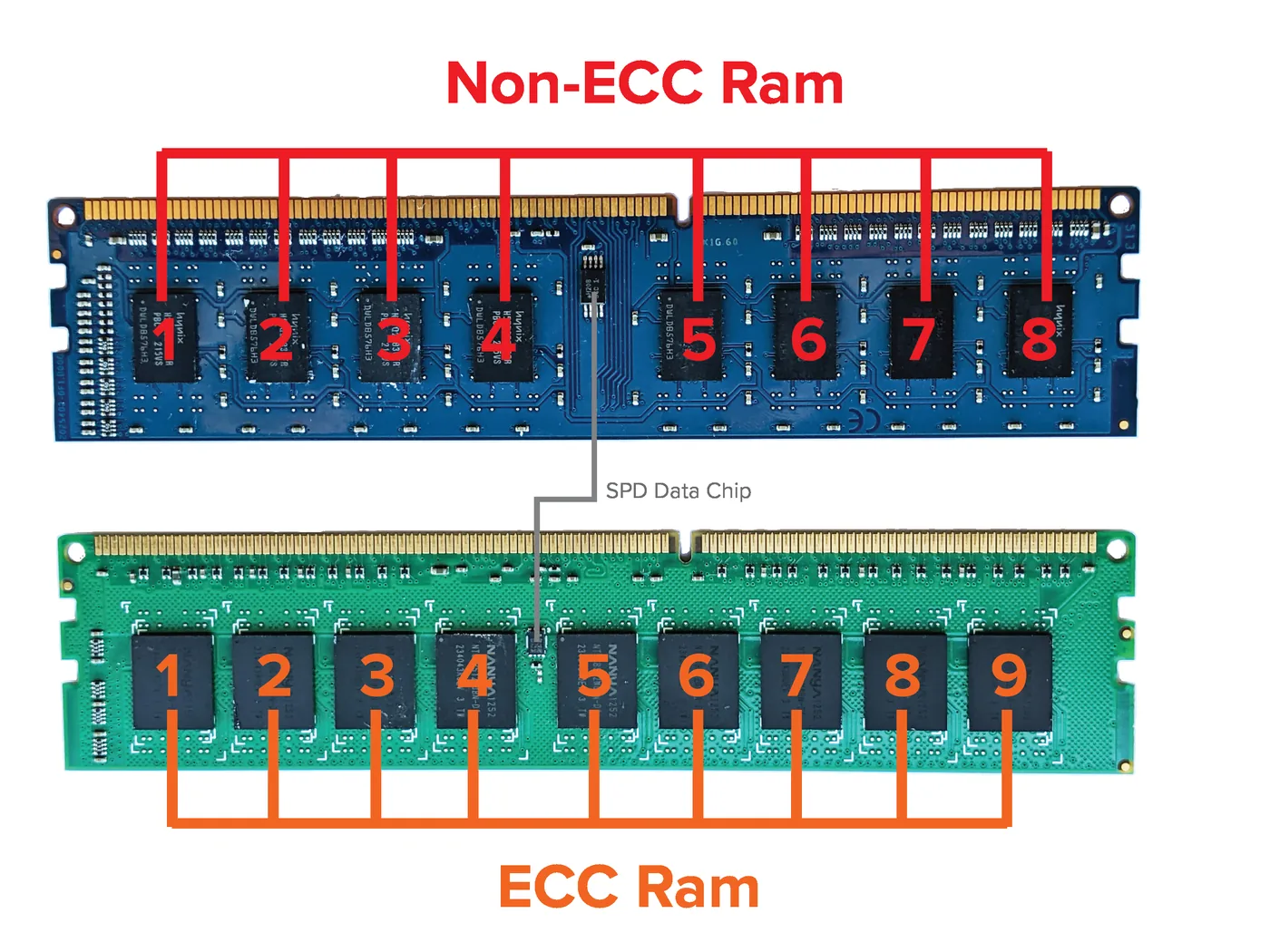
Memory controllers handle check bits using different architectural schemes depending on device space and bus layout. Side-band ECC serves as the standard method in desktop workstations and enterprise servers using standard DDR4 and DDR5 modules [1, 2]. Under this approach, the memory bus contains check-bit lines, labeled CB0 through CB7, running in parallel with 64 data lines (DQ0 through DQ63) [1].
Side-band architectures transmit data and error codes concurrently, so clean read operations incur minimal latency penalty compared to non-ECC hardware. Vadhiraj Sankaranarayanan (2020) at Synopsys explained that standard DDR4 ECC DIMMs are 72 bits wide, adding two extra x4 DRAM chips or a single x8 DRAM chip to store the 8-bit check codes. But mobile hardware cannot afford the extra motherboard traces and wider channels needed for side-band buses. Compact smartphones demand different trade-offs [2].
Low-power memory standards like LPDDR4 and LPDDR5 feature fixed 16-bit channel widths per chip, where reserving an entire extra channel for 8 check bits would waste bus bandwidth and board space. Instead of adding bus lines, inline ECC partitions standard system memory space to hold check codes in the very same DRAM chips that store application payloads [1, 2]. To write data, the memory controller issues a normal write command followed by a separate overhead write command directed at the reserved check partition. High-performance controllers mitigate command overhead by packing error codes for several consecutive memory addresses into a single write request [2]. Exploring alternative approaches, Udipi et al. (2012) introduced LOT-ECC to localize check data into the same DRAM row, separating error detection from correction to boost access efficiency in commodity hardware [7].


On-Die Protection in DDR5 Devices
As memory manufacturers shrink silicon lithography to boost DRAM capacity, capacitor cells become smaller and hold fewer electrons. Smaller cells suffer increased electrical leakage and noise from neighboring traces. To maintain viable manufacturing yields at higher data rates, JEDEC made on-die ECC mandatory for all DDR5 and LPDDR6 memory chips [2, 4].
In DDR5 hardware, the chip embeds 8 check bits for every 128 bits of payload data directly on the silicon die [2]. On-die ECC operates entirely inside the DRAM package, correcting single-bit retention errors during operations like row refreshes. But on-die mechanisms do not offer full end-to-end protection for the computer system. On-chip logic fixes charge decay within memory arrays, yet it never transmits check bits over the memory bus to the CPU [1, 2].
If electrical noise flips a bit while data travels along motherboard traces between the memory chip and the processor, on-die circuitry cannot detect or repair that transmission damage [1, 2]. On-die error correction also remains invisible to the operating system, providing no telemetry logs to help administrators replace failing modules [1, 4]. To guard data traveling across mobile memory channels, LPDDR5 introduces an independent mechanism known as Link-ECC [1, 2]. With Link-ECC, the memory controller computes check bits for outgoing write data and sends them along the bus, allowing the DRAM chip to verify and repair transmission faults before storage [2]. High-performance accelerators also demand tailored protection; Chen et al. (2018) developed Configurable-ECC for High Bandwidth Memory (HBM) systems, cutting DRAM energy by 17 to 21 percent while safeguarding variable GPU access widths [8].
Why Memory Scrubbing Stops Error Buildup
While SECDED hardware repairs a single bad bit inside a 64-bit word, it cannot correct two flipped bits in the same location [1, 5]. In long-running servers with months of uptime, soft errors do not strike all memory addresses evenly [5]. Dormant memory words remain vulnerable to second strikes.
If a server holds data in an idle memory bank that is rarely accessed, a second cosmic particle may flip another bit in that same word before the first error is read and cleared. When the CPU eventually reads that double-fault word, SECDED logic detects the corruption but cannot fix it, forcing an emergency system crash [1, 5]. To prevent correctable errors from accumulating into fatal double-bit faults, enterprise platforms employ memory scrubbing [5].
Scrubbing is a background maintenance routine where the memory controller systematically reads through memory addresses, checks their ECC status, and rewrites clean data whenever it discovers a corrected bit. Data center administrators can configure scrubbing through two operational modes known as demand scrubbing and patrol scrubbing. While demand scrubbing only repairs corrupted cells when applications actively request that specific data, patrol scrubbing scans through memory in the background during idle periods. System firmware allows administrators to set custom scrubbing intervals in the BIOS, balancing hardware reliability against power consumption [5]. Exploring hardware repair without adding area costs, Papavramidou and Nicolaidis (2018) introduced iterative diagnosis methods for embedded memories, using single-read double-fault detection algorithms to identify damaged cells during fabrication and runtime [11].
Hardware Requirements for Running ECC Memory
End-to-end error protection is not a simple software toggle that can be turned on across standard consumer PCs. Implementing reliable error correction needs a complete hardware chain spanning the central processor, the motherboard circuit layout, and RAM modules [1]. Software alternatives carry massive performance penalties for computing tasks.
Research by Nyzhnyk (2026) revealed that software-level SECDED containers protect volatile memory with 12.5% storage overhead but cause a 180-fold slowdown for small-state updates and a 654-fold slowdown for streaming buffers [6]. To run hardware error correction efficiently, the processor must include an ECC-capable memory controller, a feature traditionally reserved for server chips like Intel Xeon and AMD Opteron [1, 3]. Modern desktop chips like certain AMD Ryzen models also support ECC, but motherboards must connect check-bit traces between CPU sockets and memory slots [1].

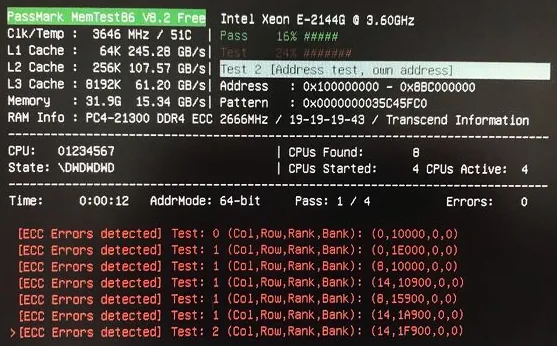
If a motherboard lacks circuit traces, plugging in server RAM will either fail to boot or run in uncorrected non-ECC mode. System firmware must also expose options such as DRAM ECC Enable on ASUS, MSI, and ASRock boards, or ECC Mode in American Megatrends BIOS menus. Enabling hardware error correction introduces a minor performance penalty of approximately 2 to 3 percent due to parity calculation and verification latency. Diagnostic tools like PassMark MemTest86 can poll hardware registers in the chipset to confirm that error correction is active. When an error occurs, MemTest86 logs the exact channel, slot, rank, bank, row, and column where the bit flipped. While home users rarely need this protection, banking servers and medical equipment rely on error correction to prevent financial discrepancies and equipment failures [1].
How Attackers Bypass ECC Memory with Rowhammer
For years, engineers believed that error-correcting memory was immune to DRAM disturbance attacks like Rowhammer. First documented in 2014, Rowhammer occurs when an attacker repeatedly reads a specific row of memory cells, leaking electrical charge into neighboring rows and flipping bits. Hardware vendors assumed SECDED logic stopped these threats [3].
Security researchers at VUSec at Vrije Universiteit Amsterdam disproved that assumption with their ECCploit research. The VUSec team proved that error correction does not stop Rowhammer attacks; it merely slows them down. Because flipping two bits triggers a double-bit crash, attackers cannot simply hammer rows indiscriminately. Instead, researchers discovered a timing side channel (tracked as CVE-2018-18904) where reading a memory location undergoing error correction takes measurably longer than reading clean data. In tight access loops, that timing gap can be up to 1000 times slower during repair [3].
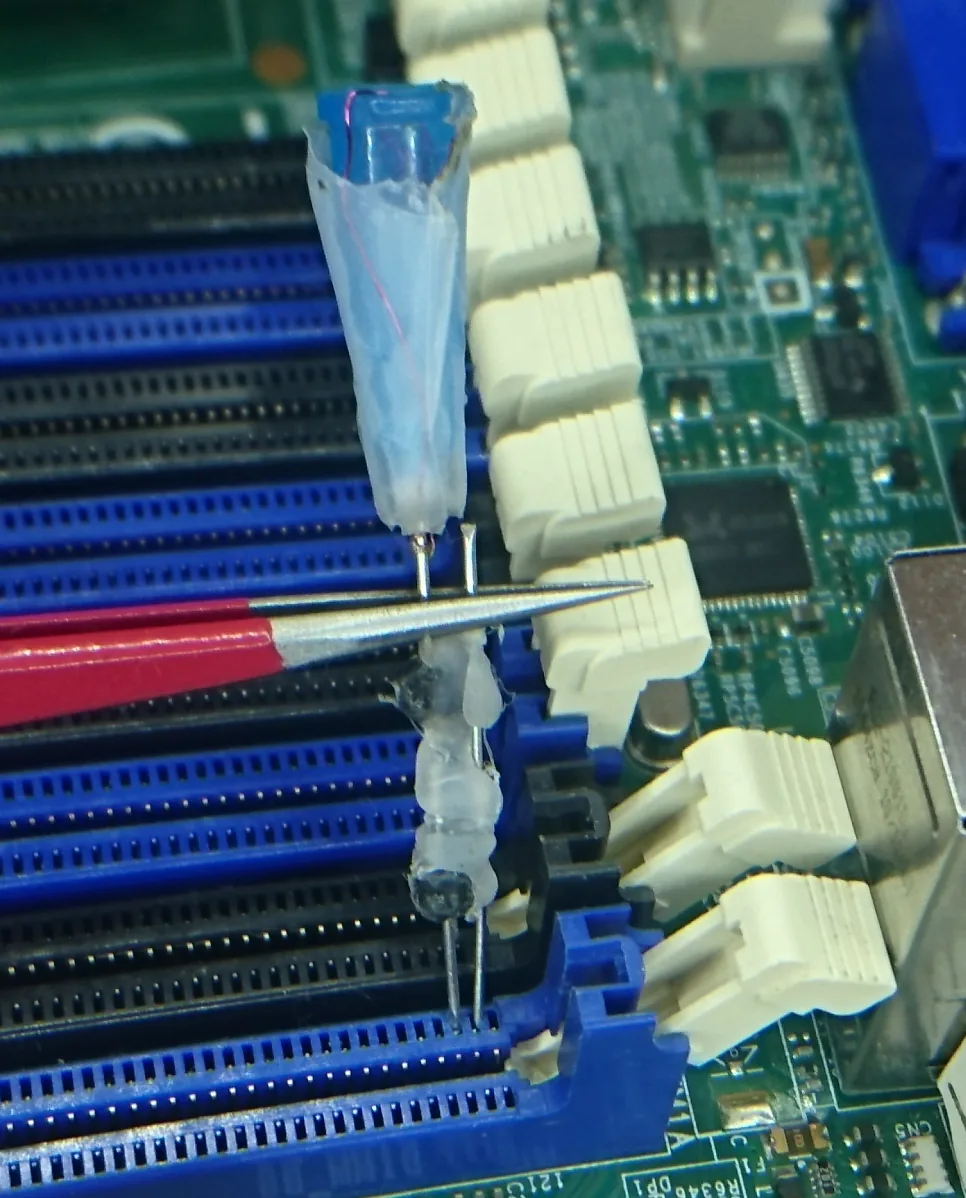
VUSec researchers reverse-engineered the memory controller using cold-boot attacks and custom syringe needle probes on the bus. By crafting memory patterns where only one bit differs between hammer rows, attackers isolate and verify individual bit flips using this timing channel. Once an attacker locates three vulnerable bits in a single 64-bit word, hammering all three locations at once flips three bits simultaneously. Because SECDED only catches up to two flipped bits, a three-bit flip slips past detection completely, causing silent data corruption. In tests across Intel Xeon E3-1270 v3 and AMD Opteron 6376 servers, page table attacks succeeded in 32 minutes to one week (tracked under CVE-2018-18905 and CVE-2018-18906) [3]. While software engineers patch buffer overflow vulnerabilities in application code, hardware security needs layered mitigations against charge leakage.
- WEBSITE PassMark Software. (2021). ECC technical details: Memory diagnostic tool. MemTest86. [Article Link]
- WEBSITE Sankaranarayanan, V. (2020). Error correction code (ECC) in DDR memories. Synopsys IP. [Article Link]
- WEBSITE VUSec Systems Security Research Group. (2020). ECCploit: ECC memory vulnerable to Rowhammer attacks after all. Vrije Universiteit Amsterdam. [Article Link]
- WEBSITE Wikipedia. (n.d.). ECC memory. Wikimedia Foundation. [Article Link]
- WEBSITE Wikipedia. (n.d.). Memory scrubbing. Wikimedia Foundation. [Article Link]
- ACADEMIC JOURNAL Nyzhnyk, A. (2026). Evaluating the impact of software-based ECC memory protection on the performance of UAV onboard software. ISU. [Article Link]
- ACADEMIC JOURNAL Udipi, A. N., Muralimanohar, N., Balsubramonian, R., Davis, A., & Jouppi, N. P. (2012). LOT-ECC: Localized and tiered reliability mechanisms for commodity memory systems. ACM SIGARCH Computer Architecture News, 40(3), 285-296. [Article Link]
- ACADEMIC JOURNAL Chen, H., Lee, S., Mudge, T., Wu, C., & Chakrabarti, C. (2018). Configurable-ECC: Architecting a flexible ECC scheme to support different sized accesses in high bandwidth memory systems. IEEE Transactions on Computers, 68(5), 646-659. [Article Link]
- ACADEMIC JOURNAL Kim, J. R., Sullivan, M. B., Lym, S., & Erez, M. (2016). All-inclusive ECC: Thorough end-to-end protection for reliable computer memory. ACM SIGARCH Computer Architecture News, 44(3), 622-633. [Article Link]
- ACADEMIC JOURNAL Shin, D., Park, J., Park, J., Paul, S., & Bhunia, S. (2016). Adaptive ECC for tailored protection of nanoscale memory. IEEE Design and Test, 34(6), 84-93. [Article Link]
- ACADEMIC JOURNAL Papavramidou, P., & Nicolaidis, M. (2018). Iterative diagnosis approach for ECC-based memory repair. IEEE Transactions on Computer-Aided Design of Integrated Circuits and Systems, 39(2), 464-477. [Article Link]
Cover image: Steve Jurvetson from Los Altos, USA / Wikimedia Commons, CC BY 2.0


