





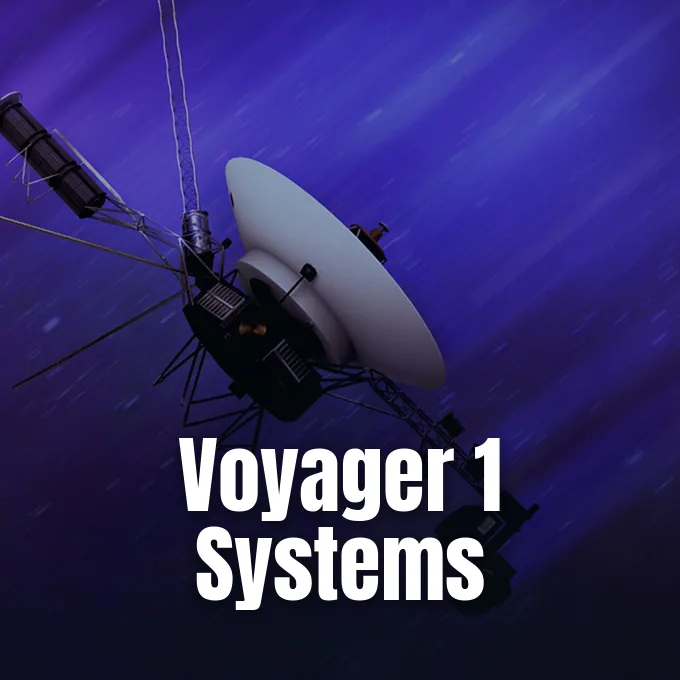
NASA built Voyager 1 as an autonomous robotic probe that relies on nuclear heat, thruster pulses, and focused radio waves to explore beyond the solar system. Understanding how Voyager 1 works in deep space means seeing how its bus, power sources, and data systems operate together without active steering from ground crews [1]. The craft carries no solar panels. Launched from Cape Canaveral Launch Complex 41 on September 5, 1977, aboard a Titan IIIE-Centaur rocket, the explorer flew past Jupiter and Saturn before crossing the heliopause into the interstellar medium in August 2012 [2]. Archival mission tracking compiled by PerEXP Teamworks shows that the 721.9-kilogram probe maintains its flight path at 17 kilometers per second while collecting environmental data from the space between the stars [10].
Structure of the Interstellar Probe
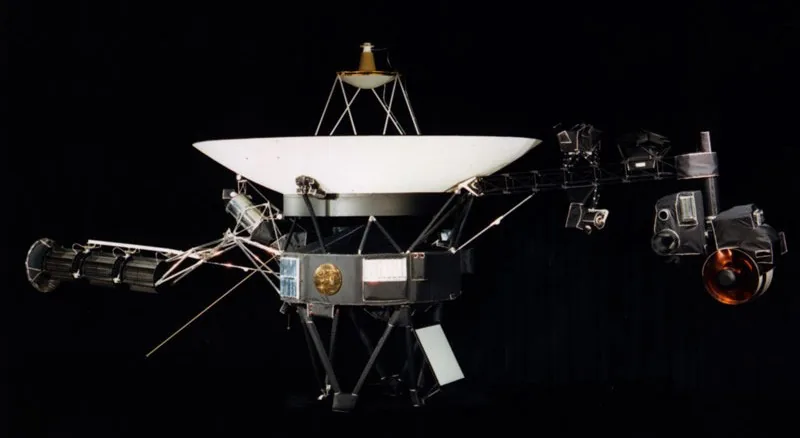
The main body of Voyager 1 is a ten-sided prism called a decahedral bus, measuring 47 centimeters tall and 1.78 meters wide across opposite flats while housing propellant tanks and flight computers. This central structure houses electronic compartments, fuel tanks, and core computers while serving as the structural anchor for multiple booms and exterior sensors. On top sits a parabolic Cassegrain dish antenna measuring 3.66 meters in diameter, dominating the physical silhouette of the vehicle [1].
A 2.5-meter boom extends outward to hold instruments that need distance from electrical interference originating inside the electronic bays within the bus. At the tip of this boom sits a steerable scan platform carrying cameras and spectrometers, while particle detectors sit at measured distances along its frame. Magnetometers require strict isolation from spacecraft magnetic fields, so engineers mounted them along an outrigger fiberglass boom extending 13 meters away on the opposite side [1]. Two flexible whip antennas, each measuring 10 meters, stick out to detect plasma waves. The probe weighed 721.9 kilograms at launch with all parts stowed [2]. Edward C. Stone helped shape this layout at the Jet Propulsion Laboratory to survive launch shaking and cosmic rays [9].
Voyager 1 keeps steady along three axes using gyroscopes and celestial references rather than spinning continuously like the earlier Pioneer 10 and Pioneer 11 explorers launched in the early 1970s. This steady platform allows imaging cameras and spectrometers to lock onto fast-moving planetary targets during close encounters. It also keeps the narrow radio beam pointed at Earth. Project manager Ed B. Massey oversaw these systems to secure decades of deep space flight [1].

How Voyager 1 Works on Nuclear Heat
Electrical power on Voyager 1 comes from three Multi-Hundred Watt Radioisotope Thermoelectric Generators assembled in tandem on a deployable boom hinged on struts attached to the bus. Examining how Voyager 1 works with nuclear fuel shows that sunlight in deep space is far too weak for conventional solar panels, so the craft relies on decaying Plutonium-238 oxide [1].
Each generator unit contains 24 pressed ceramic spheres of plutonium fuel enclosed in a beryllium outer case measuring 40.6 centimeters across and 50.8 centimeters long, and weighed 39 kg. Thermocouples made of silicon and germanium convert that thermal heat directly into electric power without employing any moving mechanical parts. At launch in September 1977, the three units made about 470 watts of 30-volt direct-current power, or about 158 watts each [1]. Much of the heat escapes into space as waste warmth, which prevents electronics from freezing in deep cold. The design provides steady current without using batteries [10].
Plutonium-238 has a half-life of 87.7 years, causing the electric output to fall by roughly 4 watts each year as fuel decays and thermocouples slowly degrade [5]. By 1997, about 19.5 years post-launch, electrical output had fallen to approximately 335 watts, forcing ground controllers to shut down heaters and auxiliary equipment. Total spacecraft construction, launch, and flight operations cost $875 million across the Neptune encounter phase [1]. Current plans indicate the nuclear units can power basic flight systems into the 2030s [10].
Thrusters for Attitude Control
The Attitude and Articulation Control Subsystem guides orientation so the dish antenna points toward Earth, using 16 hydrazine thrusters split into roll, pitch, yaw, and trajectory correction branches. Understanding how Voyager 1 works in orientation requires looking at its thruster layout. Tiny gas bursts preserve antenna alignment [3].
Sensors tracking the Sun and the bright star Canopus provide celestial orientation fixes along three axes to maintain the high-gain parabolic dish aligned directly with receiving stations on Earth [10]. When the ship drifts beyond narrow limits, small puffs of hydrazine gas push it back. Over fifty years of flight, fuel line tubes suffer from clogging as propellant residues build up inside narrow pipes. The probe lost its first roll branch in 2004 when electrical faults cut power to two internal heaters. Engineers at JPL chose to rely on the backup branch because they did not expect the flight to last another twenty years. Mission manager Kareem Badaruddin said the team accepted that loss because the backup worked well [3].
By early 2025, residue threatened to clog the backup roll thrusters, forcing teams to re-examine the dormant 2004 branch. The plan worked. Engineers determined that an electrical switch had shifted to an incorrect position and successfully sent commands to restart the thruster heaters on March 20, 2025. Heating the unit prevented an explosion before the Deep Space Station 43 dish in Canberra paused operations for upgrades. Propulsion lead Todd Barber said, “It was such a glorious moment,” praising the rescue [3].
Three Onboard Computers
Because radio signals take many hours to reach Earth, the ship relies on three linked computer systems with the Computer Command Subsystem storing flight sequences and handling autonomous fault protection [10]. It uses code adapted from the Viking Mars orbiters of the 1970s. The Flight Data Subsystem controls instruments and formats data [1].
All three computers feature dual backup units to keep running if a circuit fails [1]. When the craft loses line of sight to ground stations or turns during maneuvers, an onboard digital tape recorder stores up to 64 megabytes of scientific data for later downlink [10]. Autonomous fault code can switch computers to backup units without waiting for human intervention from Earth. That built-in autonomy protected the ship during close encounters with Jupiter and Saturn when real-time ground help was impossible. Program scientist William E. Brunk coordinated these computers with early mission teams to ensure steady data collection [1].
Old memory chips pose risks for the Flight Data Subsystem. In late 2023, a damaged memory chip corrupted telemetry code, forcing engineers to relocate software routines across scattered memory addresses to restore science transmissions. A similar data halt occurred on November 14, 2026, when ground antennas received an unmodulated carrier tone with no data packets, though the carrier confirmed that transmitters and antenna pointing remained operational [4].
Radio Links as Voyager 1 Works Far Away
Talking across billions of kilometers requires dishes aimed within fractions of a degree, so Voyager 1 sends science data through its 3.66-meter parabolic dish using Deep Space Network Channel 18 [10]. Downlink signals run on S-band at 2.3 gigahertz and X-band at 8.4 gigahertz, while ground commands travel on 2.1 gigahertz to direct automated operations [1].
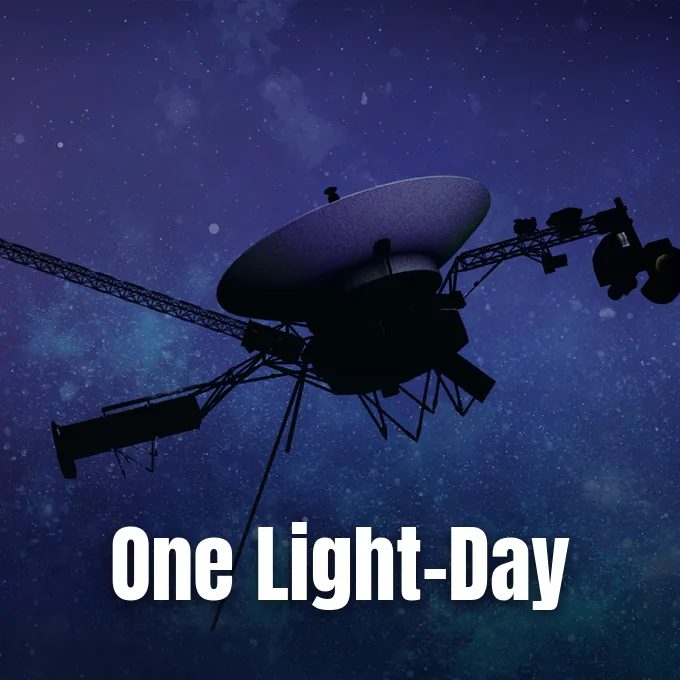
NASA operates three ground antenna complexes in California, Spain, and Australia to keep continuous line of sight as Earth turns beneath the spacecraft. As Voyager 1 works across billions of kilometers, the 70-meter dish at the Canberra Deep Space Communication Complex is the only ground terminal with enough broadcast strength to send commands to the probe [3]. Ground teams listen to the ship daily and send routine commands weekly. Project manager Suzanne Dodd said that radio signals traveling at light speed take 24 hours to reach the craft and 24 hours to return [5].
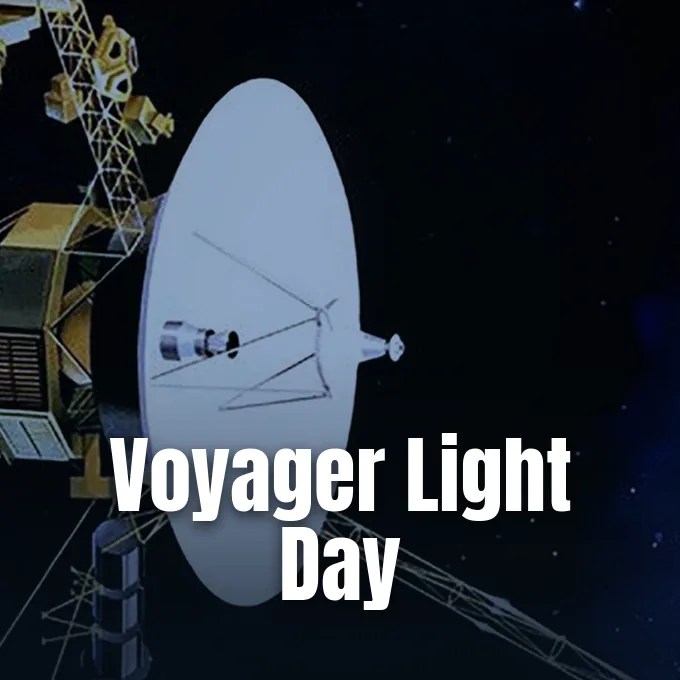
Radio signals take one full day to travel one way across the solar system before reaching the Deep Space Network antennas operated by NASA. In November 2026, the spacecraft moved beyond 25.9 billion kilometers from the Sun as Voyager 1 crossed one light-day of distance from Earth, marking a distance milestone verified through radio tracking. Ground tracking verified this position when the craft reached a deep space distance threshold that requires a 48-hour round trip for communication. Light travels at roughly 299,000 kilometers per second in vacuum [5]. Even when data pauses, the carrier tone lets teams verify speed and direction with high accuracy [4].
Measuring Plasma as Voyager 1 Works in Deep Space
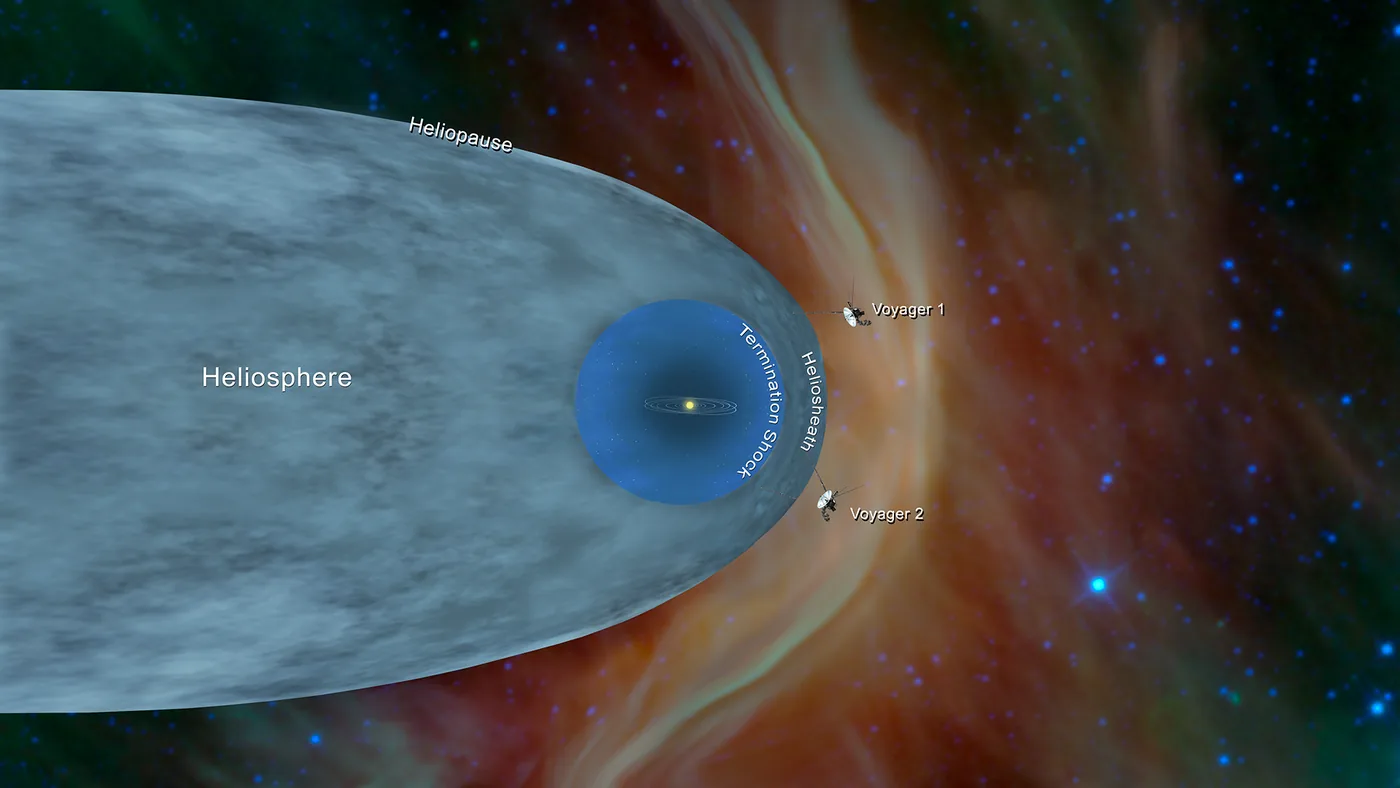
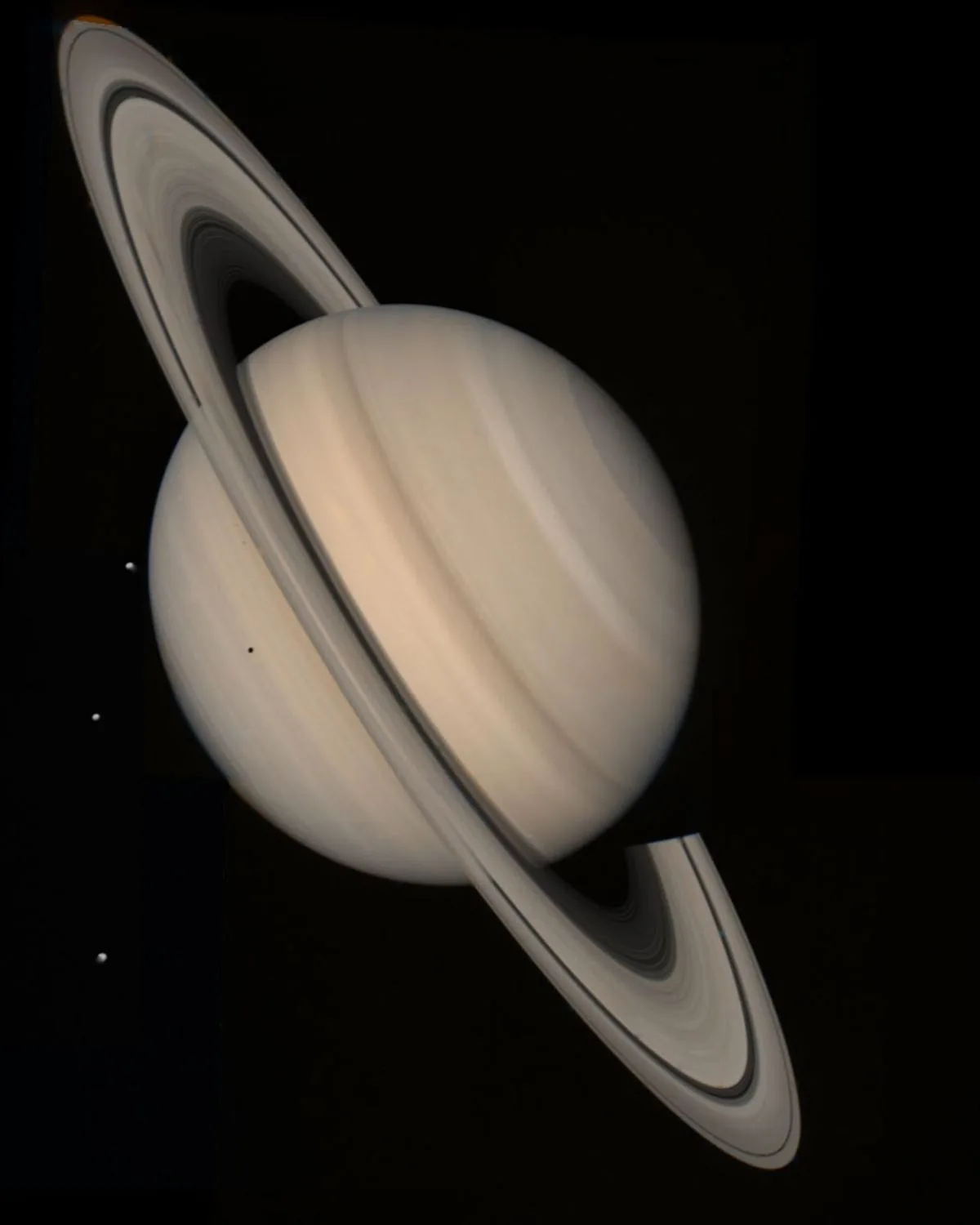
The way Voyager 1 works in interstellar plasma depends on wave receivers and magnetic sensors that monitor solar wind edges after the craft crossed the heliopause on August 25, 2012 [2]. It detected electron plasma oscillations at 2.6 kilohertz [13].
Donald A. Gurnett and William S. Kurth reported in Science that this 2.6-kilohertz signal matched an electron density of 0.08 per cubic centimeter, showing the craft had entered interstellar gas [13]. Before crossing the heliopause, sensors found a region termed the magnetic highway. S. M. Krimigis and Edward C. Stone documented that solar ions dropped while galactic cosmic rays surged inward. L. F. Burlaga and N. F. Ness analyzed magnetic readings and discovered that field direction did not change across the boundary [14]. Data from the 13-meter boom confirmed this finding [13].
Theoretical models by S. N. Borovikov and N. V. Pogorelov in The Astrophysical Journal suggest the heliopause is a wavy surface shaped by dynamic Rayleigh-Taylor and Kelvin-Helmholtz plasma instabilities. Coronal mass ejections from our Sun still trigger plasma waves past Voyager 1 years after erupting from the solar surface, showing that solar storms push far into interstellar space [10]. Project scientist Linda Spilker said the data revealed how strongly solar activity shapes the interstellar environment far beyond the heliopause [5]. Where does solar influence end and undisturbed interstellar plasma begin? Ground teams watch the telemetry carefully [10].
Power Cuts to Save Core Systems
Managing a shrinking power supply has defined operations since the planetary flybys ended. In 1990, controllers shut off the imaging cameras to save power after taking the Pale Blue Dot mosaic, which Carl Sagan had urged to photograph six planets from a distance of approximately 6 billion kilometers away [2].
Narrow-angle cameras took that final frame 34 minutes before teams shut them down for good [2]. The two Voyagers had taken 67,000 images, including 18,000 pictures of Jupiter and 16,000 of Saturn, during flybys originally budgeted at $250 million through Saturn operations [1]. As power drops by 4 watts each year, teams turn off instruments to protect basic flight functions [5]. Engineers turned off the Cosmic Ray Subsystem on February 25 and shut down the Low-Energy Charged Particle sensor on April 17 [10]. Replacing devices with low-power options allowed the mission to extend operations without losing radio contact [5]. Each shutdown decision requires careful planning to avoid triggering emergency software routines on the ship [4].
The Golden Record for Deep Space
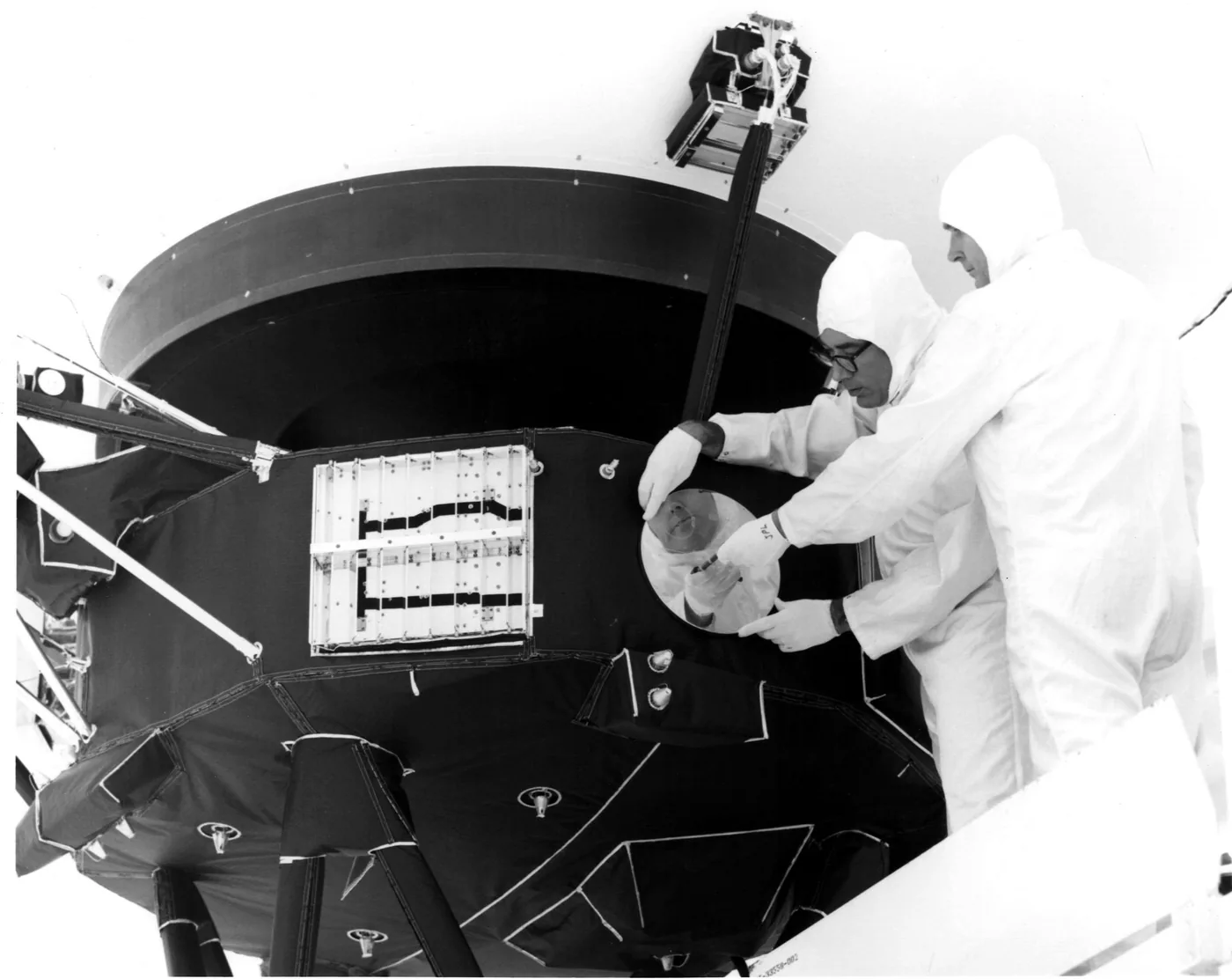
Mounted to the bus is a 12-inch gold-plated copper phonograph record intended as a cultural message for any extraterrestrial finders. Encased in an aluminum jacket with a needle, the disc carries symbols explaining its playback speed of 1000 revolutions per minute and Earth’s position relative to fourteen pulsars [1].
The disc cover features an electroplated sample of Uranium-238 with a measured radioactivity of 0.26 nanocuries, whose 4.51-billion-year half-life serves as a nuclear clock to date the voyage. The record holds 115 analog images of Earth, 35 natural and human sounds, and greetings spoken in 55 languages [1]. It includes music from Bach and Chuck Berry, alongside greetings from United States President Jimmy Carter and United Nations Secretary-General Kurt Waldheim. Carl Sagan led the team that chose these contents before launch [2]. Like plaques on Pioneer 10 and Pioneer 11, the disc carries humanity’s story [1].
Voyager 1 travels northward at about 3.5 astronomical units per year toward a point in the sky near the constellation Ophiuchus, moving at 61,000 kilometers per hour relative to the Sun [1]. On February 17, 1998, it became the most distant human-made object when it passed Pioneer 10 [2]. Although it has crossed the heliopause, the probe remains inside the Sun’s gravity. Astrophysicists estimate the ship will spend 300 years traveling before entering the inner Oort Cloud, and another 30,000 years passing through the far boundary of that icy reservoir [8]. After its nuclear heat fades, Voyager 1 will drift through space as a quiet messenger from Earth [5].
- WEBSITE National Space Science Data Center. (2026). Voyager 1 Spacecraft Details. NASA Goddard Space Flight Center. [Article Link]
- ONLINE NEWS Cermak, A., & NASA Science Editorial Team. (2017). Voyager 1: The Farthest Spacecraft. NASA Science. [Article Link]
- ONLINE NEWS Agreicius, A., & NASA Science Editorial Team. (2025). NASA’s Voyager 1 Revives Backup Thrusters Before Command Pause. NASA Science. [Article Link]
- ONLINE NEWS Barnett, A., & NASA Science Editorial Team. (2026). Voyager 1 Engineers Analyze Data Issue, Ready to Confirm Light-day. NASA Science. [Article Link]
- PRESS RELEASE Taveau, J. (2026). NASA’s Voyager 1 Makes History Reaching One Light-Day From Earth. National Aeronautics and Space Administration. [Article Link]
- WEBSITE National Space Science Data Center. (2026). Voyager 2 Spacecraft Details. NASA Goddard Space Flight Center. [Article Link]
- ONLINE NEWS Cermak, A., & NASA Science Editorial Team. (2017). Voyager 2: First To Visit All Four Giants. NASA Science. [Article Link]
- PRESS RELEASE National Aeronautics and Space Administration. (2018). NASA’s Voyager 2 Probe Enters Interstellar Space. National Aeronautics and Space Administration. [Article Link]
- BOOK CHAPTER Butrica, A. J. (1996). Voyager: The Grand Tour of Big Science. In From Engineering Science to Big Science (NASA SP-4219). National Aeronautics and Space Administration. [Article Link]
- WEBSITE Wikipedia contributors. (2026). Voyager 1. Wikipedia, The Free Encyclopedia. [Article Link]
- WEBSITE Wikipedia contributors. (2026). Voyager 2. Wikipedia, The Free Encyclopedia. [Article Link]
- WEBSITE Wikipedia contributors. (2026). Voyager program. Wikipedia, The Free Encyclopedia. [Article Link]
- ACADEMIC JOURNAL Gurnett, D. A., Kurth, W. S., Burlaga, L. F., & Ness, N. F. (2013). In Situ Observations of Interstellar Plasma with Voyager 1. Science, 341(6153), 1489-1492. [Article Link]
- ACADEMIC JOURNAL Krimigis, S. M., Decker, R. B., Roelof, E. C., Hill, M. E., Armstrong, T. P., Gloeckler, G., Hamilton, D. C., & Lanzerotti, L. J. (2013). Search for the Exit: Voyager 1 at Heliosphere’s Border with the Galaxy. Science, 341(6142), 144-147. [Article Link]


