






Lagrange points are five distinct orbital locations where the gravitational pull of two large celestial bodies balances the centrifugal force felt by a third smaller object. In celestial mechanics, having Lagrange points explained reveals how spacecraft can hover in fixed positions relative to Earth and the Sun while burning very little rocket fuel [11]. These five balance zones exist in every two-body system, including Sun-Earth and Earth-Moon orbital planes [6]. They let space agencies park sensitive observatories in stable environments that make continuous deep space observation possible [2].
- How Orbital Gravity Creates Equilibrium in Deep Space
- Lagrange Points Explained for Collinear Geometry
- Why Are Triangular Points L4 and L5 Stable?
- Space Telescopes Stationed at Sun-Earth L2
- Monitoring Space Weather from the L1 Position
- Lagrangian Points Harbor Ancient Trojan Asteroids
- Earth-Moon Libration Points in Space Exploration
- Habitats and Science Fiction Concepts at L5
How Orbital Gravity Creates Equilibrium in Deep Space
In a static two-body system with the Sun and Earth, only one balance point exists directly between two stationary masses. But real celestial bodies orbit their common center of mass. That orbital motion introduces centrifugal effects, creating five distinct equilibrium locations where gravitational pull matches rotational inertia in deep space [5].
The underlying physics comes from the restricted three-body problem investigated by European mathematicians. Swiss mathematician Leonhard Euler identified the three collinear balance points around 1750. Italian-born mathematician Joseph-Louis Lagrange, born Giuseppe Luigi Lagrancia, discovered the two triangular equilibrium positions in his 1772 treatise titled Essay on the three-body problem [11]. Today, astronomers across the International Astronomical Union name all five equilibrium solutions after Lagrange, whose equations solved constant-pattern orbital motions [6].
At each balance point, the combined gravitational pull of the two large masses provides the precise centripetal acceleration required for a third body to orbit in tandem with the secondary mass [2]. An object orbiting closer to the Sun than Earth naturally feels stronger solar gravity, causing it to travel at higher speeds along a shorter orbital year. Earth changes that dynamic. Positioned directly between the Sun and Earth at L1, our planet exerts an outward gravitational pull that cancels part of the solar attraction, which allows the spacecraft to slow down and match Earth’s exact 365-day orbital period around the Sun [6]. Understanding this orbital mechanics helps mission planners at NASA and ESA design fuel-efficient trajectories for deep space exploration [9].
Lagrange Points Explained for Collinear Geometry
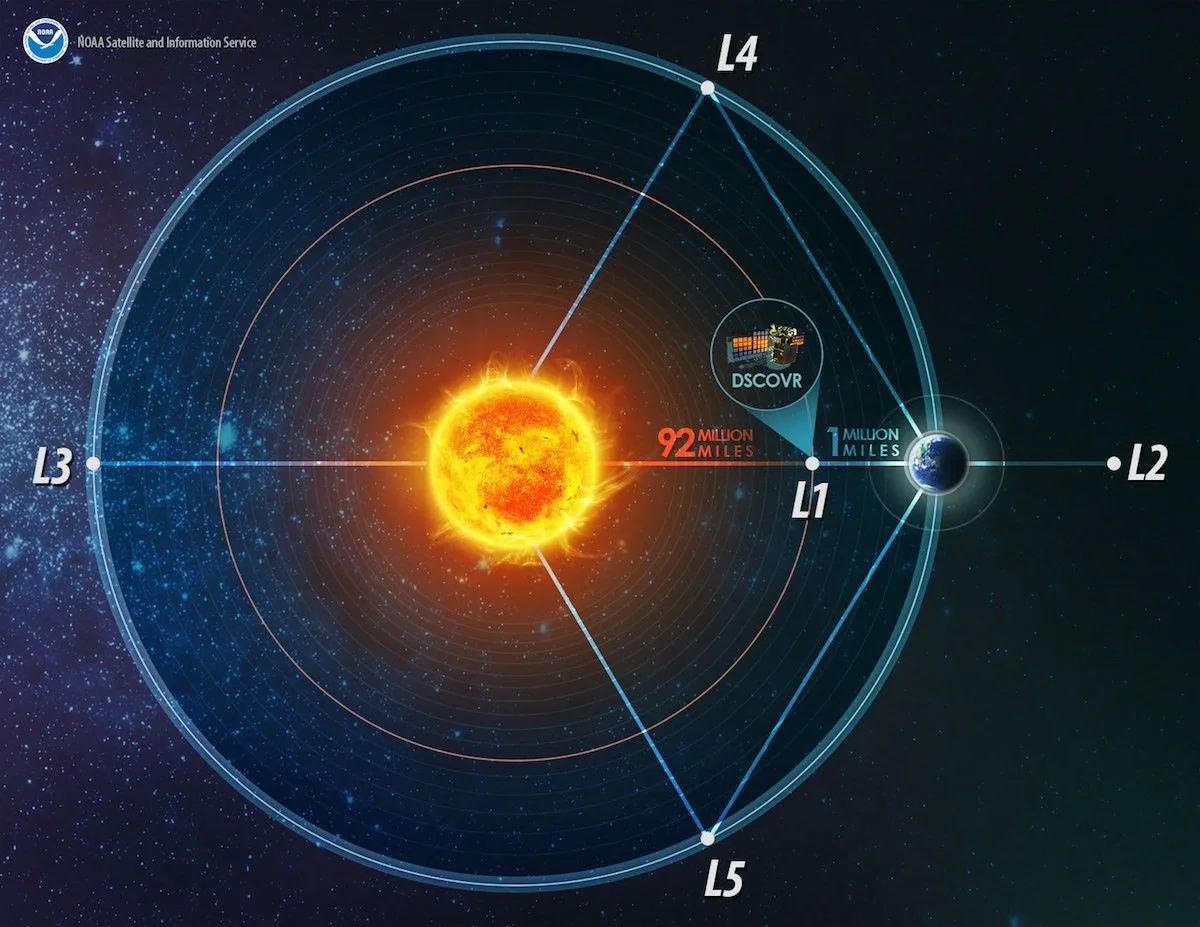
The first three equilibrium locations, labeled L1, L2, and L3, lie along a straight line connecting the centers of two primary masses like the Sun and Earth [11]. Physicists compare these collinear positions to mountain summits or saddle points. Any small nudge pushes an unpowered spacecraft away from equilibrium [5].
With Lagrange points explained across collinear vectors, the delicate nature of these saddle points becomes apparent [5]. The L1 point sits between the Sun and Earth at a distance of roughly 1.5 million kilometers, or about 0.01 astronomical units, from our planet. The L2 point lies on the opposite side of Earth, also 1.5 million kilometers away, where Earth’s extra gravitational pull speeds up the spacecraft’s orbital period so it keeps pace with Earth [11]. Beyond the Sun lies L3, hidden from terrestrial observers on the far side of our orbit [6]. Because the Sun wobbles around the Earth-Sun barycenter located inside the solar body, L3 sits slightly farther from that barycenter than Earth does [11].
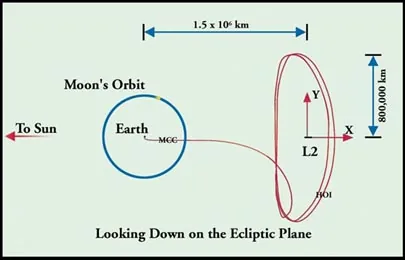
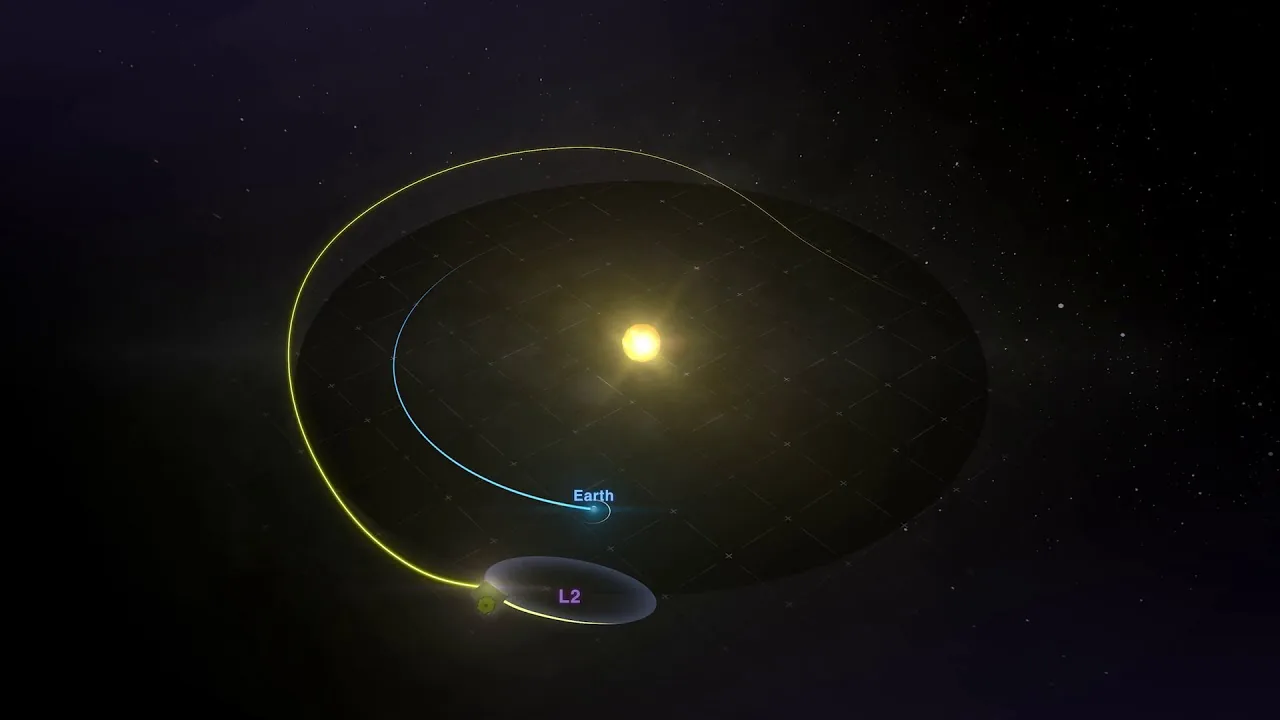
No spacecraft sits motionless at L1 or L2 [2]. Instead, flight controllers direct observatories into wide halo or Lissajous orbits, looping along three-dimensional curves around the invisible equilibrium coordinate so that solar panels stay illuminated while maintaining continuous line-of-sight communication with tracking stations on Earth [11]. Periodic thruster burns provide essential station-keeping maneuvers. Without them, spacecraft drift into solar orbit [2].
Why Are Triangular Points L4 and L5 Stable?
Unlike the three collinear positions, the triangular points L4 and L5 act as gravitational valleys where objects can settle naturally without burning propellant [5]. As seen from above the ecliptic plane, L4 sits sixty degrees ahead of the smaller body in its orbit, while L5 trails sixty degrees behind [6]. Each triangular point forms an equilateral triangle with the centers of the two primary masses. When a passing particle experiences a small displacement, Coriolis forces bend its trajectory into a stable kidney bean-shaped loop around the balance center [11]. This natural trapping mechanism allows triangular points to collect dust swarms and minor celestial bodies over millions of years [7].
Mathematical analysis proves that triangular points achieve true stability only when the primary body is at least 24.96 times as massive as the secondary body [7]. This mass ratio holds true for the Sun-Earth system, the Sun-Jupiter pair, and the Earth-Moon system [11]. If the two main bodies are closer in mass, mutual tidal forces destabilize the triangular regions and eject stray particles. Even in stable systems, gravitational tugs from external planets can disturb delicate orbits [5].
Why do dust particles linger in these zones? In a 2019 unreviewed preprint, researchers Judit Slíz-Balogh, András Barta, and Gábor Horváth simulated four-body dynamics 1,860,000 times over 3,650 days to map Kordylewski dust clouds at Earth-Moon L5, where faint particles drift up to ten degrees away from the balance point [4].
Space Telescopes Stationed at Sun-Earth L2
The Sun-Earth L2 point provides an ideal vantage point for astronomy because it keeps observatories in a cold, unchanging deep space environment [6]. Located 1.5 million kilometers behind Earth, L2 allows a single sunshield to block heat and light from the Sun, Earth, and Moon simultaneously without continuous rotation [2].
NASA and the Space Telescope Science Institute, known as STScI, selected this region during feasibility studies conducted between 1995 and 1996 for the James Webb Space Telescope [10]. Webb reached L2 roughly thirty days after its launch, coasting into a halo orbit similar in size to the Moon’s path around Earth. Webb’s five-layer sunshield delivers the equivalent of SPF one million protection against solar radiation. This shield keeps the telescope’s beryllium mirrors at about minus 225 degrees Celsius, or minus 370 degrees Fahrenheit, while the sunlit side stays warm enough to boil water. Unlike the Hubble Space Telescope, which enters Earth’s shadow every ninety minutes, Webb enjoys continuous twenty-four-hour science operations [2]. Flight controllers perform nominal station-keeping maneuvers every 21 days to counteract solar radiation pressure [10].
Radio communication with Webb runs through NASA’s Deep Space Network using ground stations in Goldstone, California, Madrid, Spain, and Canberra, Australia. The observatory downlinks science data twice per day [2]. Other astronomical spacecraft at Sun-Earth L2 include the Wilkinson Microwave Anisotropy Probe, Herschel, Planck, Gaia, and Euclid. On 30 August 2026, NASA launched the Nancy Grace Roman Space Telescope from Kennedy Space Center toward L2 to investigate dark energy [11].

Monitoring Space Weather from the L1 Position
While L2 faces outward toward the dark cosmos, the Sun-Earth L1 position offers an uninterrupted view of the sunlit side of Earth and the incoming solar wind. Positioned 1.5 million kilometers sunward, observatories at L1 detect coronal mass ejections between 15 and 60 minutes before geomagnetic storms strike Earth [1].
The Deep Space Climate Observatory, known as DSCOVR, has operated at Sun-Earth L1 since June 2015. Vice President Al Gore conceived the mission as Triana in 1998. NASA scheduled the 570-kilogram spacecraft for launch aboard Space Shuttle Columbia on mission STS-107, but canceled the project in 2001 and placed the hardware into storage. Storage lasted seven years. In 2008, the Committee on Space Environmental Sensor Mitigation Options evaluated the platform, recommending recertification for NOAA and USAF space weather requirements before a Falcon 9 rocket launched DSCOVR from Cape Canaveral in 2015. NOAA forecasters now rely on its real-time solar wind data to issue geomagnetic storm alerts [1].
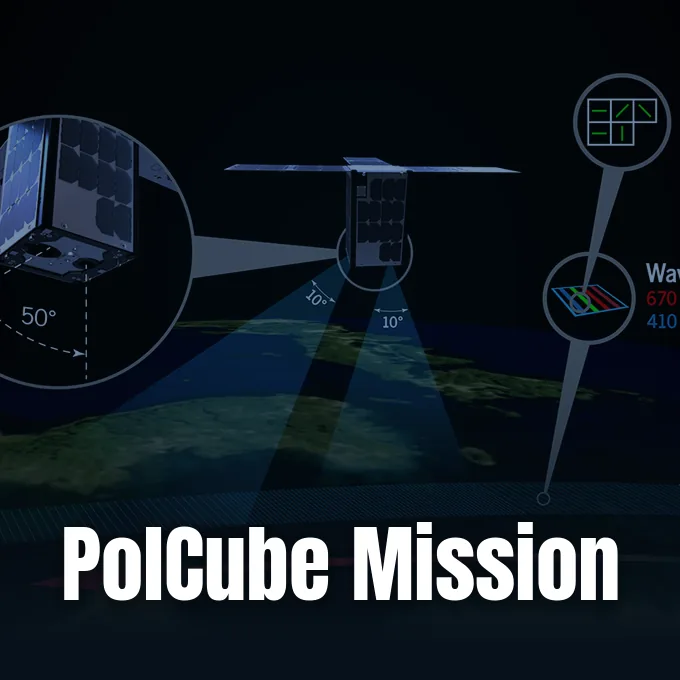
DSCOVR carries the Earth Polychromatic Imaging Camera, or EPIC, which captures a full-disc color image of Earth every two hours [1]. Observations from L1 complement low-orbit satellites like the PolCube mission mapping Earth’s atmosphere and oceans by tracking planetary weather patterns. Other historic solar watchdogs stationed at Sun-Earth L1 include SOHO, WIND, and NASA’s Advanced Composition Explorer [2].
Lagrangian Points Harbor Ancient Trojan Asteroids
Because triangular equilibrium zones act as stable gravitational sinks, thousands of natural celestial bodies have accumulated around them across the Solar System. Astronomers refer to these co-orbital companions generically as trojan asteroids, named after the Greek and Trojan warriors in Homer’s Iliad [11]. German astronomer Max Wolf discovered the first Trojan asteroid, 588 Achilles, in 1906 using photographic plates at Heidelberg Observatory. Achilles spans 116 kilometers across and orbits at Jupiter’s L4 point. By astronomical convention, Greek heroes occupy L4 while Trojan fighters occupy L5, with Hektor and Patroclus as the only misplaced exceptions [7]. Today, astronomers estimate that Jupiter hosts more than one million trojans larger than one kilometer across [11].
Other planets also harbor co-orbital asteroids, including Neptune with 2001 QR322 and Mars with 5261 Eureka, discovered in 1990 by David Levy. Earth shares its orbit with two known trojans at L4: the 300-meter asteroid 2010 TK7 and the 1200-meter asteroid 2020 XL5 [7]. In a 2021 unreviewed preprint, an astronomical team led by Man-To Hui, Paul A. Wiegert, David J. Tholen, and Dora Föhring confirmed that 2020 XL5 was captured into its current status in the 15th century [3].
Their calculations revealed a 99.5% likelihood that encounters with Venus will eject 2020 XL5 from L4 within ten thousand years [3]. These co-orbitals differ from temporary captures, seen when Earth gravity traps asteroid 2026 QQ8 in temporary orbit before releasing the object [7].
Earth-Moon Libration Points in Space Exploration
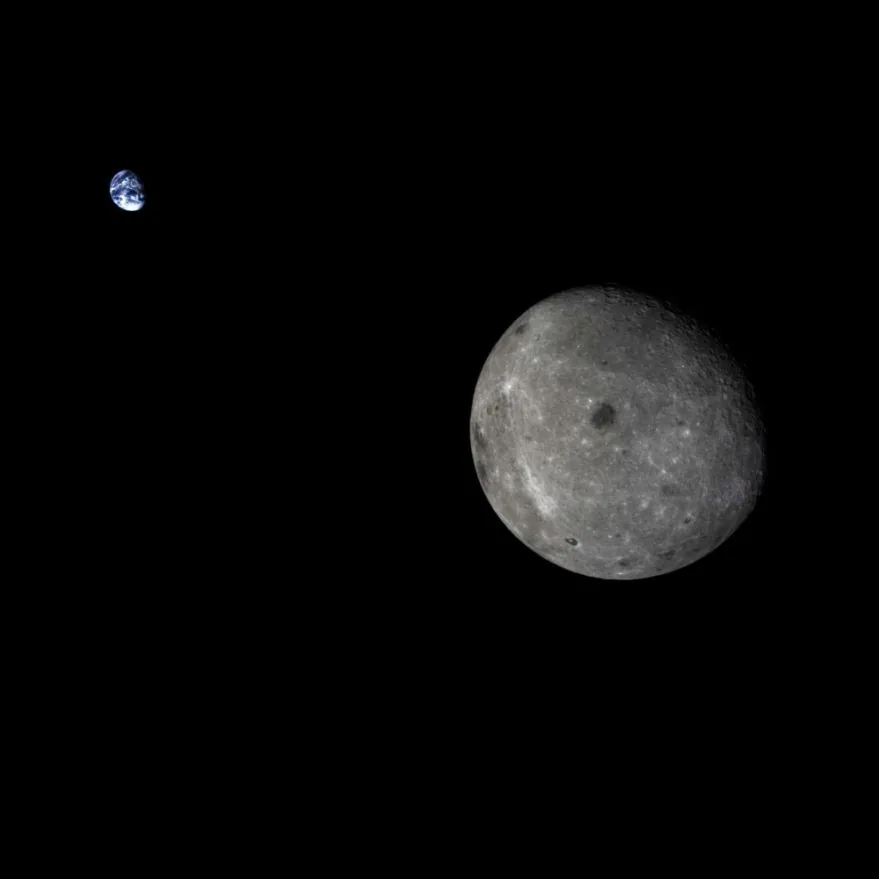
In the Earth-Moon system, five distinct libration points provide critical staging positions for lunar surface exploration and cis-lunar communications [11]. Because the Moon is tidally locked to Earth, the lunar far side never faces our planet, making direct communications impossible without a relay satellite placed in orbit beyond the lunar limb [8].
To solve this communication barrier, the China National Space Administration launched the Queqiao relay satellite from Xichang on May 20, 2018, sending it toward Earth-Moon L2 roughly 65,000 to 80,000 kilometers beyond the Moon. Queqiao fired its propulsion system under commands from the Beijing Aerospace Command and Control Center to enter a halo orbit on June 13, 2018. The burn concluded at 11:06 p.m. EDT, making Queqiao the first communication satellite to operate at Earth-Moon L2. Using a 4.2-meter parabolic antenna, Queqiao relayed telecommands and telemetry between Earth and the Chang’e-4 lander in Von Kármán crater within the South Pole-Aitken Basin. CAST president Zhang Hongtai said the satellite laid the foundation for the far side lunar landing [8].

Queqiao carried the Netherlands-China Low-Frequency Explorer to detect radio signals from the cosmic dark ages. Along with the relay craft, China launched two 47-kilogram microsatellites developed by the Harbin Institute of Technology. Longjiang-2 entered lunar orbit successfully, though Longjiang-1 was lost during transit. JAXA and the University of Tokyo also developed the EQUULEUS 6U CubeSat, using water resistojet propulsion to reach Earth-Moon L2 [8].
Habitats and Science Fiction Concepts at L5
Beyond robotic exploration, the natural stability of triangular equilibrium points inspired ambitious proposals for permanent human settlements. In 1974, Princeton physics professor Gerard K. O’Neill suggested building cylindrical and spherical space habitats at Earth-Moon L5, where thousands of people could live under artificial gravity [12]. His 1976 book The High Frontier sparked the creation of the L5 Society to promote space colonization [5]. A contemporary NASA study estimated that constructing a 500,000-tonne orbital colony at L5 would cost 5.1 billion dollars, equivalent to roughly 33 billion dollars in 2025. These concepts envisioned moving hollowed asteroids into orbit to shelter human communities within the shallow gravitational potential [12].
Science fiction authors quickly integrated Lagrange points into space travel literature. Mack Reynolds wrote a series of novels set in orbital colonies, including Lagrange Five in 1979 and The Lagrangists in 1983. Earlier, George O. Smith published Venus Equilateral in 1942, imagining a three-mile-long communications station at Sun-Venus L4. In Arthur C. Clarke and Stephen Baxter’s 2005 novel Sunstorm, engineers position a solar shield at Sun-Earth L1 to protect humanity from dangerous flares [5].
Video games have also embraced these balance points as settings for futuristic colonies. In 1991, Konami released the role-playing game Lagrange Point for the Family Computer, featuring the Isis Cluster colonies and the custom VRC7 sound chip [13]. Through research and fiction, understanding these equilibrium zones shows how orbital balance transforms empty space into strategic outposts [5].
- WEBSITE Cermak, A., & NASA Science Editorial Team. (2019). DSCOVR. [Article Link]
- WEBSITE Cermak, A. (2022). Orbit. [Article Link]
- PREPRINT Hui, M., Wiegert, P. A., Tholen, D. J., & Föhring, D. (2021). The Second Earth Trojan 2020 XL5. [Article Link]
- PREPRINT Slíz-Balogh, J., Barta, A., & Horváth, G. (2019). Celestial Mechanics and Polarization Optics of the Kordylewski Dust Cloud in the Earth-Moon Lagrange Point L5 Part I. 3D Celestial Mechanical Modelling of Dust Cloud Formation. [Article Link]
- WEBSITE Stanway, E. (2026). Home on Lagrange. [Article Link]
- WEBSITE European Space Agency. (2004). What are Lagrange points? [Article Link]
- WEBSITE Baez, J. (2009). Lagrange. [Article Link]
- ONLINE NEWS Jones, A. (2018). Chang’e-4 relay satellite enters halo orbit around Earth-Moon L2, microsatellite in lunar orbit. [Article Link]
- WEBSITE Weisstein, E. W. (2007). Lagrange Points. [Article Link]
- WEBSITE Space Telescope Science Institute. (1995). L2 Orbit. [Article Link]
- WEBSITE Wikipedia contributors. Lagrange point. [Article Link]
- WEBSITE Wikipedia contributors. Lagrange point colonization. [Article Link]
- WEBSITE Wikipedia contributors. Lagrange Point (video game). [Article Link]


