






The Oort cloud marks the distant boundary of the Solar System, where trillions of frozen planetesimals orbit far beyond the planets and the heliosphere. Dutch astronomer Jan Oort proposed this vast reservoir in 1950 to explain how long-period comets continue to visit the inner planets without vanishing over billions of years. While no telescope has imaged these distant bodies directly, orbital calculations show that passing stars and galactic tides steadily steer icy fragments toward the Sun [12].
Outer Boundaries of the Solar System
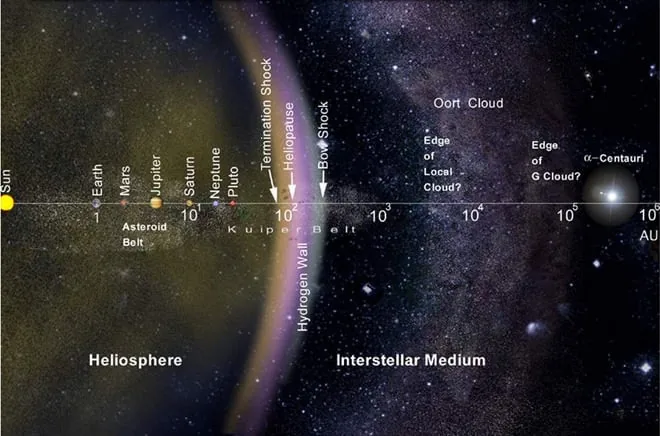
Astronomers calculate that the inner boundary of the icy shell starts from roughly 2,000 to 5,000 astronomical units away from the Sun, while outer regions span from 50,000 to 200,000 astronomical units. One astronomical unit represents the mean span separating our planet from the Sun, measuring about 93 million miles or 150 million kilometers, which places the outermost cometary boundary up to 3.2 light-years away [13]. By comparison, the Kuiper Belt occupies a flat disc between 30 and 55 astronomical units, meaning the nearest cometary bodies in the outer shell sit dozens of times farther out than Neptune’s orbit [15]. NASA models indicate that the outer shell holds trillions of icy bodies larger than one kilometer across and billions measuring over twenty kilometers in diameter, stretching nearly halfway to Proxima Centauri [12].
Human space probes will take centuries before crossing even the threshold of this distant realm. Voyager 1 travels as the fastest spacecraft leaving the planetary neighborhood, but it will need about 300 years to reach the inner cometary boundary and roughly 30,000 years to pass through it completely. Yet its radioisotope thermoelectric generators will run out of electric power around 2025, turning off its instruments centuries before arrival [12]. Sister probes Voyager 2, Pioneer 10, Pioneer 11, and New Horizons will likewise lose power long before entering the cloud, leaving scientists to study incoming cometary fragments for direct clues about this outer frozen shell [15].
Why Is the Oort Cloud Theoretical?
Astronomers consider the Oort cloud theoretical because no telescope has observed its distant, frozen members in space, where tiny kilometer-scale objects remain far too faint for current imaging technology [12]. In 1907, astronomer Armin Otto Leuschner showed that short observation windows make comet paths look parabolic, whereas longer tracking reveals truly elliptical orbits bound to the Sun. His work established that comets return periodically on closed gravitational tracks [15].
Estonian astronomer Ernst Öpik took that insight further in 1932, suggesting that long-period comets originate from an orbiting reservoir at the outer edge of the Solar System where frozen volatiles survive without evaporating under solar heat [12]. Dutch astronomer Jan Oort revived this concept in 1950 to resolve a fundamental paradox concerning cometary lifespans. He recognized that repeated passes near the Sun would boil away volatile cometary ices within a few million years [15].
If comets had stayed on their current paths since the birth of the protoplanetary disc 4.5 billion years ago, none would survive today [15]. Oort analyzed 46 well-observed comets tracked between 1850 and 1952, discovering that their orbital aphelia clustered near 20,000 astronomical units with reciprocal orbital separations spiking below 10^-4 inverse astronomical units [6]. That sharp spike pointed to a vast, unseen reservoir between 40,000 and 150,000 astronomical units that steadily feeds new comets into the planetary region [16].
Architecture of the Hills Cloud
Astronomer Jack G. Hills at the Los Alamos Laboratory broadened the theoretical model in 1981 by proposing an inner disc-shaped reservoir known as the Hills cloud. This inner region extends from roughly 2,000 to 20,000 astronomical units from the Sun, though some estimates place its inner edge closer to 250 astronomical units. Hills calculated that passing stars would strip comets from the tenuous outer shell over billions of years, meaning the outer reservoir would have emptied long ago without a secondary core supplying replacements. Researchers including Sidney van den Bergh in 1982 and Mark E. Bailey in 1983 built on this framework, with Bailey suggesting a dense cometary core with a semi-major axis near 5,000 astronomical units. Victor Clube, Bill Napier, and R. B. Stothers subsequently broadened these models during the late 1980s [16].
The inner cloud likely contains roughly five to ten times as many cometary bodies as the outer spherical shell, totaling about 20 trillion objects [16]. Because these objects sit closer to the Sun, solar gravity holds them tightly enough to resist mild galactic tides, preserving their disc-like alignment with the planets [15]. Observational evidence for this inner region grew when astronomers discovered the distant dwarf planet Sedna in 2003, which measures three-quarters the size of Pluto and travels on an elliptical orbit taking 11,000 years. A 2021 study by V. A. Zubko, A. A. Sukhanov, K. S. Fedyaev, V. V. Koryanov, and A. A. Belyaev calculated that Sedna will reach perihelion in 2073, offering a rare window to study inner cloud dynamics [13].
Why Is the Oort Cloud Spherical?
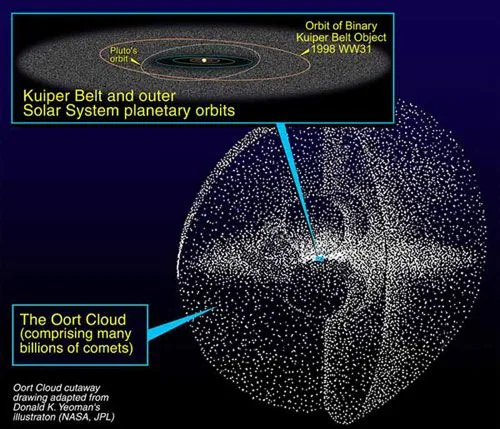
The Oort cloud acquired its spherical shape because outside gravitational forces randomized the orbits of scattered icy debris over billions of years [12]. While planets and Kuiper Belt bodies orbit within a flat disc near the ecliptic plane, long-period comets plunge toward the Sun from every angle across the sky as non-uniform gravitational fields from the Milky Way’s disc exert twisting torques on cometary paths [15].
Astrophysical models show that as an orbit grows wider, galactic torque twists its orientation with increasing force, tilting orbits away from the planetary plane into a rounded swarm over astronomical timescales [14]. Passing stars also played a key role in shaping this spherical shell [12]. In a 2019 study published in Astronomy & Astrophysics, S. Torres, M. X. Cai, A. G. A. Brown, and S. P. Zwart analyzed stars within 50 parsecs of the Sun using Gaia DR2 astrometric data, demonstrating that the cumulative tug of passing stars within 1 parsec steadily perturbs cometary orbits [5]. Passing stellar kicks lifted orbital inclinations and circularized cometary paths over billions of years [12].
Simulations by Alessandro Morbidelli at the Observatoire de la Cote d’Azur showed that galactic tides and stellar kicks produced a spherical outer shell while leaving the tightly bound Hills cloud flattened. Stronger solar gravity closer in protected the inner disc from complete randomization, preserving the distinct geometry observed in outer reservoirs today [12].

Planetary Scattering and Early Migration
The icy bodies populating the outer reservoirs formed around the same time as the giant planets roughly 4.6 billion years ago [15]. As Jupiter, Saturn, Uranus, and Neptune migrated, their gravity scattered leftover planetesimals out of the young disc, where Jupiter’s early dust barrier had divided inner rocky material from outer icy reservoirs [1]. Only about 5 to 10 percent of the scattered planetesimals were captured into the outer cometary cloud, while the remaining 90 percent were hurled into interstellar space as wandering rogue objects [14]. Computer simulations indicate that the cloud’s cumulative mass peaked around 800 million years after formation, as destructive collisions reduced smaller fragments [15].
The Sun’s early stellar environment also influenced this retention process [12]. Astrophysical models indicate that the young Solar System formed within an embedded cluster of 200 to 400 sibling stars, retaining the signature of a dense birth cluster exceeding 1,000 solar masses per cubic parsec. In a 2021 investigation, S. P. Zwart, S. Torres, M. X. Cai, and A. G. A. Brown concluded that most of the outer cometary shell coalesced only after the Sun escaped this birth cluster, between early cluster ejection and subsequent galactic wandering [6]. In their 2022 preprint, Nathan A. Kaib and Kathryn Volk reviewed comet reservoirs, noting that this earlier release had not undergone peer review before its 2024 publication, showing how giant planets built the modern scattered disc and cloud [1].
Volatiles and Rocky Interlopers
Spectroscopic studies show that most comets emerging from the outer reservoir consist of volatile ices, including water, carbon monoxide, methane, and hydrogen cyanide [15]. In 2005, D. Hutsemékers, J. Manfroid, E. Jehin, C. Arpigny, A. L. Cochran, R. M. Schulz, J. A. Stüwe, and J. Zucconi measured carbon and nitrogen isotope ratios in comets 88P Howell and C/1999 S4 LINEAR, finding a carbon-12 to carbon-13 ratio near 90 and a nitrogen-14 to nitrogen-15 ratio near 145. These consistent values match measurements in both comet groups, indicating that cyanide radicals formed from refractory organic dust in the cold protosolar cloud [3].
Similarly, M. J. Mumma, M. A. DiSanti, and Karen Magee-Sauer analyzed the Deep Impact collision with comet 9P/Tempel 1 in 2005 using the W. M. Keck Observatory, detecting parent volatiles between 2.8 and 5.0 micrometers. Their spectroscopic findings confirmed that volatile ices in Jupiter-family comets and outer comets originated from shared regions of the protoplanetary disc, even as prebiotic chemicals during comet impacts faced heavy thermal destruction upon atmospheric entry [4].

Despite their icy reputation, these outer reservoirs also harbor rocky bodies from the inner Solar System [15]. In 2014, A. Shannon, A. P. Jackson, D. Veras, and M. C. Wyatt estimated that about 4 percent of bodies in the cloud formed within 2.5 astronomical units of the Sun, predicting roughly 8 billion rocky asteroids [7]. Observers confirmed this rocky population in 2016 when Karen J. Meech and colleagues identified C/2014 S3 with the Pan-STARRS survey, revealing a tailless Manx comet that holds tiny fractions of water ice [10].
Paths of Returning Comets
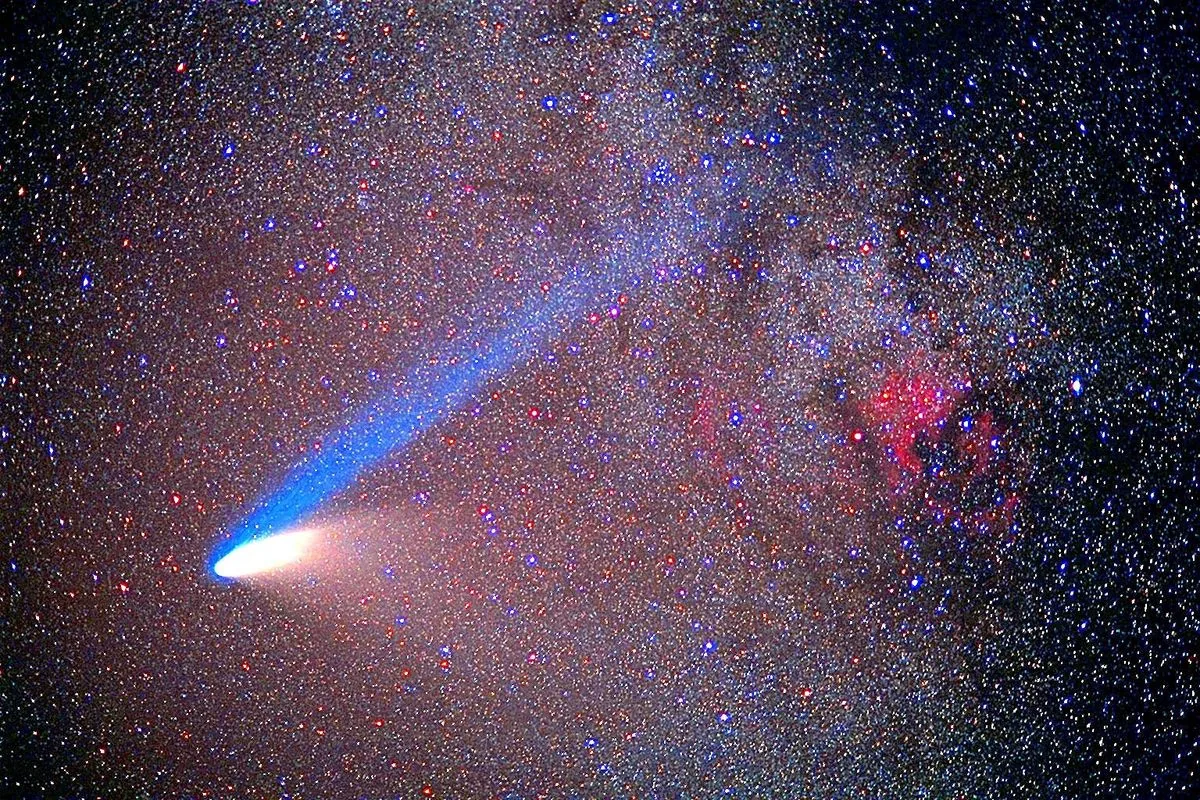
Astronomers separate comets into two main dynamical groups based on orbital periods and inclinations [12]. Short-period comets complete orbits in under 200 years near the ecliptic plane, whereas long-period comets take thousands or millions of years to return, swooping in from random inclinations across the celestial sphere. Comet Hale-Bopp became one of the most famous examples after traveling in from the outer reservoir during the late 1990s, passing within 122 million miles of Earth and remaining visible for eighteen months [13]. Orbital calculations suggest its aphelion reaches deep into the outer cometary zone, matching the isotropic distribution predicted for bodies originating far beyond Neptune [15].
Planetary gravity can also redirect long-period visitors into permanent inner orbits, as seen when Halley-family comets had their trajectories altered by gravitational encounters with Jupiter and Saturn [12]. In a 2012 numerical study, R. Brasser, M. E. Schwamb, P. S. Lykawka, and R. S. Gomes found that high-inclination Centaurs orbiting between 15 and 30 astronomical units also trace their origin to the outer cloud, calculating that between 1 and 200 of these bodies currently orbit among the gas giants [11]. Furthermore, computer simulations by M. Fouchard, A. Higuchi, T. Itô, and L. Maquet in 2018 showed that comets whose previous perihelia lay beyond 10 astronomical units retain an orbital memory of the original scattered disc [9]. About one-third of the scattered disc population is projected to enter the cloud over 2.5 billion years [15].

How the Oort Cloud Traps Planets
Recent numerical simulations indicate that outer cometary reservoirs around stars may also harbor full-sized planets. In a 2021 study, S. P. Zwart simulated the 200 nearest stars within 16 parsecs of the Sun using Gaia DR2 data, finding that up to 6 percent of nearby stars could retain a planet in their cometary clouds. Astrometric data suggest that some stars even exchange planetary bodies during close encounters in dense stellar clusters [8].
Astrophysicists Andre Izidoro and Nate Kaib tested planetary instabilities, finding that between 2 and 10 percent of stars trap an ejected planet in their outer clouds, with a Neptune-mass planet captured in 7 percent of test runs modeled on our early giant planets. Lower-mass planets were ejected and captured far more frequently than massive gas giants. If such a planet exists at 100,000 astronomical units, it would be far too faint and cold for current observatories to detect without measuring precise velocity vectors together with the motion of nearby stars. Any captured planet would drift in extreme darkness, nearly invisible against the background of interstellar space [14].
Spectroscopic studies of distant atmospheres, including ammonia isotopologues detected in chilly brown dwarf atmospheres, show how subtle chemical fingerprints help astronomers understand planet formation across the galaxy [14]. As upcoming survey observatories scan the sky over the coming decade, new discoveries among long-period comets will continue to refine our understanding of the distant Solar System, potentially revealing whether an undiscovered planet orbits quietly within the freezing outer shell [1].
- ACADEMIC JOURNAL Kaib, N. A., & Volk, K. (2024). Dynamical Population of Comet Reservoirs. [Article Link]
- PREPRINT Kaib, N. A., & Volk, K. (2022). Dynamical Population of Comet Reservoirs. arXiv:2206.00010. [Article Link]
- ACADEMIC JOURNAL Hutsemékers, D., Manfroid, J., Jehin, E., Arpigny, C., Cochran, A. L., Schulz, R. M., Stüwe, J. A., & Zucconi, J. (2005). Isotopic abundances of carbon and nitrogen in Jupiter-family and Oort Cloud comets. Astronomy and Astrophysics, 440(2). [Article Link]
- ACADEMIC JOURNAL Mumma, M. J., DiSanti, M. A., Magee-Sauer, K., Bonev, B. P., Villanueva, G. L., Kawakita, H., Russo, N. D., Gibb, E. L., Blake, G. A., Lyke, J. E., Campbell, R. D., Aycock, J., Conrad, A., & Hill, G. M. (2005). Parent Volatiles in Comet 9P/Tempel 1: Before and After Impact. Science, 310(5746), 270-274. [Article Link]
- ACADEMIC JOURNAL Torres, S., Cai, M. X., Brown, A. G. A., & Zwart, S. P. (2019). Galactic tide and local stellar perturbations on the Oort cloud: creation of interstellar comets. Astronomy & Astrophysics, 629, A139. [Article Link]
- ACADEMIC JOURNAL Zwart, S. P., Torres, S., Cai, M. X., & Brown, A. G. A. (2021). Oort cloud Ecology: II. the chronology of the formation of the Oort cloud. Astronomy and Astrophysics, 652, A144-A144. [Article Link]
- ACADEMIC JOURNAL Shannon, A., Jackson, A. P., Veras, D., & Wyatt, M. C. (2014). Eight billion asteroids in the Oort cloud. Monthly Notices of the Royal Astronomical Society, 446(2), 2059-2064. [Article Link]
- ACADEMIC JOURNAL Zwart, S. P. (2021). Oort cloud Ecology: I. Extra-solar Oort clouds and the origin of asteroidal interlopers. Astronomy and Astrophysics, 647, A136-A136. [Article Link]
- ACADEMIC JOURNAL Fouchard, M., Higuchi, A., Itô, T., & Maquet, L. (2018). The “memory” of the Oort cloud. Astronomy and Astrophysics, 620, A45-A45. [Article Link]
- ACADEMIC JOURNAL Meech, K. J., Yang, B., Kleyna, J. T., Hainaut, O., Berdyugina, S. V., Keane, J. V., Micheli, M., Morbidelli, A., & Wainscoat, R. J. (2016). Inner solar system material discovered in the Oort cloud. Science Advances, 2(4), e1600038-e1600038. [Article Link]
- ACADEMIC JOURNAL Brasser, R., Schwamb, M. E., Lykawka, P. S., & Gomes, R. S. (2012). An Oort cloud origin for the high-inclination, high-perihelion Centaurs. Monthly Notices of the Royal Astronomical Society, 420(4), 3396-3402. [Article Link]
- ONLINE NEWS Williams, M. (2015). What is the Oort Cloud?. Universe Today. [Article Link]
- ONLINE NEWS Stein, V. (2018). Oort Cloud: The Outer Solar System’s Icy Shell. Space.com. [Article Link]
- WEBSITE Raymond, S. (2023). Oort cloud (exo)planets. planetplanet. [Article Link]
- WEBSITE Wikipedia contributors. (2026). Oort cloud. Wikipedia, The Free Encyclopedia. [Article Link]
- WEBSITE Wikipedia contributors. (2026). Hills cloud. Wikipedia, The Free Encyclopedia. [Article Link]


