





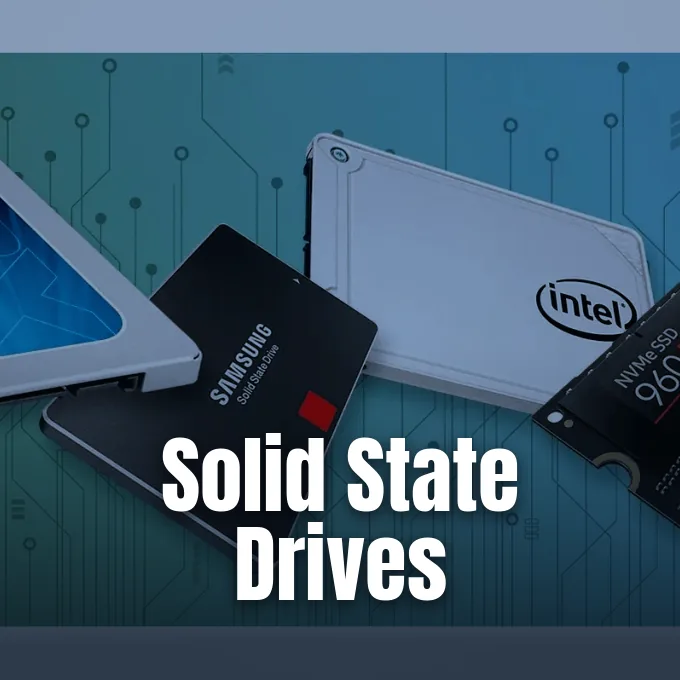
Solid state drives store digital files electronically using semiconductor integrated circuits instead of spinning magnetic platters. By holding information in non-volatile flash memory cells, these storage devices deliver rapid read speeds, silent operation, and immediate data access in personal computers [10]. Older magnetic disks rely on motorized spindles that introduce seek latency, but solid-state engineering eliminates moving parts [9]. Personal laptops, enterprise servers, and embedded appliances now rely on NAND flash memory as their main storage medium [10].
Inside Flash Memory Cells
Solid-state electronics rely on semiconductor devices like transistors and diodes where electric charge carriers move within crystalline silicon instead of crossing vacuum gaps or tripping electromechanical switches. Transistor development accelerated after 1947 at Bell Laboratories when John Bardeen and Walter Houser Brattain invented the point-contact transistor under William Shockley. General Electric engineers showcased an early transistor audio system in Philadelphia at the University of Pennsylvania in 1955, followed by the commercial Fisher TR-1 preamplifier in 1956 and the Transis-tronics TEC S-15 amplifier in 1961. Consumer television brands in the 1960s advertised chassis hardware as 100% solid state [11].
In computer storage, NAND flash memory retains data bits by trapping electric charges inside floating-gate cells. These cells retain their programmed state when disconnected from power, providing non-volatile storage without constant power supply lines. Intel developed an alternative approach called 3D XPoint for its Optane storage line, changing electric resistance instead of storing charges in cell gates [10]. Even so, NAND flash stays dominant in commercial SSD hardware because decades of fabrication scaling lowered cost per gigabyte [1].
Without periodic electrical refresh, floating gates slowly leak electrons through insulating oxide layers, causing heavily used consumer drives left unpowered in room storage to begin losing data after one to two years. Abrupt power cuts during active write operations also risk corrupting in-flight data buffers before values settle onto flash chips [10].
Internal Controller Architecture
Every solid-state drive relies on three core parts: a controller chip, cache memory, and an onboard power backup capacitor that protects volatile write buffers during unexpected power interruptions [9]. The controller executes firmware to direct all internal operations, coordinating bad block mapping, wear leveling, and hardware encryption across memory dies [10]. In an analysis of drive anatomy for Communications of the ACM, Cornwell wrote that while an SSD presents an interface that looks like a regular disk, its internal operations are completely different [2].
Cache memory speeds up address lookups by holding translation tables alongside incoming user writes [9]. Early solid-state storage devices built in the 1970s and 1980s used volatile DRAM chips for primary data storage, requiring battery backup to prevent catastrophic memory loss. Modern drives employ NAND flash for persistent data, using a smaller DRAM buffer to accelerate lookup tables [9, 10]. Budget systems sometimes use host memory buffer protocols to borrow system RAM instead of dedicated DRAM chips [10].
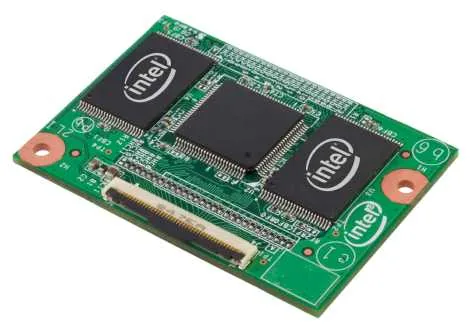
Storage makers install onboard capacitors or small batteries that supply backup current when system power drops unexpectedly, giving controllers time to flush cached directories onto persistent NAND flash dies. Without dedicated backup capacitors, sudden host power loss can corrupt pending file fragments or render mapping tables unreadable [9, 10].
How Solid State Drives Use Multi-Level Cells
NAND flash capacity depends on cell bit depth, where single-level cell architecture stores only one bit of data per floating gate to deliver low latency and high endurance at elevated production costs [10].
To increase storage density and lower unit costs, chip makers developed multi-level cell storing two bits per cell, triple-level cell storing three bits, and quad-level cell storing four bits. QLC cells distinguish sixteen separate voltage levels within a microscopic space [10]. In Proceedings of the IEEE, Cai and coauthors reported that packing multiple bits into a cell leaves fewer electrons in floating gates, increasing vulnerability to electrical noise and reducing endurance. Raw cycle life drops below one thousand writes. Greater capacity forces engineers to design more resilient error-correcting firmware to protect data integrity [1].
Planar lithography shrinking eventually reached boundaries where adjacent cells interfered with each other [1]. To overcome these limits without compromising data stability, flash makers introduced 3D NAND technology, stacking memory layers vertically in 32, 64, or more strata per die. This vertical stacking expands drive capacity, increases manufacturing yields, and avoids the cell crosstalk common in dense planar lithography. In July 2015, Samsung announced 2TB SSD drives using SATA connectors, followed in August 2015 by a 16TB enterprise drive built on stacked flash dies [9].
Wear Leveling and Garbage Collection
Why can’t flash memory overwrite files directly in place? Unlike magnetic disks that overwrite sectors directly, NAND flash chips read and program bits in small pages but must wipe entire blocks of pages at once during write cycles [10]. When files update, the controller writes new versions to empty pages elsewhere, marks previous pages as stale, and updates the flash translation layer directory so host operating systems access revised data [4].
Repeated write and erase operations slowly wear out the insulating oxide layers in flash cells. To prevent specific blocks from failing prematurely while others remain unused, the drive controller executes dynamic and static wear leveling algorithms. These algorithms track erase counts throughout the memory array and route incoming writes to less-worn areas of flash storage [10]. In a 2011 study on drive sanitization, Wei and coauthors reported that because the FTL continuously redirects writes, traditional operating system file-shredding tools cannot reliably overwrite individual files on an SSD [4].
As deleted files accumulate over time, flash blocks become fragmented with mixed valid and obsolete pages, prompting internal garbage collection routines to consolidate valid pages into empty blocks before erasing old structures. Operating systems assist this maintenance by sending TRIM commands through SATA or NVMe channels, signaling deleted file ranges so firmware reclaims stale blocks during idle system intervals [10].


Comparing Mechanical Disks and SSDs
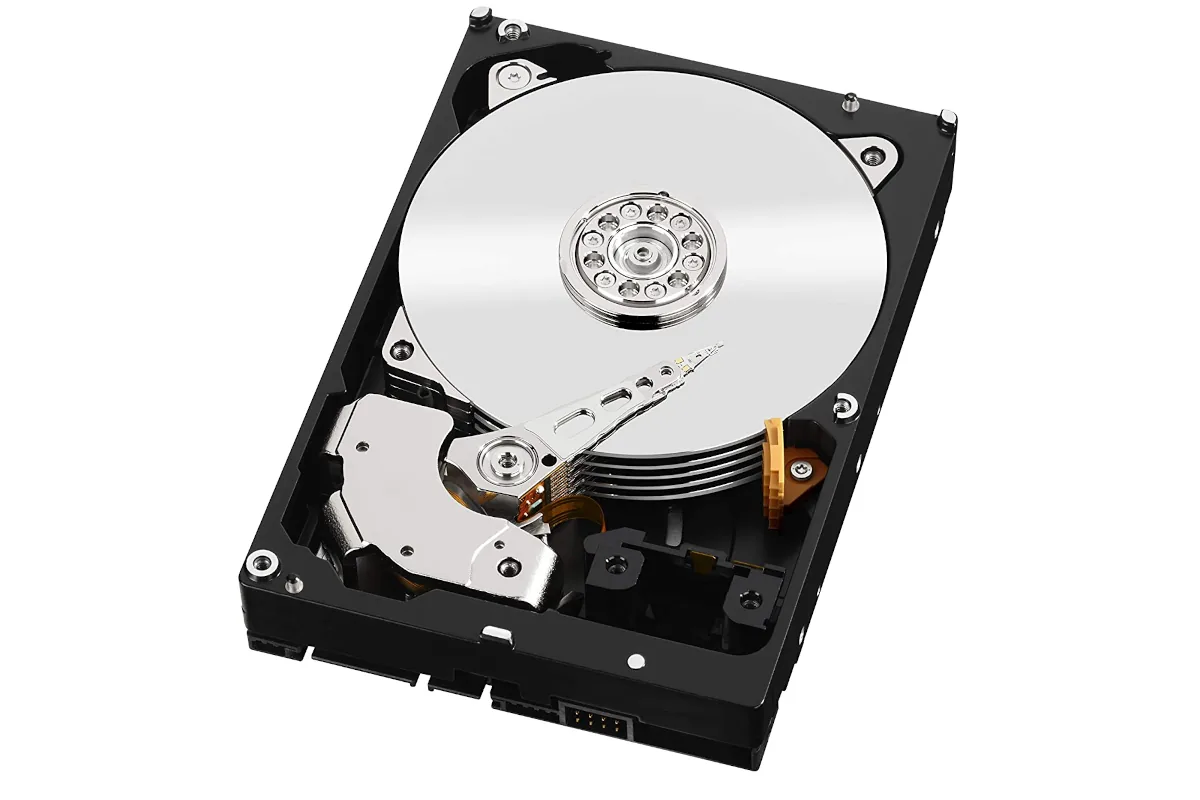
Traditional hard disk drives store binary files on rotating circular platters coated with magnetic material. Motorized spindles spin these platters at speeds of 5,400 rpm or 7,200 rpm, while magnetic heads hover nanometers above the recording surface on a moving arm [7, 9]. Enterprise hard drives employ airtight helium-filled enclosures to keep temperatures down across stacked platters [7].
Mechanical hard drives achieve sequential read and write speeds of roughly 200MB per second, but because platters must rotate to locate fragmented sectors, throughput plummets during demanding multi-tasking workloads [7]. Benchmark data from Diffen shows hard drives deliver 175 IOPS for small reads and 280 IOPS for small writes. By comparison, flash SSDs achieve 1075 IOPS for small reads, while specialized DRAM drives hit 4091 IOPS and Intel benchmarks show boot times up to eight times faster than mechanical disks [9]. Solid state drives contain no moving components, retrieving data electronically with typical access times measured in mere fractions of a millisecond [7]. Small write operations on flash SSDs reached 21 IOPS in basic tests [9].
In hard drives, non-contiguous file clusters force the read head to seek across platters, requiring periodic software defragmentation to restore sequential performance. Solid-state media access all memory cells in uniform time regardless of physical address, making defragmentation unnecessary. In fact, defragmenting flash storage causes unnecessary write cycles that degrade cell lifespan. Furthermore, solid-state designs resist vibrations up to 2000Hz, whereas mechanical drives risk head crashes when dropped or subjected to physical shocks [9].
Parallel Data Channels
Although individual NAND flash dies operate at modest speeds, solid-state storage achieves high overall bandwidth because controllers manage multiple memory chips over independent channels simultaneously. In ACM Transactions on Storage, Chen, Hou, and Lee reported that multi-channel interleaving hides cell programming latency, enabling parallel write operations to match or exceed read speeds regardless of random or linear patterns. Their experiments demonstrated that concurrent access patterns create distinct layout dynamics inside controller firmware [5].
Interface bandwidth limits real-world drive speed, as early solid-state drives adopted standard 2.5-inch form factors using the legacy SATA III interface, which maxes out at sequential transfers around 560MB/s and prevents newer flash chips from reaching full speed. To eliminate this bottleneck, the storage industry transitioned to NVM Express protocols operating over high-speed PCI Express motherboard buses [7, 10]. NVMe communicates directly with the central processor across multiple lane pairs, bypassing legacy storage controller stacks [7].
PCI Express generations have expanded bandwidth boundaries with each iteration. A PCIe 3.0 NVMe SSD in the compact M.2 form factor typically achieves sequential read rates exceeding 3,000MB/s. Newer PCIe 4.0 drives surpass 7,000MB/s on sequential reads, more than thirty times faster than high-end consumer hard drives. Because PCIe interfaces maintain backwards compatibility, a PCIe 4.0 drive will operate inside a PCIe 3.0 motherboard slot, though speed stays capped at generation 3 boundaries [7]. Industrial systems also use U.2, EDSFF, and XFM Express form factors for hot-swappable enterprise drive bays [10].
Drive Endurance Limits
NAND flash cells degrade with repeated writes as each program and erase cycle subjects cell oxides to high electric fields, gradually trapping stray electrons until threshold voltages shift beyond readable boundaries [1, 3]. In Proceedings of the IEEE, Mielke and colleagues reported that cell degradation dominates late-life failures, whereas JEDEC specification JESD218 standardizes full-lifetime testing to evaluate reliability in enterprise environments. Published field statistics confirm SSDs are more reliable on average than hard drives, though firmware bugs and power issues still cause device failures [3].
Drive endurance is commonly quantified through Terabytes Written and Drive Writes Per Day. TBW measures the total cumulative data volume a user can write to the drive before memory cells exceed their warrantied error tolerances. For example, a 1TB Samsung 970 EVO NVMe M.2 drive carries an endurance rating of 600 TBW, which equates to roughly 600 full drive write cycles. Enterprise storage administrators also track the Unrecoverable Bit Error Ratio to measure the frequency of uncorrectable read errors [10].
Modern controllers protect aging flash cells through advanced error-correcting codes [1, 6]. Older SSD designs relied on basic BCH codes, but rising cell densities required more robust error correction. In an experimental evaluation, Zhao and colleagues showed that Low-Density Parity-Check codes can correct severe read errors, though fine-grained cell sensing can increase latency if not managed efficiently [6]. Field failure data shows that when cell wear is mitigated, primary drive failures stem from firmware bugs, unplanned power loss, and non-NAND electronics instead of worn-out flash cells [3].
When Solid State Drives Reached Parity
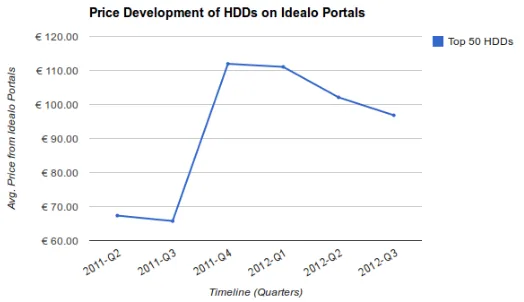
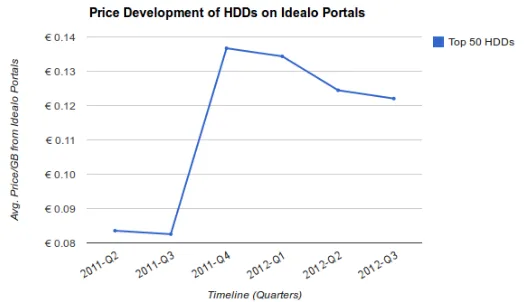
Market data from price comparison service Idealo, reported by Zack Whittaker at ZDNET, showed SSD costs fell by €0.15 ($0.19) per gigabyte between Q2 and Q3 in 2011. Drive costs dropped further by €0.10 ($0.13) in late 2011 and €0.24 ($0.31) across 2012. Units between 300GB and 600GB experienced price reductions of approximately €0.50 ($0.65) per gigabyte as global chip supply expanded. Smaller units between 120GB and 250GB stayed around €1 ($1.29) per gigabyte during that period [8].
Supply chain disruptions altered storage pricing in late 2011. Floods in Thailand submerged hard drive factories, doubling mechanical drive prices. IHS analyst Fang Zhang said that while floods hindered hard drives, SSDs remained roughly nine times more expensive per gigabyte in 2012 [8]. Manufacturers introduced solid-state hybrid drives to bridge this pricing gap [7, 12]. Products like the Seagate 1TB gaming SSHD combined platters with flash cache at $0.08 per gigabyte [7]. Systems also deployed hybrid caching schemes like Linux bcache, Apple Fusion Drive, and Intel Smart Response Technology under SATA-IO 3.2 specifications [10, 12].
By 2015, storage consultant Jim O’Reilly wrote in Network Computing that 3D NAND manufacturing would bring solid-state pricing to parity with mechanical disks [9]. Consumer SSDs like the 1TB Samsung 870 EVO dropped to roughly $0.14 per gigabyte, while high-capacity mechanical hard drives like the 4TB WD Black and 10TB Seagate Barracuda Pro reached $0.03 per gigabyte. Enterprise setups and external units like the WD My Passport 5TB continue using mechanical drives for massive secondary backups. Solid state drives remain the standard boot foundation in modern computing systems [7].
- ACADEMIC JOURNAL Cai, Y., Ghose, S., Haratsch, E. F., Luo, Y., & Mutlu, O. (2017). Error Characterization, Mitigation, and Recovery in Flash-Memory-Based Solid-State Drives. Proceedings of the IEEE, 105(9), 1666-1704. [Article Link]
- ACADEMIC JOURNAL Cornwell, M. (2012). Anatomy of a solid-state drive. Communications of the ACM, 55(12), 59-63. [Article Link]
- ACADEMIC JOURNAL Mielke, N. R., Frickey, R. E., Kalastirsky, I., Quan, M., Ustinov, D., & Vasudevan, V. J. (2017). Reliability of Solid-State Drives Based on NAND Flash Memory. Proceedings of the IEEE, 105(9), 1725-1750. [Article Link]
- ACADEMIC JOURNAL Wei, M., Grupp, L. M., Spada, F. E., & Swanson, S. (2011). Reliably erasing data from flash-based solid state drives. [Article Link]
- ACADEMIC JOURNAL Chen, F., Hou, B., & Lee, R. (2016). Internal Parallelism of Flash Memory-Based Solid-State Drives. ACM Transactions on Storage, 12(3), 1-39. [Article Link]
- ACADEMIC JOURNAL Zhao, K., Zhao, W., Sun, H., Zhang, T., Zhang, X., & Zheng, N. (2013). LDPC-in-SSD: making advanced error correction codes work effectively in solid state drives. [Article Link]
- ONLINE NEWS PCWorld. (2021). SSD vs. HDD vs. hybrid: Which storage tech is right for you? [Article Link]
- ONLINE NEWS Whittaker, Z. (2012). Solid-state disk prices falling, still more costly than hard disks. ZDNET. [Article Link]
- WEBSITE Diffen. (2012). HDD vs SSD. [Article Link]
- WEBSITE Wikipedia. (n.d.). Solid-state drive. [Article Link]
- WEBSITE Wikipedia. (n.d.). Solid-state electronics. [Article Link]
- WEBSITE Wikipedia. (n.d.). Hybrid drive. [Article Link]


