





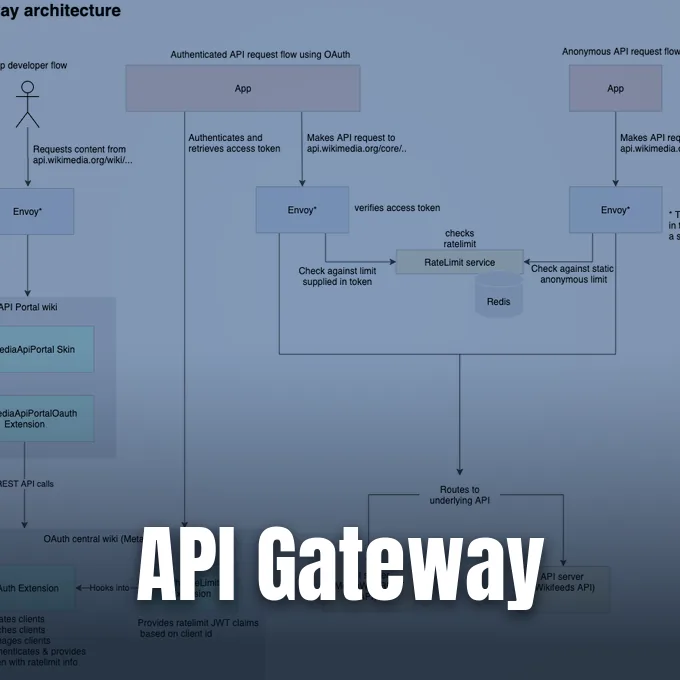
An API gateway serves as an application front-end that accepts client calls, directs network traffic to backend microservices, and returns the appropriate response to users. Web browsers and mobile apps avoid talking to dozens of private microservices straight, relying instead on a single stable network address. The gateway coordinates common tasks such as identity verification, traffic throttling, data transformation, and request routing. Software teams break down older monolithic software into cloud services, and this intermediate entry point shields private pods while keeping user consumption clean and dependable [2].
- What Is an API Gateway?
- Core Request Routing for Microservices
- Security Enforcement and Access Control
- API Gateway Throttling and Quotas
- Protocol Transformation for Backend Services
- Telemetry Collection in Distributed Architectures
- Enterprise API Gateway Deployment Models
- Full Management Platforms Versus Standalone Proxies
What Is an API Gateway?
Why do cloud architectures rely on an entry proxy instead of direct service communication? Coupling becomes severe when client apps call private services without an intermediary [2]. In Information and Software Technology, researchers Overeem, Mathijssen, and Jansen pointed out that traffic policies and perimeter security are often treated as rushed afterthoughts during early software development. Placing a central gateway at the edge prevents engineering teams from duplicating complex access rules inside every backend service [7].
A reverse proxy does much more than pass byte streams between network sockets. The gateway functions as a transformation engine that can orchestrate and modify requests and responses on the fly while collecting analytics data and managing cache stores. Client apps often need a composite view of customer records. The proxy queries several backend services in parallel, stitches the resulting payloads together, and returns a single compact object. Proxy engines like Nginx and HAProxy provide the network foundation for custom gateway deployments, enforcing audit controls, legal compliance, and security policies before client requests reach private business logic. This design keeps backend code small and simple [2].
In an unreviewed preprint hosted by Cornell University on arXiv, researchers Mathijssen, Overeem, and Jansen reviewed the broader discipline of API management, identifying 24 unique definitions and 114 distinct software practices that organizations execute to integrate business processes. Traditional firms are steadily turning into software producing entities that link business units and outside partners through networked interfaces. The API gateway operates as the execution data plane for these interfaces, while developer portals handle documentation and OpenAPI definitions [5].
Core Request Routing for Microservices
Network routing directs all incoming traffic. When an HTTP request reaches the gateway, the routing engine inspects headers, path parameters, and query strings to decide which backend service should receive the payload. Path prefixes like /users map to account services, while /orders routes to billing clusters [2]. Writing in the International Journal of Computer Engineering & Technology, researcher Depa examined how API-led connectivity has become an architectural foundation that helps organizations achieve greater runtime speed and integration flexibility while shielding core microservice topologies from external clients. Clean routing rules hide private network changes from outside mobile apps and browser clients [10].
Cloud microservices rarely live on static IP addresses with fixed hardware network configurations. Container pods spin up and shut down dynamically in autoscaling server clusters in response to shifting real-time demand. Samira, Weldegeorgise, Osundare, Ekpobimi, and Kandekere studied cloud models in Magna Scientia Advanced Research and Reviews, emphasizing that scalable IT systems depend on containerization, orchestration, and microservices architecture. In container platforms like Kubernetes and AWS EKS, the gateway queries service registries to discover healthy pod endpoints instantly [6].
Routing logic can also branch based on payload data, client software versions, or geographic location. In cloud setups, routing rules can dispatch requests to specialized models, such as the Gemini Decisions API for fast bounded choices, when applications need deterministic outputs from AI pipelines. In a comparative review published in the International Journal of Computer Applications, researcher Venkiteela evaluated enterprise tools including Amazon API Gateway, Google Apigee X, and Kong Konnect. Venkiteela noted that deployment flexibility and path-based routing let organizations modernize backend software incrementally without disrupting client consumers [8].
Security Enforcement and Access Control
Public web access to private services creates an attack surface for malicious actors. In API management systems, the gateway inspects credentials such as API keys, OAuth2 Client ID strings, and Client Secret tokens [2]. Early traffic filtering at the network boundary protects backend computing resources for authentic customers [4].
Perimeter proxies create a centralized enforcement point that validates identity and permissions before any network packet reaches backend code [2]. As documented in platform specifications for IBM API Management, environments delegate to the API gateway appliance full responsibility for rate limits, rejecting unknown users, and maintaining perimeter security. Version 4.0.3 of IBM API Management introduced redirect capabilities for OAuth schemes, permitting Access Code Flow and Implicit Flow authentications through external identity portals so edge proxies can validate identity without calling identity servers on every transaction. When an incoming request carries a JSON Web Token, the gateway checks its signature and expiration timestamp [4]. In his study of modern integration landscapes, Depa explained that zero-trust security architectures now rely heavily on automated perimeter gateways to protect private services from unauthorized lateral movement [10].

Gateways shield backend systems by validating schemas and enforcing browser security headers. Version 4.0.2.0 of IBM API Management added support for the HTTP OPTIONS method and native Cross-Origin Resource Sharing (CORS) rules to govern browser requests safely [4]. In February 2025, SAP teamed up with software firm PortSwigger to strengthen web security across SAP ARIBA, SAP BTP, and SAP S/4HANA using Burp Suite Enterprise Edition. Automated edge scanning stops malformed JSON payloads from triggering unhandled exceptions in backend services [1].
API Gateway Throttling and Quotas
Unregulated traffic spikes from viral events or automated bot scripts can easily overwhelm backend databases unless an API gateway steps in to enforce strict call quotas and rate limits defined in published product plans. A developer plan might allow a partner application 500 calls per minute, returning a rejection status code if requests exceed that threshold [2]. In their focus area maturity model (API-m-FAMM), Overeem, Mathijssen, and Jansen identified performance and traffic management as core capabilities needed to keep digital services reliable under heavy stress. The gateway acts as a shock absorber for distributed backend systems. Traffic quotas protect internal services from connection pool exhaustion and memory starvation [7].
When a backend service slows down or stops responding, intelligent gateways employ circuit breaker patterns to prevent failures from cascading through the system. If error rates cross a defined threshold, the gateway trips the circuit, returning cached responses or fallback messages without keeping client connections hanging [2].
Field documentation for IBM API Connect v2018.4.1.0 showed that unexpected database failures, such as Cassandra pods crashing, caused HTTP 504 errors in management interfaces and broken gateway connections. The update resolved these issues through refined health probes and robust policy catch blocks, allowing the gateway to stay online even when secondary systems stumble [3]. Telemetry engines track total hits, completed transactions, compute duration, and data transfer volumes to help organizations establish enforceable Service-Level Agreements. Premium business tiers receive higher bandwidth priority, while free tier consumers face lower connection thresholds during peak traffic hours [2].


Protocol Transformation for Backend Services
Enterprise software environments often contain a mix of modern cloud microservices and older legacy systems built decades ago. Many internal applications still communicate over SOAP and XML, while mobile applications require fast JSON payloads over lightweight HTTP endpoints [4]. An API gateway bridges this technical divide by converting protocols on the fly [2]. When IBM API Management deployed hardware on IBM WebSphere DataPower SOA Appliances, DataPower 7.2 firmware parsed incoming WSDL documents, enforced XML schema validation rules, and translated complex SOAP envelopes into lightweight RESTful operations at wirespeed [4].
Within gateway assembly flows, engineers can map request fields, redact sensitive payment numbers, and transform response bodies using declarative policy logic. In version 4.0.3 of IBM API Management, developer enhancements introduced template functions like setVariable, getVariable, and payloadType to evaluate whether data arrived as XML or JSONx payloads before running subsequent transformation policies inside the assembly pipeline. Development teams often weigh architectural trade-offs, evaluating GraphQL vs REST to determine the best interface design for mobile applications. Gateways accommodate these differing paradigms by accepting diverse client requests and orchestrating multiple internal queries into a single structured response. Wire payload modifications shield client applications from backend schema migrations [4].
Model-driven approaches have emerged to streamline how teams design and execute complex request transformations. In a research study published in Complex Systems Informatics and Modeling Quarterly, researcher Chiș introduced a method that enriches BPMN standards to link REST calls directly with business process diagrams. By integrating API requests with visual modeling environments, software engineers can test endpoints and map data transformations without writing custom glue code. Automated mapping engines relieve developers from tedious integration work, accelerating service modernization across the enterprise [9].

Telemetry Collection in Distributed Architectures
Every inbound and outbound request flows through the API gateway, giving operators an ideal vantage point for observing system health. The gateway logs latency measurements, response codes, client identities, and transaction volumes in real time [2]. Real-time logs stream to Logstash and syslog daemons [3]. According to market research from KBV Research, the performance analytics segment captured a 22% revenue share of the global API management market in 2024. Perimeter metric collection gives operations teams clear visibility into slow backend dependencies, capacity bottlenecks, and rising error rates in distributed environments. Operators can detect performance regressions within seconds rather than waiting for customer support tickets to arrive [1].
Modern gateways work with distributed tracing engines to track requests hopping between microservice boundaries. When a client initiates a transaction, the gateway injects a unique trace identifier into the HTTP headers, allowing downstream services to correlate their internal log outputs. Wikipedia documentation notes that monitoring tools can also run synthetic transactions against API endpoints to test uptime and measure latency proactively [2].
Telemetry collection also plays a vital role in meeting strict regulatory mandates. In Europe, legal frameworks such as GDPR and the Revised Payment Services Directive (PSD2) mandate comprehensive audit trails for financial and personal data access [1]. Release updates for IBM API Management version 4.0.3 added programmatic audit event retrieval, enabling administrators to forward security logs directly to remote syslog collectors for archiving. Centralizing these audit trails at the gateway simplifies regulatory compliance without burdening backend developers with custom logging routines [4].
Enterprise API Gateway Deployment Models
Deployment choices depend on an enterprise’s regulatory environment, latency requirements, and existing server infrastructure. Analysis by KBV Research revealed that on-premise installations held a 50% revenue share of the API management market in 2024. Heavily regulated institutions like banks and healthcare providers favor an on-premise API gateway because they provide complete physical control over sensitive customer payloads [1].
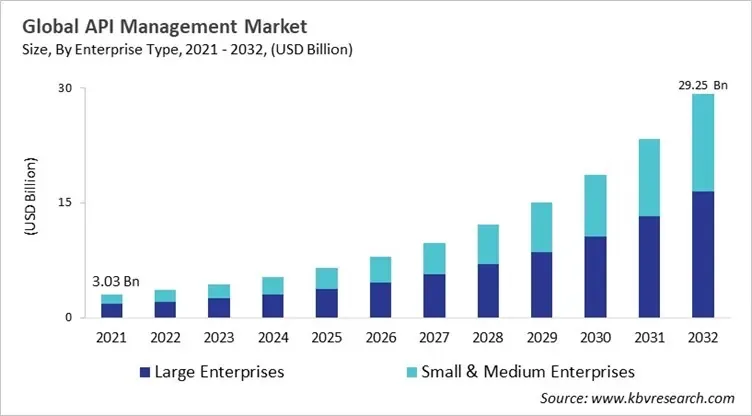
In February 2025, IBM partnered with Alinma Bank to launch an enterprise API platform powered by IBM API Connect, Cloud Pak for Integration, and Red Hat OpenShift to expand digital banking services for fintech clients across Saudi Arabia. This hybrid setup helped Alinma Bank modernize fintech integrations while satisfying regional banking mandates. Public cloud adoption is expanding swiftly across global regions. KBV Research estimated the market at $6.48 billion in 2025, projecting it to reach $29.25 billion by 2032 with a 24.0% compound annual growth rate. North America represented the largest regional market with a 38% revenue share in 2024, on track to reach $10.65 billion by 2032 [1]. Venkiteela analyzed how managed platforms like Google Apigee X, Microsoft Azure API Management, and Amazon API Gateway deliver serverless elasticity for cloud workloads [8].
Clustered gateway deployments require reliable underlying storage to keep routing tables and access policies synchronized across server nodes. Release documentation for IBM API Connect v2018.4.1.0 emphasized that GlusterFS does not provide sufficient speed or stability for clustered databases, recommending instead CephFS with block storage or AWS EBS with storage volumes of type (GP2 or IO1) on Amazon EC2 instances. When a local gateway loses connection to central management servers, cached policies keep active traffic flowing without interruption [3].
Full Management Platforms Versus Standalone Proxies
When designing modern systems, engineering teams must decide whether a standalone reverse proxy or a full API management suite fits their needs best. A standalone proxy like Nginx or HAProxy provides exceptional throughput, low memory overhead, and straightforward URL rewriting. Full management platforms incorporate developer portals, administrative policy managers, and monetization engines alongside the gateway data plane [2]. In April 2025, Microsoft partnered with software firm Pronovix to enhance Azure API Management with customizable developer portals, improving API discoverability and client onboarding. Self-service portals allow external developers to register apps and obtain keys without manual administrative intervention. Dedicated developer onboarding coupled with automated API gateway provisioning accelerates digital product delivery across the entire enterprise [1].
Monetization tools represent another key differentiator between standalone proxies and complete enterprise platforms. Full suites allow organizations to bill external consumers based on call volumes, compute time, or subscription tiers. Historical industry analysis traces the rapid rise of this sector: Gartner estimated global market spending at $70 million in 2013, Forrester estimated US spend at $140 million in 2014, and KBV Research projected the global market to reach $6.2 billion by 2024. Platforms also support OpenAPI and RAML specifications to automate documentation and testing throughout the software lifecycle [2].
Multi-vendor gateway governance has become increasingly prevalent as firms adopt multiple cloud providers. Wikipedia notes that major platform vendors including Google, Kong, MuleSoft, Gravitee, and Boomi have shifted toward multi-vendor control, with Boomi now capable of discovering and governing third-party gateways to create a unified management layer across distributed cloud infrastructure. Many enterprises begin by deploying a lightweight entry proxy to solve basic routing and SSL termination challenges. As their microservice ecosystems mature, they layer on centralized governance platforms to supervise security, analyze telemetry, and coordinate partner integrations within global infrastructure [2].
- REPORT KBV Research. (2026). API Management Market Size & Growth | Forecast Report 2032. KBV Research. [Article Link]
- WEBSITE Wikipedia. (n.d.). API management. Wikipedia. [Article Link]
- WEBSITE IBM. (2019). IBM API Connect V2018.4.1.0 is available. IBM Support. [Article Link]
- WEBSITE Wikipedia. (n.d.). IBM API Management. Wikipedia. [Article Link]
- PREPRINT Mathijssen, M., Overeem, M., & Jansen, S. (2020). Identification of Practices and Capabilities in API Management: A Systematic Literature Review. arXiv. [Article Link]
- ACADEMIC JOURNAL Samira, Z., Weldegeorgise, Y. W., Osundare, O. S., Ekpobimi, H. O., & Kandekere, R. C. (2024). API management and cloud integration model for SMEs. Magna Scientia Advanced Research and Reviews, 12(1), 078-099. [Article Link]
- ACADEMIC JOURNAL Overeem, M., Mathijssen, M., & Jansen, S. (2022). API-m-FAMM: A focus area maturity model for API Management. Information and Software Technology, 147, 106890. [Article Link]
- ACADEMIC JOURNAL Venkiteela, P. (2025). Comparative Analysis of Leading API Management Platforms for API Modernization. International Journal of Computer Applications, 187(54), 35-48. [Article Link]
- ACADEMIC JOURNAL Chiș, A. (2020). A Modeling Method for Model-Driven API Management. Complex Systems Informatics and Modeling Quarterly, 1-18. [Article Link]
- ACADEMIC JOURNAL Depa, V. R. (2025). The Evolution of API Management: Transforming Modern Integration Landscapes. International Journal of Computer Engineering & Technology, 16(1), 70-81. [Article Link]
Cover image: APaskulin / Wikimedia Commons, CC BY-SA 4.0


